

Perplexity is the only major AI answer engine that shows its work on every response. Each claim carries a numbered source.
Each source is a clickable link. That makes it the clearest window you have into whether AI systems treat your brand as a credible reference, and the fastest surface to fix when they do not.
Most teams treat Perplexity as a smaller version of ChatGPT. It is not. It runs a live retrieval pass on nearly every query, which means your visibility there is not frozen into a training run from eighteen months ago.
It is decided fresh, at query time, by what your pages say right now and what the wider web says about you.
That is good news and bad news. Good, because you can move the needle in weeks rather than model generations. Bad, because a competitor can move it back just as fast.
This guide covers how Perplexity selects sources, what to change on and off your site, and how to build a measurement stack that survives contact with a client dashboard.
Key Takeaways
- Perplexity is a citation system, not a ranking system. Being cited passes no link equity, but it does pass attention, trust, and high-intent clicks.
- Two crawlers, two paths in. PerplexityBot builds the index. Perplexity-User fetches pages live for a specific question. Block either one and you lose a route to being cited.
- Extractability beats eloquence. Answer-first paragraphs, one claim per block, specific numbers, and stable URLs win citations more reliably than beautifully argued narrative.
- Your brand story is partly written by third parties. Review sites, forums, and industry publications frequently define you inside Perplexity answers. Audit them like you audit your own pages.
- GA4 will undercount you. Google’s own documentation does not name Perplexity in the AI Assistants channel, so those sessions land in generic Referral unless you build a custom channel group.
- Track three layers: answer-level presence, referral traffic, and crawler activity. Any one of them alone gives you a misleading picture.
How Perplexity Actually Chooses What to Cite
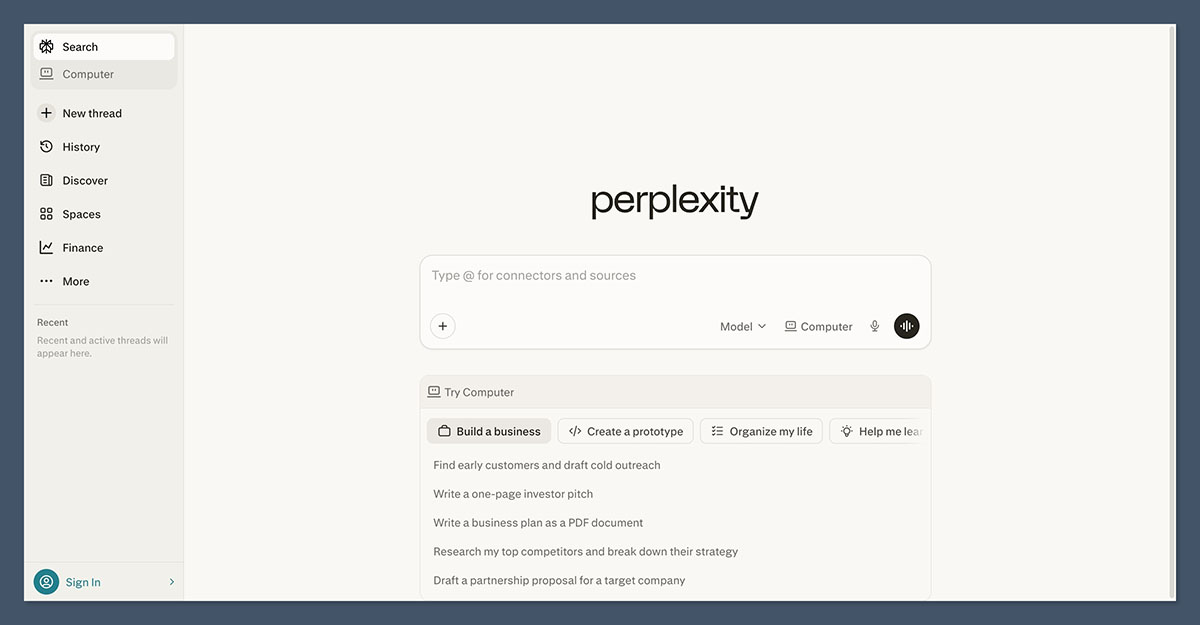
Perplexity runs a retrieval-augmented generation pipeline. Simplified, a query moves through four stages:
- Query interpretation. Your prompt is rewritten and expanded into one or more search operations, often broadening a vague question into several specific ones.
- Retrieval. Candidate pages are pulled from Perplexity’s own index and, where needed, fetched live from the open web.
- Reranking. Candidates are scored on relevance to the specific question, source credibility, clarity, and recency. Most candidates are discarded here.
- Synthesis. The answer is composed from surviving passages, with numbered citations attached to the sentences they support.
The consequential detail sits in stage three. Perplexity is not ranking your domain, it is ranking passages against a question.
A twelve-year-old domain with a vague, meandering page will lose to a two-year-old domain with a page that answers the question in the first two sentences. Domain strength still matters, but it functions as a trust filter rather than a queue position.
The practical reframe
Stop asking “how do I rank for this keyword.” Start asking “if someone typed this exact question, would a machine find a clean, quotable sentence on my page that answers it?” If the answer is no, no amount of authority will save the placement.
Citations pass attention, not authority
A Perplexity citation does not contribute to PageRank, domain rating, or any classical ranking signal. What it does contribute is presence at the moment of decision.
A buyer researching vendor options sees your name attached to the specific claim that answers their question, alongside three or four competitors. That is a shortlist placement, and it happens before they ever open a browser tab.
This is why treating Perplexity as a traffic channel alone understates it. Many high-value citations produce zero clicks and still shape which vendor gets shortlisted.
The Two Crawlers You Need to Understand
Perplexity operates two distinct user agents, and they do different jobs. Confusing them is one of the most common technical mistakes in AI visibility work.
| Attribute | PerplexityBot | Perplexity-User |
|---|---|---|
| Job | Surfaces and links websites in Perplexity search results. Builds the standing index. | Supports a live user action. Visits a page to help answer a specific question being asked right now. |
| Used for model training | No, per Perplexity’s documentation | No, per Perplexity’s documentation |
| Honors robots.txt | Yes | Generally ignores robots.txt, because a human requested the fetch |
| Blocking effect | Removes you from the index that feeds most citations | Removes the live-fetch path used for fresh or niche questions |
| Verification | User-agent string plus published IP list at perplexitybot.json | User-agent string plus published IP list at perplexity-user.json |
Perplexity recommends allowing PerplexityBot in robots.txt and permitting requests from its published IP ranges if you want to appear in search results.
Changes to robots.txt can take up to 24 hours to reflect in their systems, so do not judge a fix on the same afternoon.
User-agent: PerplexityBot
Allow: /
User-agent: Perplexity-User
Allow: /
The silent killer
Robots.txt is rarely the real blocker. Web application firewalls are. Cloudflare, AWS WAF, and most managed bot-protection rules classify unfamiliar crawlers as suspicious and serve them a challenge page. The bot sees a CAPTCHA, not your content, and your pages quietly stop appearing.
Perplexity publishes IP address lists for both agents specifically so you can build allow rules that combine user-agent matching with IP verification. Audit this before you touch a single word of copy.
Rendering, not just access
AI crawlers generally read the HTML they retrieve rather than executing a full JavaScript render pass. If your key content, pricing tables, or documentation only materialise after client-side hydration, assume it is invisible.
Server-side rendering or static generation for your commercially important pages is not a nice-to-have for AI visibility, it is the precondition.
What Makes a Page Citable
Once access is solved, the question becomes extraction. Perplexity needs to lift a passage out of your page, attach it to a claim, and stand behind it. Everything below reduces the friction in that process.
Lead with the answer
The first two sentences under a heading should resolve the question that heading asks. No throat-clearing, no scene-setting, no “in today’s fast-moving landscape.” Front-loading the answer is the single highest-leverage formatting change most sites can make.
One load-bearing claim per paragraph
A paragraph carrying four separate assertions is hard to cite, because citing it means endorsing all four. A paragraph carrying one specific, verifiable claim is easy to cite. Break dense prose into shorter units built around single ideas.
Be specific enough to be worth quoting
“Significantly faster onboarding” is unquotable. “Median onboarding time of eleven days across 340 deployments” is quotable. Named entities, concrete numbers, dated observations, and defined methodology all raise the probability a passage survives reranking. Vague marketing language is filtered out precisely because a machine cannot verify it.
Write self-contained sections
Test every H2 and H3 section by reading it in isolation. If it only makes sense after the three sections above it, it will not survive extraction. Repeat the subject rather than relying on pronouns that reach back across headings.
Make freshness legible
Perplexity favours recent content on questions where recency matters, which covers most software, pricing, and market questions. Show a visible last-updated date, keep figures current, and remove stale claims rather than leaving them to rot. A page carrying pricing from two restructures ago is worse than no page, because it teaches the system your domain is unreliable on that topic.
Cite your own sources
Pages that reference primary sources, published data, and named experts read as more verifiable. This is partly a trust signal and partly practical: a page that shows its own evidence chain is easier for a reranker to validate against other retrieved documents.
Structured data helps parsing, not ranking
Schema markup makes your entity relationships explicit: what your product is, who published the page, what the FAQ answers are, what a review score refers to. That aids interpretation. It is not a citation lever on its own, and any vendor selling schema as an AI visibility shortcut is overselling. Implement it because it removes ambiguity, not because it buys placement.
The Off-Site Layer: Who Else Defines You
Here is the finding that surprises most founders. Run a category prompt in your own space and read the source panel. A meaningful share of the citations describing vendors, including yours, will not be vendor-owned pages.
They will be review platforms, industry publications, community threads, comparison roundups, and documentation hosted elsewhere.
If your own pages are thin, inconsistent, or hard to parse, Perplexity will let third parties define what your product is. That is how a startup ends up described by its pricing from two years ago, or by a feature it deprecated, or by a competitor’s comparison page.
Run a source-panel audit
For each of your priority prompts, log every cited domain, not just whether you appeared. Then look for the pattern:
- Which domains recur across prompts? Those are the sources Perplexity already trusts in your category. Placement there is worth more than another blog post on your own site.
- Which domains describe competitors but never you? That is a concrete, addressable gap.
- What is the authority level of the sources describing you? If a low-quality aggregator is the primary source for your product description, you have a substitution problem, not a volume problem.
- Is the description accurate? Outdated pricing and wrong positioning are visibility problems even when your citation count looks healthy.
Priority order that actually works
Fix accuracy first, then presence, then volume. Being cited frequently and described wrongly is worse than being cited rarely and described correctly. One creates confident misinformation at scale. The other is just a gap.
Build a Prompt Set, Not a Keyword List
Keyword volume data does not map cleanly onto conversational queries. People ask Perplexity longer, more constrained, more comparative questions than they type into Google. Your tracking unit should be the prompt, not the keyword.
A workable starting set is 25 to 40 prompts across these classes:
| Prompt class | Example shape | What it tells you |
|---|---|---|
| Brand | “What is [brand] and who is it for?” | Whether the system has an accurate entity model of you |
| Category | “Best [category] tools for [segment]” | Whether you make the consideration set at all |
| Comparison | “[Brand] vs [competitor] for [use case]” | How you are framed against named rivals |
| Use case | “How do I [job to be done] without [constraint]?” | Whether you surface on problem-first queries |
| Alternatives | “Alternatives to [incumbent]” | Displacement opportunity, usually the highest intent |
| Objection | “Is [brand] secure / compliant / worth the price?” | What risk narrative attaches to you |
| Pricing | “How much does [category tool] cost?” | Whether your pricing is represented accurately |
Version this set and keep it stable. Changing prompts mid-quarter destroys your trend data, which is the most common reason AI visibility reporting fails to convince a leadership team. Add prompts in a new tier rather than editing existing ones.
Also run each prompt more than once. Perplexity answers vary between runs, and personalisation, account history, and model routing all introduce noise. A single check is an anecdote.
Five runs on a schedule is a measurement.
Layer One: Tracking Answer-Level Presence
This is the layer that matters most and the one most teams skip, because it does not show up in any analytics platform they already own.
For each prompt run, log:
- Mention: was the brand named in the answer text?
- Citation: was one of your URLs in the source panel?
- Position: where in the answer did the mention appear? A first-paragraph recommendation carries far more weight than a footnote.
- Citation share: what proportion of cited sources across your prompt set are yours?
- Competitor set: which rivals appeared, and how often?
- Accuracy: does the description match your actual positioning, pricing, and feature set?
- Cited page: which specific URL was chosen? This tells you what content type is earning citations.
Mention and citation are different metrics and should never be collapsed into one number. A mention without a citation means the model knows you but is sourcing the claim elsewhere. That gap is your entire content brief.
Tooling
You can run this manually in a spreadsheet, and for a first baseline you probably should, because it forces you to actually read the answers. Beyond twenty or thirty prompts checked weekly, it stops being viable.
Dedicated AI visibility platforms handle scheduled multi-run prompt tracking, source-level attribution, and competitor share of voice. The category spans low-cost entry tools, mid-market analytics platforms, and enterprise products, with the major SEO suites also shipping AI visibility modules.
Two cautions. First, pricing and platform coverage in this category change quarterly, so verify against vendor pages rather than any comparison article, including this one. Second, most tools query Perplexity through an API or a clean session, which is not identical to what a logged-in human with search history sees. Treat the numbers as directional trend data, not ground truth.
Layer Two: Tracking Referral Traffic
Perplexity passes a referrer reliably on desktop web sessions, which means clicks generally arrive as perplexity.ai / referral. Then the reporting gets messy.
The GA4 problem worth knowing about
Google Analytics added a native AI Assistants channel to the Default Channel Group in May 2026. It requires no setup: when a session arrives with a referrer on Google’s recognised list, GA4 sets the medium to ai-assistant, stamps the campaign as (ai-assistant), and files it under the new channel.
Google’s published channel description names ChatGPT, Gemini, Deepseek, Copilot, and Grok as example sources, and explicitly excludes Google’s own AI Overviews and AI Mode, which continue to report under Organic Search.
Perplexity is not named in that description, and Google has not published the full recognised-referrer list. Reporting across the industry has been inconsistent on whether Perplexity is included.
The practical answer: do not assume either way, and do not rely on the native channel alone. Check your own property, and keep a custom channel group running regardless.
The setup that works
- Go to Admin, then Data display, then Channel groups, and create a new group based on the default.
- Add a channel with a matches regex condition on Source covering the platforms you care about, for example:
chatgpt|openai|perplexity|claude|anthropic|gemini|copilot|deepseek|grok - Order that channel above Referral so AI sessions match first instead of falling through to the generic bucket.
- Custom channel groups apply retroactively, which recovers historical AI traffic the native channel cannot touch. The native channel only counts forward from its launch.
- Annotate the launch date in your reports so nobody reads a reporting change as a traffic change.
The dark traffic problem
A substantial share of AI-referred sessions arrive with no referrer at all and land in Direct.
This happens when someone copies a URL out of an answer, when an in-app browser strips the header, or when the session moves across devices.
Published estimates of how much traffic this affects vary widely enough that you should treat any single figure with suspicion, but the direction is consistent: your measured AI traffic is a floor, not a total.
Two partial mitigations. Cross-reference server logs, which capture the raw referer header independent of client-side tracking and ad blockers. And add a hidden form field that captures the landing referrer, so the source survives into your CRM instead of being overwritten by the last touch before conversion.
Set expectations early
Perplexity’s traffic volume will look small next to organic search. That is the wrong comparison. Judge it on engagement and conversion rate, not sessions.
Visitors arriving from an AI answer have already read a synthesis of the category and chosen to click through to you specifically. That is a qualified visit, and it should be benchmarked as one.
Layer Three: Tracking Crawler Activity
This is the leading indicator, and almost nobody watches it. Google Search Console does not report Perplexity’s crawlers, so server log analysis is the only way to see them.
Filter your access logs for the PerplexityBot/1.0 and Perplexity-User/1.0 user-agent strings, then verify against the published IP lists, since user-agent strings are trivially spoofed. What you are looking for:
- Coverage: which sections of your site are being crawled, and which are being ignored entirely?
- Frequency: crawl rate tends to scale with query demand on a topic, so rising frequency on a content cluster is an early signal that the cluster is becoming relevant.
- Response codes: a wall of 403s or challenge pages is your WAF quietly locking you out.
- Timing: a spike in PerplexityBot activity on a new page often precedes citations by days or weeks.
Crawl activity is the earliest point in the chain where you can detect a problem. Citations are a lagging indicator. Traffic lags further still.
The Reporting Scorecard
Pull the three layers into one view. This is the structure that survives a board meeting.
| Layer | Metric | Source | Cadence |
|---|---|---|---|
| Presence | Mention rate across prompt set | Prompt monitoring | Weekly |
| Presence | Citation rate and citation share | Prompt monitoring | Weekly |
| Presence | Competitor share of voice | Prompt monitoring | Monthly |
| Presence | Description accuracy score | Manual review | Monthly |
| Traffic | Sessions, engagement rate, conversion rate | GA4 custom channel group | Weekly |
| Traffic | Referrer-confirmed sessions | Server logs | Monthly |
| Traffic | Pipeline attributed to AI sources | CRM hidden field | Monthly |
| Crawl | PerplexityBot hits by section | Server logs | Monthly |
| Crawl | Non-200 responses to Perplexity agents | Server logs | Weekly |
The Operating Loop
Visibility work fails when it is run as a project. It works when it runs as a loop, because the underlying systems change faster than a quarterly content calendar.
Week one: baseline
Verify crawler access across robots.txt, WAF, and rendering. Build and version the prompt set. Run every prompt five times and log presence, citation, position, accuracy, and the full source panel. Do not optimise anything yet.
Week two: diagnose
Separate the failure modes. Prompts where you are absent entirely are a coverage problem. Prompts where you are mentioned but not cited are an extractability problem. Prompts where you are cited but described wrongly are an accuracy problem. Each needs a different fix, and treating them all as “write more content” wastes the quarter.
Weeks three and four: fix the highest-leverage pages
Rewrite existing pages that already earn citations before publishing new ones. A page the system already trusts is a far cheaper win than a new URL it has never fetched. Front-load answers, tighten claims, update figures, add the missing comparison table.
Ongoing: re-measure and expand
Re-run the prompt set on a fixed schedule. Track movement against the baseline, not against gut feeling. Then extend outward into the third-party sources that keep appearing in competitor source panels.
Where Perplexity Is Heading
Two developments should shape how you plan.
The first is agentic browsing. Perplexity’s Comet browser, which went free worldwide, does not just answer questions. It performs tasks: comparing products, filling forms, completing purchases on a user’s behalf.
In August 2026, the Ninth Circuit vacated Amazon’s injunction against Comet’s shopping agent, holding that the user, not Perplexity, accesses the site when the agent acts at the user’s direction.
That was the first appellate ruling on whether an AI agent “accesses” a website, and for now it is a green light for agentic browsing. The implication for brands is that an agent may read your page, evaluate you, and act on the result without ever sending a human visitor. Your click-based metrics will keep understating your influence.
The second is publisher economics. Perplexity’s Comet Plus subscription pays participating publishers based on visits, citations, and agent actions rather than a flat licensing fee, with the large majority of subscription revenue routed to partners.
Whether that model scales is unresolved, but it signals a direction: citation as a compensated event rather than uncompensated extraction. Worth watching if you operate content properties as well as a product.
Common Mistakes
Optimising for Perplexity in isolation
Perplexity accounts for a modest slice of overall AI referral traffic. It is the best diagnostic surface because it shows its sources, but the work that earns citations there, clear structure, verifiable claims, and third-party authority, is the same work that earns visibility in ChatGPT, Gemini, and AI Overviews. Use Perplexity as the test environment. Do not build a strategy that only serves it.
Trusting vendor statistics without checking
Published figures on Perplexity’s scale disagree substantially. Estimates of monthly active users span a range wide enough that most of them cannot be right, and market-share figures vary depending on whether app usage is included. The last usage figure Perplexity itself disclosed was roughly 780 million queries in May 2025. Build your case on your own measured data, not on stat roundups.
Reporting a floor as if it were a total
Every number in this space is an undercount. Referrer-less sessions, agent reads that never click, and answers seen without engagement all sit outside your instrumentation. Say so in the report, before someone else notices.
Changing the prompt set every month
It destroys the only trend line you have. Freeze the core set, add new prompts as a separate tier.
Treating a citation as the finish line
An inaccurate citation is a liability. Check what the answer actually says about you, not just whether your URL appeared.
FAQ
Does blocking PerplexityBot remove my brand from Perplexity entirely?
Largely, yes, for the index-driven path. Blocking the indexing crawler means your pages are not in the standing index that feeds most citations. Live fetches by Perplexity-User remain a separate and narrower route, and Perplexity may still reference your domain at a basic level, but you lose the primary mechanism by which pages get cited.
Do Perplexity citations improve my Google rankings?
No. Citations do not pass link equity and are not a Google ranking signal. The value is qualified attention and shortlist placement, not authority transfer. That said, strong traditional search performance correlates with Perplexity citation because both reward the same underlying signals of relevance and credibility.
How long does it take to see movement after optimising a page?
Crawl activity often shifts within days. Citation changes typically show up over two to six weeks, depending on how frequently your topic is queried and how often the page is recrawled. High-demand topics get recrawled more often, so movement is faster there and slower on niche content.
Can I use UTM parameters to track Perplexity citations?
Not for organic citations. Perplexity generates those links itself, so you cannot append parameters to them. UTMs only help where you control the link, such as a partnership placement or a sponsored mention. For organic citation traffic, rely on referrer-based tracking plus server logs.
Is Perplexity worth optimising for given its size relative to ChatGPT?
Yes, for two reasons. Its users skew toward research-intensive and professional queries, which correlates with commercial intent, particularly in B2B. And because it exposes its sources on every answer, it is the cheapest available laboratory for understanding how AI systems evaluate your content. Findings there transfer to surfaces that hide their reasoning.
Should I add an llms.txt file to improve Perplexity visibility?
There is no evidence it drives citations. Treat it as low-cost insurance for a possible agentic-web convention, not as a visibility tactic. Prioritise crawler access, rendering, and content extractability first, since those have demonstrable effects.
How many prompts should I track?
Start with 25 to 40 covering brand, category, comparison, use case, alternatives, objection, and pricing questions. Run each several times per check to average out answer variance. Expand only after you have a stable baseline, and add prompts as a new tier rather than replacing existing ones.
The Short Version
Perplexity rewards brands that are accessible to its crawlers, extractable by its reranker, and corroborated by sources it already trusts. Those three conditions, in that order, determine whether you appear.
Measurement is where most programmes fall apart, because the default analytics setup will not show you this channel honestly. Build the three layers, accept that every number is a floor, and report the trend rather than the absolute.
The brands winning citations right now are not the ones with the biggest content budgets. They are the ones who made their answers easy to lift, kept their facts current, and treated AI visibility as an operating loop instead of a launch.

