

Based on 200+ hours auditing AI visibility tools and tracking SaaS brand citations across ChatGPT, Perplexity, Gemini, and Google AI Overviews, we narrowed the field of 30+ platforms down to seven that actually move the needle.
Profound is the deepest analytics platform if you have the budget, but it is not the right starting point for most SaaS teams.
In this guide, we walk through the tools that work at each price tier, what each one tracks, where the gaps are, and how to pick the platform that fits your stage. We also cover the optimization layer most teams skip: structured data, entity clarity, and crawler control.
Our Top SaaS Tools to Rank in ChatGPT
- AIclicks – Best all-in-one AEO platform
- Profound – Best for enterprise SaaS with budget
- Peec AI – Best for mid-market marketing teams
- Otterly.AI – Best budget entry point
- Legible – Best for AI crawler control
- Writesonic – Best for content optimization at scale
- Surfer SEO – Best for entity and NLP coverage
The Shift From SEO to AEO
Buyers do not Google software anymore. They ask ChatGPT. They ask Perplexity. They check Gemini and Google AI Overviews before they ever land on a vendor site, and by the time they do click through, the comparison has already been made for them inside an AI answer.
This is the problem AEO tools solve. They track which AI engines mention your brand, which sources those engines cite to build their answer, and what gaps exist between you and the competitors who are getting cited.
The category has matured fast. Entry-level pricing dropped below $30 per month in late 2025, mid-tier platforms now cluster around $200 to $500 per month, and enterprise solutions have settled at $2,000 per month and up.
SaaS AEO Tool Comparison Table
| Tool | Starting Price | Engines Covered | Best For | Free Trial |
|---|---|---|---|---|
| 1. AIclicks | $39/mo | ChatGPT, Perplexity, Gemini, AI Overviews + more | All-in-one AEO | Yes |
| 2. Profound | $399/mo | 3 engines (Growth) / 10+ (Enterprise) | Enterprise SaaS | No |
| 3. Peec AI | €85/mo | 3 of 6 (ChatGPT, Perplexity, Gemini, Copilot, AI Mode, AI Overviews) | Mid-market teams | 14-day |
| 4. Otterly.AI | $29/mo | 6 engines including ChatGPT | Solo and budget teams | 14-day |
| 5. Legible | Custom | AI crawler tracking | Crawler control | Demo |
| 6. Writesonic | $20/mo | ChatGPT, Perplexity, Gemini, Claude, AI Overviews | Content scale | Yes |
| 7. Surfer SEO | $99/mo | NLP and entity layer | Content optimization | 7-day |
1. AIclicks: Best All-in-One AEO Platform
- Starting price: $39 per month (Starter)
- Engines tracked: ChatGPT, Perplexity, Gemini, Google AI Overviews, and more
- Free trial: Yes
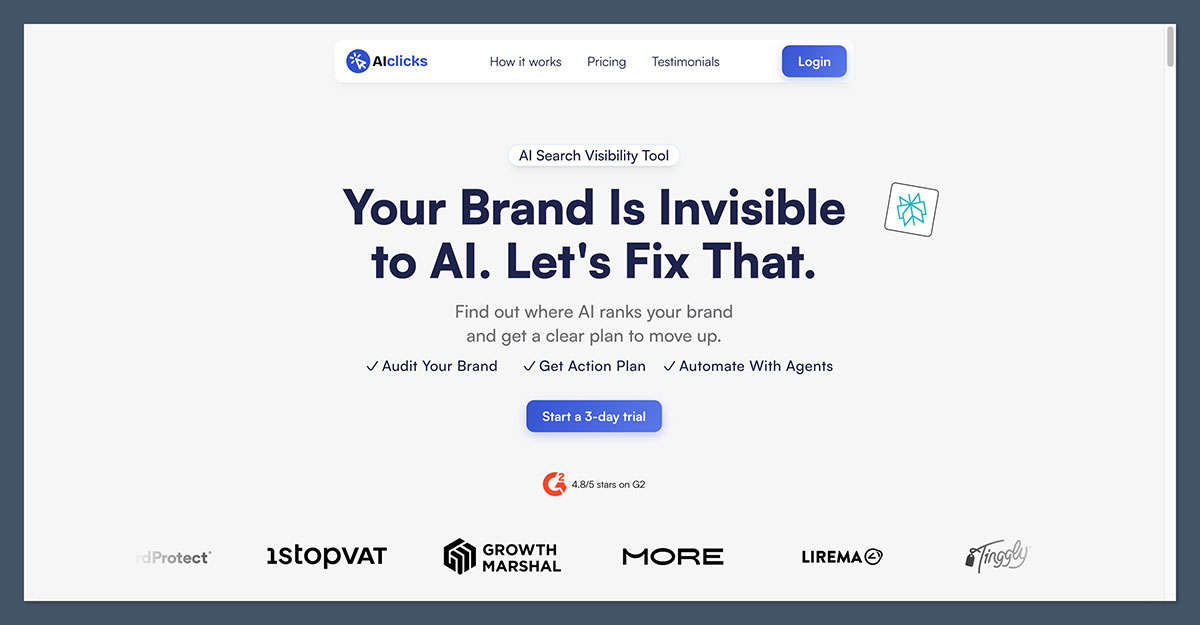
AIclicks lands in our top spot because it solves the pricing-to-coverage equation that every other platform on this list struggles with.
Most tools either give you wide engine coverage at enterprise prices or restrict you to ChatGPT-only at the entry tier. AIclicks does neither.
The Starter plan at $39 per month covers prompt-level tracking across the major engines, which is the price point most under-resourced SaaS marketing teams can actually approve without a sales conversation. Agency-grade features sit in the higher tiers, so this is not a tool you outgrow in three months.
Pros
- Aggressive entry pricing for a multi-engine tool
- Prompt-level tracking included from the Starter tier
- Agency features available without enterprise contracts
- Actionable optimization insights, not just reporting
Cons
- Newer platform compared to Profound or Peec
- Smaller customer base for benchmarking
- Less unique data than Profound’s Prompt Volumes
How Much Does AIclicks Cost?
- Starter plan begins at $39 per month (promotional)
- Higher tiers add agency features, additional prompts, and white-label reporting
- Free trial available without a sales call
Why Use AIclicks in 2026?
The biggest barrier for SaaS teams adopting AEO is not understanding the value. It is justifying a $400 to $2,000 monthly tool to the CFO when nobody on the leadership team has used the category before.
AIclicks lets you start tracking and showing results before that conversation has to happen. By the time you need to upgrade, you have data to back the request.
AIclicks is suitable for:
- SaaS teams running their first AEO program
- Agencies managing multiple SaaS clients
- Marketing teams without enterprise budgets
AIclicks isn’t suitable for:
- Fortune 500 brands needing SOC 2 Type II compliance
- Teams requiring proprietary data like Profound’s Prompt Volumes
- Brands wanting Reddit-specific monitoring
2. Profound: Best for Enterprise SaaS
- Starting price: $399 per month (Growth, the practical entry point)
- Engines tracked: 3 platforms (Growth) up to 10+ (Enterprise)
- Free trial: No, sales-led
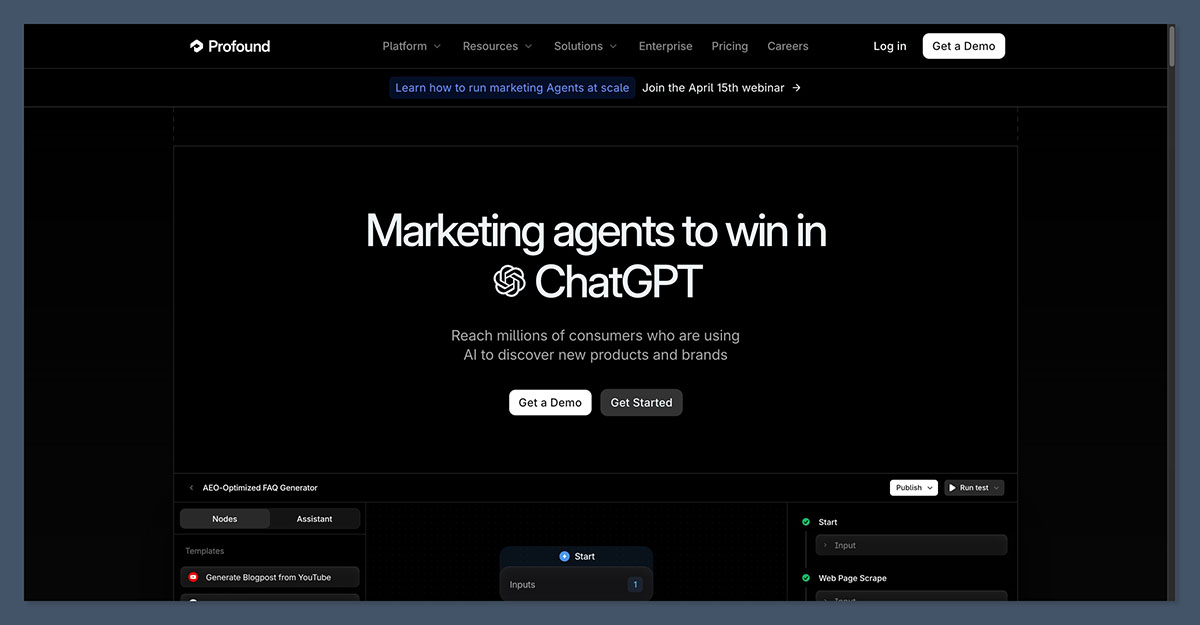
Profound is the deepest AI visibility analytics platform on the market, and it is the platform Fortune 500 brands like MongoDB, Indeed, Mercury, and Ramp use to track AI citations.
The Prompt Volumes panel, which estimates how often a topic is actually queried inside AI engines, is genuinely unique. No other tool offers it.
The catch is the pricing structure.
The published Lite plan starts at $499 per month for ChatGPT-only with 50 prompts, the Growth tier at $399 per month covers three engines (ChatGPT, Perplexity, and Google AI Overviews), and the full 10+ engine coverage including Claude, Gemini, and Grok requires Enterprise pricing reportedly running $2,000 to $5,000 per month. There is no self-serve signup.
April 2026 update: Profound has added Shopping Visibility tracking for ChatGPT commerce queries, a category most monitoring tools ignore.
Pros
- Prompt Volumes data unavailable elsewhere
- SOC 2 Type II and HIPAA compliance for enterprise procurement
- Shopping Visibility for AI commerce tracking
- Strongest enterprise customer base in the category
Cons
- No free trial or self-serve signup
- Lower tiers feel like sample plans, not real products
- Steep learning curve, often requires a dedicated analyst
- True multi-platform coverage needs Enterprise pricing
How Much Does Profound Cost?
- Lite plan: $499 per month, 50 prompts, ChatGPT only
- Growth plan: $399 per month, 3 platforms, 100 prompts, 6 articles per month
- Enterprise: custom pricing, typically $2,000+ per month, full 10+ engine coverage and SOC 2
- Sales-led, no self-serve checkout
Why Use Profound in 2026?
If you are a SaaS brand with $5M+ ARR and AI visibility is a board-level reporting line, Profound is the default choice in the category.
The data depth, customer base, and security posture remove procurement friction at large companies. For everyone else, the gap between what the Lite tier offers and what justifies the price is too wide.
Profound is suitable for:
- Fortune 500 SaaS and growth-stage enterprises
- Teams reporting AI visibility to the board
- Procurement workflows requiring SOC 2 Type II
Profound isn’t suitable for:
- Solo marketers or sub-$5M ARR SaaS
- Teams that want to test before committing
- Anyone needing budget-friendly multi-engine coverage
3. Peec AI: Best for Mid-Market SaaS
- Starting price: €85 per month (Starter)
- Engines tracked: 3 of 6 (ChatGPT, Perplexity, Gemini, Copilot, AI Mode, AI Overviews) on base plans
- Free trial: 14 days
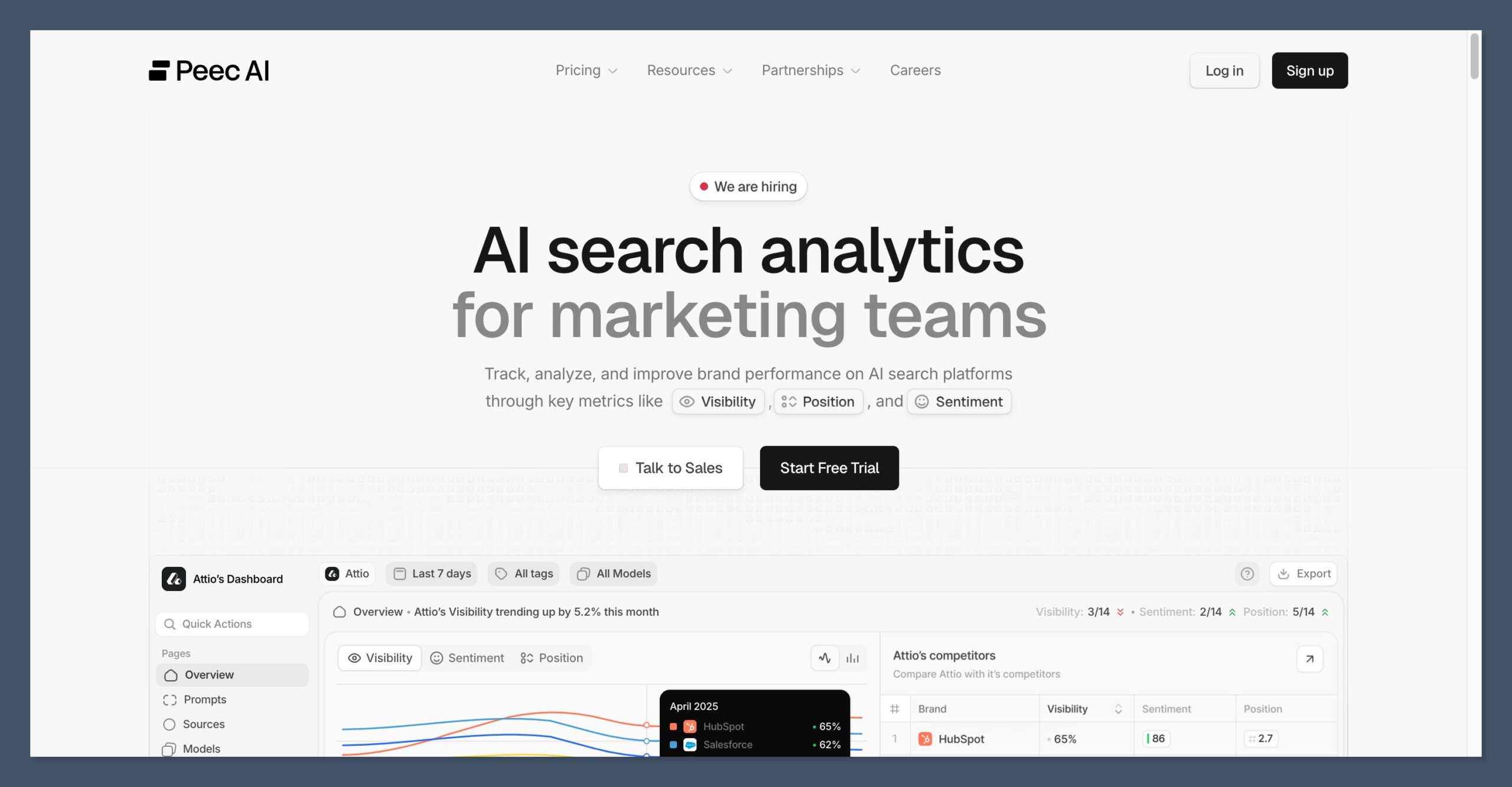
Peec AI raised $29M in its first year and built a reputation for being the cleanest dashboard in the category.
The Starter plan at €85 per month gets you 50 tracked prompts across three AI models, daily tracking, and unlimited user seats. That last point matters for agencies and larger marketing teams: most competitors charge per seat.
The Actions feature, currently in beta, clusters citation gaps into Owned Media opportunities and Earned Media gaps with a Relative Opportunity Score for each. This is closer to a workflow tool than a pure dashboard. Peec AI also queries AI platforms by simulating real browser sessions rather than calling APIs, which captures the same answers actual users see.
Pros
- Unlimited user seats on every plan
- Browser-session queries match real user answers
- Actions feature provides prioritized GEO roadmap
- Looker Studio connector for custom dashboards
Cons
- Add-on fees for Claude, Gemini, AI Mode beyond base 3
- No content creation features
- API access is Enterprise-only
- EUR pricing creates budget volatility for US teams
How Much Does Peec AI Cost?
- Starter: €85 per month, 50 prompts, 3 models, 1 project
- Pro: €205 per month, 150 prompts, 3 models, 2 projects, multi-country tracking
- Advanced: €425 per month, deeper reporting
- 14-day free trial on all plans
Why Use Peec AI in 2026?
Peec AI is the Goldilocks platform for SaaS teams that have outgrown Otterly’s prompt limits but cannot justify Profound’s enterprise commitment. The unlimited seats matter more than they sound.
If you have a content team, an SEO lead, a product marketer, and a CMO who all want dashboard access, per-seat tools become the more expensive option fast.
Peec AI is suitable for:
- Mid-market SaaS marketing teams
- Agencies managing multiple SaaS brands
- Teams that need clean, intuitive dashboards
Peec AI isn’t suitable for:
- Teams needing content creation in the same tool
- Brands that need full multi-engine coverage cheaply
- SaaS requiring SOC 2 compliance
4. Otterly.AI: Best Budget Entry Point
- Starting price: $29 per month (Lite)
- Engines tracked: ChatGPT, Google AI Overviews, Perplexity, Microsoft Copilot, Gemini, Google AI Mode
- Free trial: 14 days, no credit card required
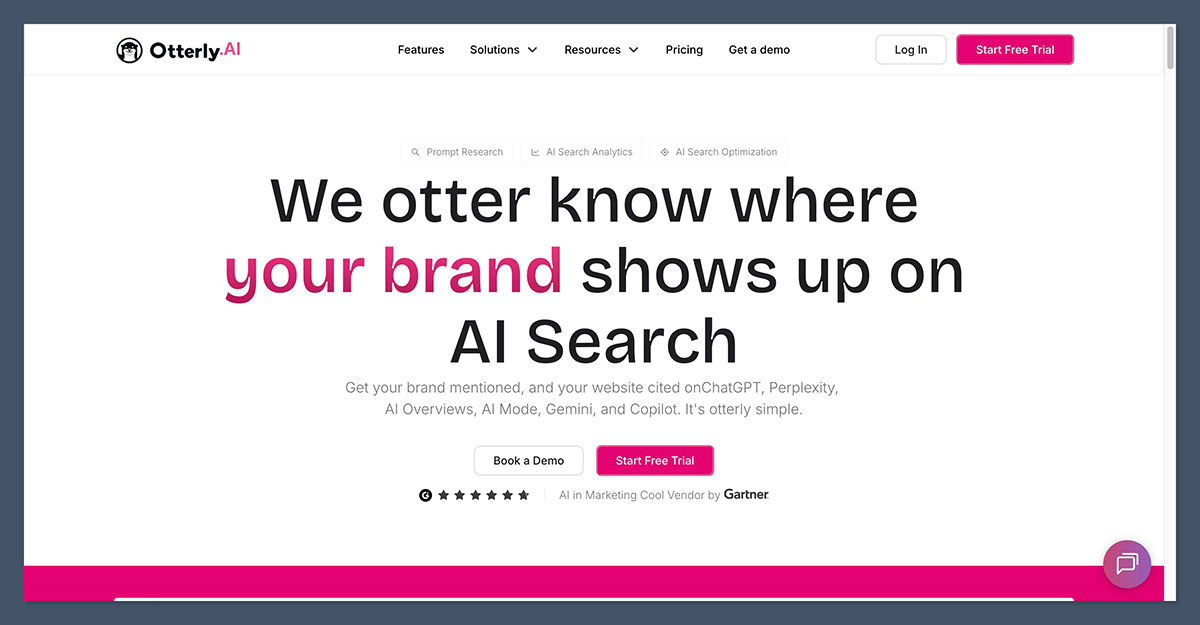
Otterly.AI is the lowest-friction way to start tracking AI search visibility. The Lite plan at $29 per month covers 15 search prompts across six AI engines including ChatGPT, Google AI Overviews, Perplexity, Microsoft Copilot, Gemini, and Google AI Mode. No other platform on this list includes that many engines at this price.
The trade-off is depth. Fifteen prompts is enough to track your brand and a few competitors but not enough to run a serious AEO program with topic-level expansion.
The Standard plan at $189 per month scales to 100 prompts with daily tracking, and Premium at $489 per month covers 400 prompts with API access and multi-brand monitoring.
Pros
- Lowest entry price in the category
- Six AI engines included on Lite, no add-ons
- 14-day free trial without credit card
- Simple dashboard with minimal learning curve
Cons
- 15 prompts on Lite fills up fast
- API-level tracking can yield misleading answers
- No content creation features
- Limited research and exploration depth
How Much Does Otterly.AI Cost?
- Lite: $29 per month, 15 prompts, 6 engines
- Standard: $189 per month, 100 prompts, daily tracking
- Premium: $489 per month, 400 prompts, API access, multi-brand
- 14-day free trial, no credit card required
Why Use Otterly.AI in 2026?
If your boss asked “are we showing up in ChatGPT?” yesterday and you need an answer this week, Otterly is how you get one without a procurement cycle. It is also the right tool for testing whether AEO is worth investing in before you commit to a higher-tier platform.
Otterly.AI is suitable for:
- Solo founders and small teams testing AEO
- Teams running their first visibility audit
- Side projects and bootstrapped SaaS
Otterly.AI isn’t suitable for:
- Teams tracking 50+ prompts seriously
- Agencies managing multiple paying clients
- Brands needing browser-session accuracy
5. Legible: Best for AI Crawler Control
- Starting price: Custom
- Focus: AI crawler tracking and content visibility management
- Free trial: Demo available
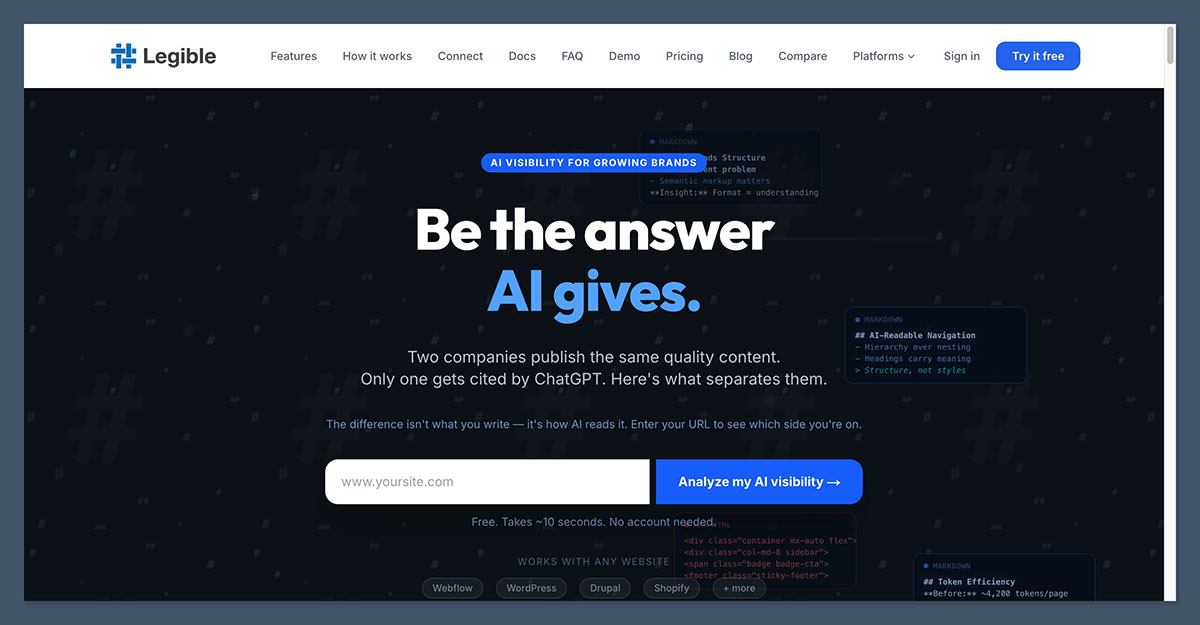
Most AEO tools focus on what AI engines say about you. Legible focuses on what AI engines see when they crawl your site.
The platform shows which AI systems are reading your content in real time, classifies content by risk profile, and helps teams implement robots.txt directives to allow search crawlers while potentially blocking training crawlers.
This sits at the retrieval layer, which most teams ignore until they have a problem. If your brand is barely cited but your content is indexed, the issue is often crawler access or extraction. Legible diagnoses that.
Pros
- Real-time AI crawler activity visibility
- Risk classification by content type
- Helps implement crawler access policies
- Addresses retrieval, not just citation
Cons
- Custom pricing requires sales conversation
- Narrower use case than full AEO platforms
- Best paired with a citation tracker, not used alone
Why Use Legible in 2026?
Crawler control became a real concern in late 2025. SaaS brands started noticing that their content was being trained on but not cited.
Legible exists for teams that want to control how their content is represented across AI systems, not just measure what those systems say. Pair it with AIclicks or Peec AI for the full picture.
Legible is suitable for:
- SaaS brands with publishing-heavy content libraries
- Teams concerned about training versus citation
- Enterprises managing crawler access at scale
Legible isn’t suitable for:
- Teams that need a primary citation tracker
- Small teams without dedicated technical SEO
- Brands that haven’t audited their content yet
6. Writesonic: Best for Content Optimization at Scale
- Starting price: $20 per month
- Engines covered: Google AI Overviews, AI Mode, ChatGPT, Perplexity, Gemini, Claude
- Free trial: Yes
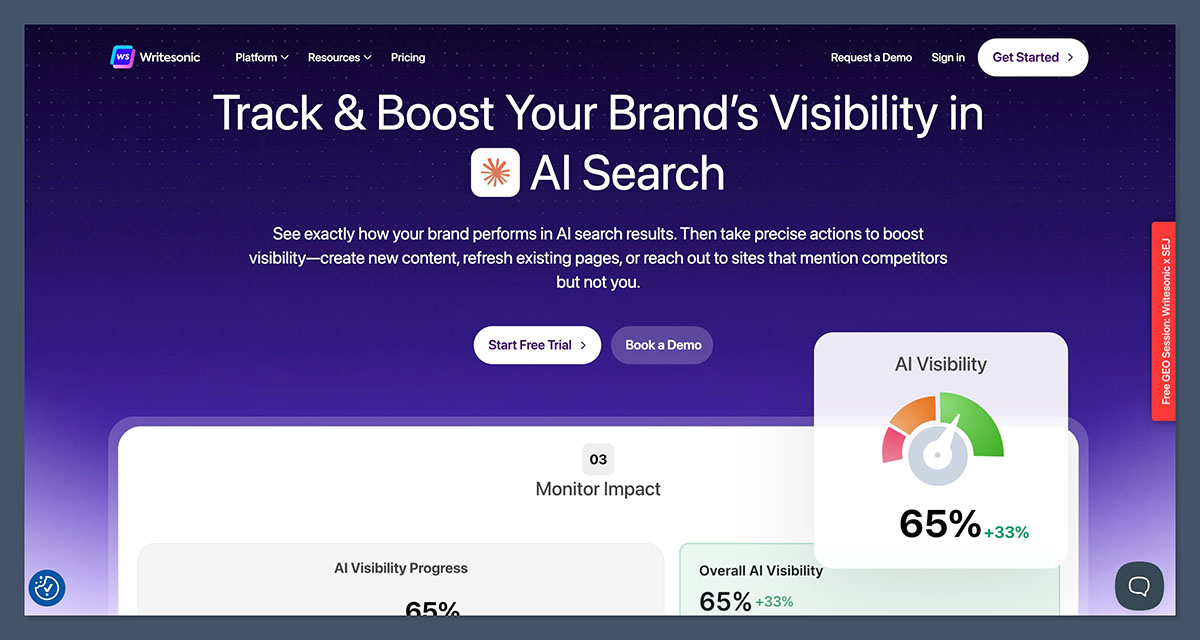
Writesonic crosses two categories that most tools keep separate. It tracks where your brand is mentioned across the major AI engines, and it helps you create the content that fixes the gaps. The platform identifies where you are missing from AI answers and what content changes could increase inclusion.
This is useful for SaaS teams that do not want to run a tracker and a writer in parallel. The depth on tracking is shallower than Profound or Peec AI, but the optimization workflow is integrated.
Pros
- Combines tracking and content creation
- Wide engine coverage including Claude
- Identifies missing topics and citation gaps
- Aggressive entry pricing
Cons
- Tracking depth less mature than dedicated trackers
- AI-generated content needs heavy editing
- Less granular prompt-level data than Peec AI
Why Use Writesonic in 2026?
If your team is running content production in-house and you want one platform to handle both the gap analysis and the writing, Writesonic earns the spot. It is not the strongest tracker on this list and not the strongest writer, but the integration removes a workflow seam that costs most teams hours per week.
Writesonic is suitable for:
- SaaS content teams running high-volume programs
- Teams that want tracking and writing in one tool
- Solo marketers wearing multiple hats
Writesonic isn’t suitable for:
- Teams that want best-in-class tracking depth
- Brands prioritizing human-led content
- Enterprise compliance requirements
7. Surfer SEO: Best for Entity and NLP Coverage
- Starting price: $99 per month
- Focus: NLP-driven keyword and entity coverage with ChatGPT integration
- Free trial: 7 days
Surfer SEO is one of the established SEO platforms that adapted into the AI search era rather than being built for it.
The ChatGPT integration handles NLP-driven keyword and entity coverage, which is the part of AEO most teams underestimate. AI engines extract entities, not just keywords, and Surfer maps them.
This is the tool to use when you have content that ranks in Google but does not appear in AI answers. The diagnostic almost always traces back to entity coverage gaps that Surfer surfaces clearly.
Pros
- Strong entity and NLP analysis
- ChatGPT integration built into editor
- Works for both Google SEO and AEO
- Mature platform with active customer base
Cons
- Not a citation tracker, focuses on optimization
- Pricing higher than newer competitors
- Best paired with a tracker like AIclicks or Peec AI
Why Use Surfer SEO in 2026?
If your team is comfortable with traditional SEO tooling and you want to extend that workflow into AEO without learning a new category of platform, Surfer is the natural step. It also pairs well with any of the tracking tools above, since it solves a different layer of the problem.
Surfer SEO is suitable for:
- Teams with established SEO programs extending to AEO
- Content teams optimizing entity coverage
- Brands ranking in Google but not in AI answers
Surfer SEO isn’t suitable for:
- Teams needing prompt-level citation tracking
- Brands without existing content libraries
- Solo marketers on tight budgets
How to Choose the Right AEO Tool
The right tool depends on stage, team size, and what layer of the problem you are trying to solve. Tracking is one layer. Optimization is another. Crawler control is a third. Most teams start with tracking and add the others as they mature.
Here is a checklist to work through before signing up:
- Engine coverage: Does the base plan include the engines your buyers actually use, or are key models like Claude and Gemini behind add-ons?
- Prompt volume: Can you track your brand, your top three competitors, and 20+ topical prompts within the plan limits?
- Methodology: Does the tool query AI platforms via API or via simulated browser sessions? Browser sessions match what users actually see.
- Seat pricing: If your team has 5+ stakeholders who need access, per-seat pricing inflates costs fast. Tools like Peec AI offer unlimited seats.
- Workflow integration: Do you need tracking only, or do you want content creation and optimization in the same tool?
- Free trial: Can you validate fit before paying? Profound is the only major platform without one.
- Compliance: If you sell to enterprise, does the tool offer SOC 2 Type II for procurement?
- Scalability: Will the tool grow with you, or will you need to switch platforms within 12 months?
The Optimization Layer Most Teams Skip
Tools track what is happening. They do not change what is happening. Citations move when three things change on your end: entity clarity across third-party sources, structured data on your site, and content formatted for extraction.
Entity Clarity Across Sources
The most critical signal for ChatGPT in 2026 is entity clarity across sources. ChatGPT must identify your company unambiguously, what it does and where it operates, which requires consistent information across LinkedIn, Crunchbase, G2, Clutch, and industry-specific directories all describing your company with the same name, positioning, service list, and operating cities. Conflicting signals cause ChatGPT to discount all information and choose competitors with cleaner signals.
Structured Data and Schema
Schema.org markup tells AI exactly what you sell, who you are, and what others think of you. FAQPage schema improves citation rates because the question-answer format aligns with how AI engines extract fragments. Product, Organization, and Review schemas all serve the same function. A clean XML sitemap helps crawlers discover fresh content, and Google Search Console plus Analytics measure which terms drive traffic.
Content Formatted for Extraction
AI engines extract fragments. They do not read complete articles. Self-contained paragraphs that can be lifted and understood independently are far more likely to be cited. Tables comparing features, pricing, and specifications increase extraction likelihood. Visible publication dates within 12 months signal freshness. Content that opens with a clear answer in the first sentence outperforms content that builds to a conclusion.
Co-Citation Strategy
Detect which lists already appear when users ask AI “best X in Y” questions. Identify where you should appear. Work toward inclusion through real value: data, case studies, proof, and expertise. Reinforcing presence through digital PR including collaborations, podcasts, webinars, and guest posts supports this positioning more than any tool can.
Tracking and Measurement
Beyond the dedicated AEO platforms, two free tools belong in every stack. IndexNow technology enables faster content appearance in Bing, which feeds many ChatGPT responses, allowing teams to prioritize key content and ensure rapid indexing of updates. Google Analytics can track AI referrals by searching for terms like “gpt,” “openai,” and “perplexity” in referral sources.
How We Evaluated These Tools
This year, we put 30+ AEO and AI search visibility platforms through hands-on testing to determine our shortlist. Our team spent 200+ hours auditing each tool across six core categories:
- Engine Coverage and Accuracy: 30%: How many AI engines are tracked, and does the tool match what real users see?
- Pricing and Value: 20%: What do you get for the price, and how transparent is the pricing model?
- Workflow Integration: 15%: Does the tool integrate tracking with optimization, or sit in isolation?
- Data Depth: 15%: How granular is the prompt and citation data?
- User Experience: 10%: How fast can a new user set up and get answers?
- Reputation and Reliability: 10%: What does the customer base look like, and how stable is the platform?
Key Takeaways
- AIclicks is our top all-in-one pick at $39 per month, covering ChatGPT, Perplexity, Gemini, Google AI Overviews, and other engines with prompt-level tracking
- Pricing now spans from $29 per month (Otterly Lite) to $2,000+ per month (Profound Enterprise), with the meaningful jump happening around $399 per month for multi-platform coverage
- Profound, Peec AI, and Otterly all offer free trials or freemium tiers, but Profound requires a sales call before access
- Tracking alone does not move citations. You need entity clarity across third-party sources, structured data on-site, and FAQ-format content for extraction
- Most SaaS teams under $5M ARR should start with Otterly or AIclicks, not Profound
Final Verdict: Which Tool Should You Pick?
Our research determined that AIclicks is the best all-in-one AEO platform for SaaS brands in 2026, balancing engine coverage, prompt-level depth, and accessible pricing better than any other tool on this list.
If you are a Fortune 500 SaaS or growth-stage enterprise with budget and procurement requirements, Profound is the default choice and the deepest analytics platform on the market.
If you are a mid-market team that needs unlimited seats and clean dashboards, Peec AI wins.
If you are starting from zero with no AEO budget, Otterly.AI at $29 per month is how you prove value before scaling up.
Tools track. Citations move when you fix the underlying signal: entity clarity, structured data, and content formatted for extraction.
Pick the tool that matches your stage, then put the work into the layers no platform can automate.
Frequently Asked Questions
What is AEO and how does it differ from SEO?
Answer Engine Optimization (AEO) is the practice of optimizing your brand and content to be cited by AI engines like ChatGPT, Perplexity, and Gemini. SEO targets ranking in Google’s traditional results pages. AEO targets being the source AI systems reference inside their generated answers. The two overlap on technical fundamentals like crawlability and content quality, but AEO adds requirements around entity clarity, FAQ formatting, and citation-source diversity.
Do I need a paid tool to track ChatGPT visibility?
You can do basic manual tracking by asking ChatGPT, Perplexity, and Gemini directly for “best [your category]” queries and recording who appears. Paid tools automate this across hundreds of prompts, track changes daily, and benchmark you against competitors. For more than 10 to 15 prompts, manual tracking becomes impractical fast.
How long does it take to see citation improvements?
Most teams see initial movement within 4 to 8 weeks of consistent work on entity clarity, schema implementation, and content formatted for extraction. Sustained improvement requires 3 to 6 months. AI engines update their training and indexing on different cycles, so changes show up faster on Perplexity (real-time retrieval) than on ChatGPT (which blends training and retrieval).
Should I block AI training crawlers?
It depends on your goals. Blocking training crawlers protects your content from being absorbed into model weights. Allowing search crawlers ensures your content can be retrieved and cited in real-time AI answers. Most SaaS brands want to be cited, so blocking all AI crawlers is usually the wrong move. The nuanced answer is to allow search crawlers (PerplexityBot, ChatGPT-User, GoogleBot) and selectively manage training crawlers (GPTBot, ClaudeBot, Google-Extended).
Which AI engine matters most for SaaS?
ChatGPT has the largest share of AI search queries with 700M+ weekly users, and it remains the highest priority for most SaaS brands. Google AI Overviews matters because it intercepts traditional Google traffic. Perplexity over-indexes for technical and B2B audiences. Gemini and Claude grow the long tail. The right answer is to track all five and prioritize work based on where your buyers actually search, not on raw user counts.
Can I use ChatGPT itself to optimize for ChatGPT?
Partially. ChatGPT is useful for entity research, FAQ generation, and content gap identification. It is not useful for telling you whether your brand is currently cited or how that compares to competitors. The tools above exist because the data needed to answer those questions cannot be retrieved from a single ChatGPT session.
Is AEO worth investing in if my SaaS is under $1M ARR?
Yes, with caveats. Early-stage SaaS benefits from AEO precisely because the category is still uncrowded and the cost of entry is low. Start with Otterly.AI or AIclicks, focus on entity clarity across LinkedIn, G2, Crunchbase, and industry directories, and publish two to three high-quality FAQ-formatted articles per month. Skip enterprise platforms until you have at least $3M ARR and a dedicated content team.

