

After analyzing 25+ AI platforms across content, CRM, automation, conversational marketing, and demand generation, we’ve shortlisted the five AI tools most likely to move the needle for B2B marketing teams in 2026.
HubSpot AI remains our top pick for the third year in a row, offering the strongest combination of native AI features, CRM depth, and B2B-specific automation under one roof.
In this guide, we walk through the key features, pricing, and drawbacks of each tool, so you can assemble the right AI marketing stack for your startup, scale-up, or enterprise team.
The analysis has been updated for 2026 to reflect new AI capabilities, pricing changes, and what actually works for B2B teams operating in an AI-driven search landscape.
Our Top 5 AI Tools for B2B Marketing
- HubSpot AI (Breeze) – Best all-in-one B2B marketing platform
- Jasper – Best for high-volume content creation
- Surfer SEO – Best for SEO and AEO optimization
- 6sense – Best for ABM and intent data
- Zapier – Best for workflow automation and AI orchestration
| 25+ AI tools evaluated | 18 months tracking category | 300+SaaS clients served | 10+ publishing sites operated |
AI Tools for B2B Marketing: Comparison Table
Take a look at our top AI marketing picks side-by-side to see which best suits your team:
| Tool | Category | Starting Price | Free Plan / Trial | Best For |
|---|---|---|---|---|
| HubSpot AI | CRM + marketing automation | $15/seat/month (Starter) | Free tier + 14-day trial | Mid-market B2B teams |
| Jasper | Content creation | $39/seat/month (Creator, annual) | 7-day free trial | High-volume copy teams |
| Surfer SEO | SEO / AEO content optimization | $79/month (Essential, annual) | 7-day refund guarantee | Content and SEO teams |
| 6sense | ABM + intent data | Custom (free tier available) | Free plan for basic access | Enterprise ABM teams |
| Zapier | Automation + AI agents | $19.99/month (Professional) | Free plan available | RevOps and marketing ops |
1. HubSpot AI: Best All-in-One B2B Platform
- Starting price: $15/seat/month (Starter, billed annually)
- AI agents: Yes (Breeze suite)
- Best for: Mid-market B2B teams that want AI embedded in a unified CRM
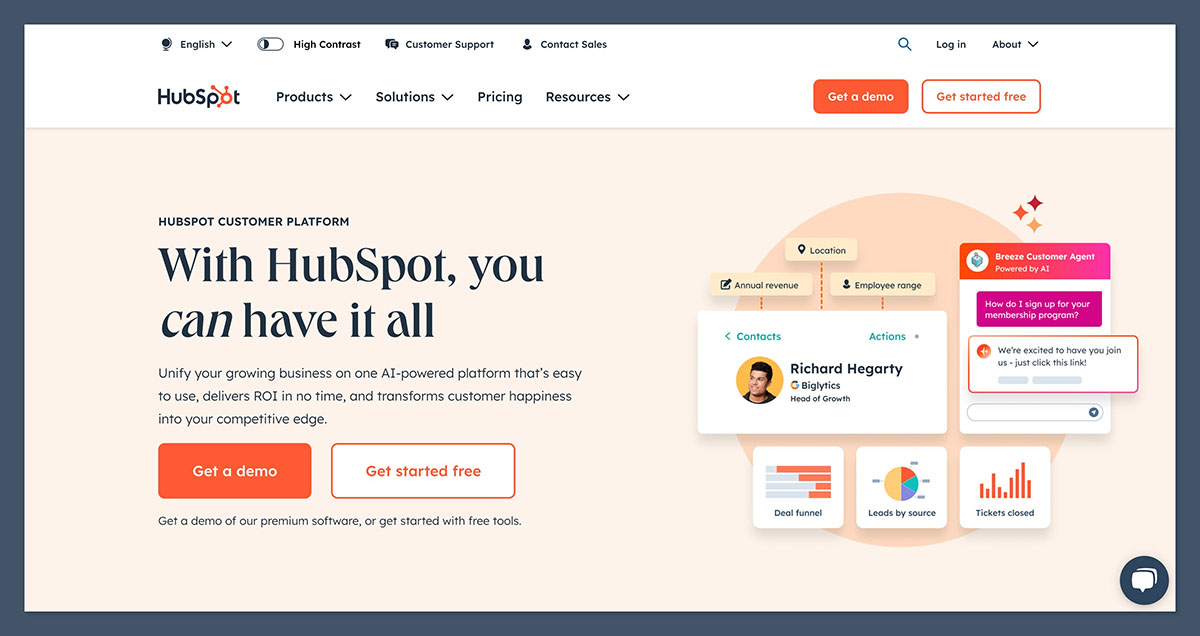
HubSpot AI is the most complete B2B marketing platform we’ve tested, taking the top position in our rankings for the third year in a row.
HubSpot’s Breeze AI agents sit on top of the Smart CRM, which means every AI suggestion, draft, or automation is informed by the same customer data your sales and service teams use.
For B2B teams, that integration is the whole point — AI outputs are only as good as the data they’re grounded in.
The Breeze suite includes agents for prospecting, content creation, social media, and customer support. On the marketing side, HubSpot AI handles blog drafts, email copy, landing page content, lead scoring, and chatbot conversations natively.
Workflows trigger from lead behavior, firmographic data, or intent signals, and reporting ties everything back to pipeline and revenue — which is where most standalone AI tools fall short.
Pros
- AI grounded in a unified Smart CRM, not bolted on top
- Native lead scoring, nurturing, and workflow automation
- Breeze agents for prospecting, content, and social
- Strong reporting that ties marketing activity to pipeline
Cons
- Professional tier jumps to $890/month — a steep step up from Starter
- Marketing contact overages can push bills significantly higher
- Mandatory onboarding fee on Professional plans ($3,000 one-time)
- Full AI value only unlocks at Professional and above
2026 Update: HubSpot expanded the Breeze agent lineup at INBOUND 2025 with deeper social, content, and prospecting capabilities. Credit-based pricing now powers AI usage across all hubs.
In hands-on testing, HubSpot AI behaves less like a chatbot and more like an embedded operations layer. The lead scoring agent, for example, doesn’t just score contacts — it explains why, referencing specific engagement patterns and firmographic fields.
For B2B teams with complex buying committees, that transparency matters. The tradeoff is complexity: HubSpot has a steeper learning curve than a standalone writing tool, and the jump from Starter to Professional is a real budgeting conversation, not a minor upgrade.
How Much Does HubSpot AI Cost?
- Free tier available with basic CRM, forms, and email marketing
- Marketing Hub Starter: from $15/seat/month (annual), 1,000 marketing contacts
- Marketing Hub Professional: $890/month (annual), 2,000 contacts, 3 core seats
- Marketing Hub Enterprise: $3,600/month (annual), 10,000 contacts, 5 core seats
- Onboarding fees: $3,000 for Professional, $7,000 for Enterprise
Why Use HubSpot AI in 2026?
B2B buying cycles are getting longer and more fragmented across channels. HubSpot AI is built for that reality — agents work on top of a CRM that already knows your accounts, deals, and intent signals.
For teams that want AI to actually influence pipeline (not just produce more content), this is the most defensible bet in the B2B category right now.
HubSpot AI is suitable for:
- Mid-market B2B teams with a centralized CRM strategy
- Teams that want AI tied to revenue, not just content volume
- Companies with 2,000+ marketing contacts and growing pipeline
HubSpot AI isn’t suitable for:
- Solo founders or teams of 2–3 (Professional is overkill)
- Teams that only need email marketing (cheaper options exist)
- Companies already committed to Salesforce or another core CRM
2. Jasper: Best for High-Volume Content
- Starting price: $39/seat/month (Creator, billed annually)
- AI agents: Yes (no-code AI Agent Builder on Business plan)
- Best for: Content and copy teams producing across multiple channels
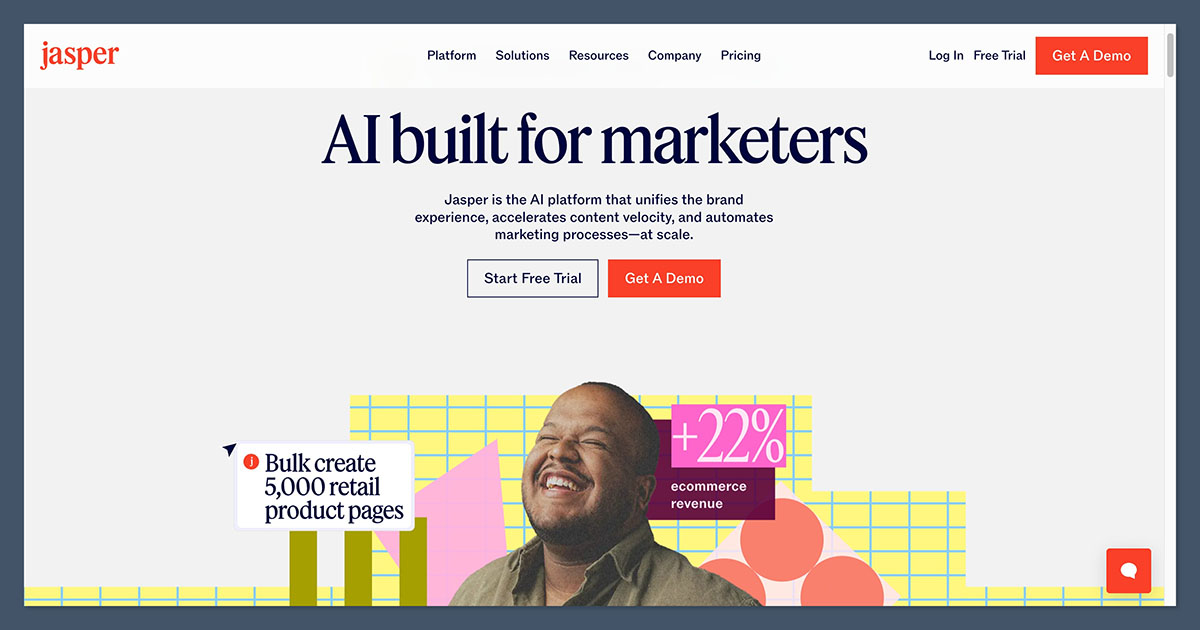
Jasper is our pick for B2B teams that need to produce copy at volume across ads, emails, landing pages, and social. Unlike generalist tools like ChatGPT, Jasper is built specifically for marketing workflows, with over 100 templates, Brand Voice training, and integrations with Surfer SEO, Grammarly, and Zapier.
For performance marketers and demand gen teams juggling dozens of creative variants per campaign, the speed advantage is real.
The Brand Voice feature is where Jasper earns its B2B keep. You can train it on your company’s tone, product messaging, and positioning — which matters when you’re producing 40 LinkedIn ads for the same campaign and need them to actually sound like your brand.
The Pro plan supports up to 5 seats and multiple brand voices, which works well for agencies or internal teams managing several products.
Pros
- Over 100 marketing-specific templates
- Brand Voice training for consistent tone across content
- Integrations with Surfer, Grammarly, and Zapier
- No-code AI Agent Builder on Business plan
Cons
- Long-form output still requires heavy editing
- No strategy layer — Jasper writes, you plan
- Pricing adds up quickly as you add seats
- Plagiarism checker is a paid add-on
2026 Update: Jasper restructured pricing into Creator ($39/mo annual), Pro ($59/mo annual), and custom Business tiers, making the entry point more accessible for solo marketers.
Testing Jasper against generalist tools, the difference shows up in short-form at scale. Asking Jasper for 20 LinkedIn ad variants targeting a specific ICP produces outputs that actually differ from each other and stay on brand.
Long-form is a different story — Jasper drafts fast, but you’ll still need to layer in original research, customer quotes, and product-specific details. That’s not a Jasper problem; that’s the reality of any AI writing tool in 2026.
How Much Does Jasper Cost?
- Creator plan: $39/month (annual) or $49/month (monthly) — 1 seat, 1 Brand Voice
- Pro plan: $59/month (annual) or $69/month (monthly) — up to 5 seats, multiple brand voices
- Business plan: custom pricing — unlimited seats, API access, SSO, dedicated account manager
- 7-day free trial available on Creator and Pro
Why Use Jasper in 2026?
B2B content needs have exploded — every campaign now demands versions for LinkedIn, email, ABM landing pages, sales enablement, and search.
Jasper handles the volume without sacrificing brand consistency, which is where most generic AI tools collapse. For teams producing 50+ pieces of content per month, it pays for itself in time saved.
Jasper is suitable for:
- B2B marketing teams producing 50+ content pieces per month
- Agencies managing multiple brand voices for clients
- Performance marketers needing ad and email variants at scale
Jasper isn’t suitable for:
- Teams that need research-heavy long-form content
- Solo founders who can make ChatGPT work for them
- Companies that need integrated CRM or automation
3. Surfer SEO: Best for SEO and AEO
- Starting price: $79/month (Essential, billed annually)
- AI features: AI Content Editor, AI outline generator, AI Tracker add-on
- Best for: B2B content teams optimizing for both traditional search and AI answers
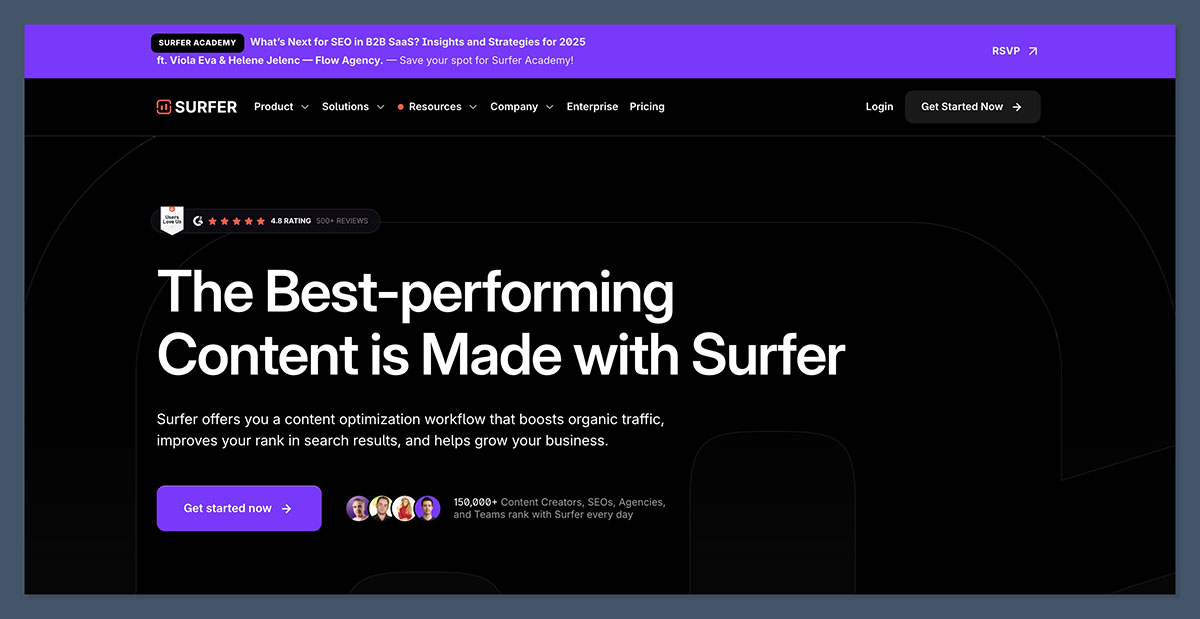
Surfer SEO is our pick for B2B teams that care about ranking in both Google and AI search. The Content Editor scores pages in real time against the SERP, surfacing NLP terms, heading structure, and length recommendations calibrated to what’s already winning.
For SaaS brands building topical authority around specific use cases or ICP problems, this is the closest thing to a feedback loop between writing and ranking.
The 2026 update added the AI Tracker — a dedicated monitor for how your brand shows up in ChatGPT, Perplexity, and other AI search engines. This is a real shift: Surfer is one of the first mainstream SEO tools to acknowledge that AEO (Answer Engine Optimization) needs its own measurement layer.
For B2B teams, the Topical Map feature is also worth flagging — it plans content clusters designed to build authority in a defined topic area, which is exactly how AI systems build trust signals before citing a source.
Pros
- Real-time content scoring against SERP competitors
- AI Tracker monitors brand visibility in ChatGPT and Perplexity
- Topical Map builds authority clusters for AEO
- Google Docs integration for team workflows
Cons
- Keyword research is weaker than Ahrefs or Semrush
- Credits don’t roll over on monthly plans
- AI Tracker is a $95/month add-on on top of base pricing
- AI article generation still needs human editing
2026 Update: Surfer added AI Tracker as a paid add-on, explicitly targeting AEO visibility measurement. AI article limits were also increased on Scale plans.
In testing, Surfer’s Content Editor is where most B2B teams get immediate ROI. Writers open a doc, paste in a keyword, and start writing against a real-time score. The first few times you do this, the difference in published articles is noticeable — pages hit page one faster and hold rank longer.
The AI Tracker is newer and still evolving; it gives directional data on how often your brand is surfaced in AI answers, which is useful for reporting but not yet a perfect substitute for more specialized AEO tools.
How Much Does Surfer SEO Cost?
- Essential plan: $79/month (annual) or $99/month (monthly) — 30 Content Editor articles, 5 AI articles
- Scale plan: $175/month (annual) or $219/month (monthly) — 100 articles, 20 AI articles
- Enterprise plan: custom pricing — unlimited seats, API, white-label reports
- AI Tracker add-on: $95/month for 25 prompts
- 7-day money-back guarantee
Why Use Surfer SEO in 2026?
Search isn’t just Google anymore. B2B buyers ask ChatGPT, Perplexity, and Google AI Overviews for vendor comparisons, use case research, and shortlists.
Surfer is one of the few content tools actively building for this shift — its Content Editor optimizes for both traditional rankings and AI citation likelihood, and the AI Tracker gives you data on AEO performance you can’t easily get elsewhere.
Surfer SEO is suitable for:
- B2B content teams publishing 6+ articles per month
- SaaS brands building topical authority for AEO visibility
- SEO specialists who want real-time optimization feedback
Surfer SEO isn’t suitable for:
- Teams that need deep keyword research (use Ahrefs instead)
- Solo bloggers publishing 1–2 articles per month
- Companies that need end-to-end content generation, not just optimization
4. 6sense: Best for ABM and Intent Data
- Starting price: Free tier available; paid plans custom-quoted
- AI capabilities: Revenue AI, predictive account scoring, intent detection
- Best for: Enterprise B2B teams running account-based marketing
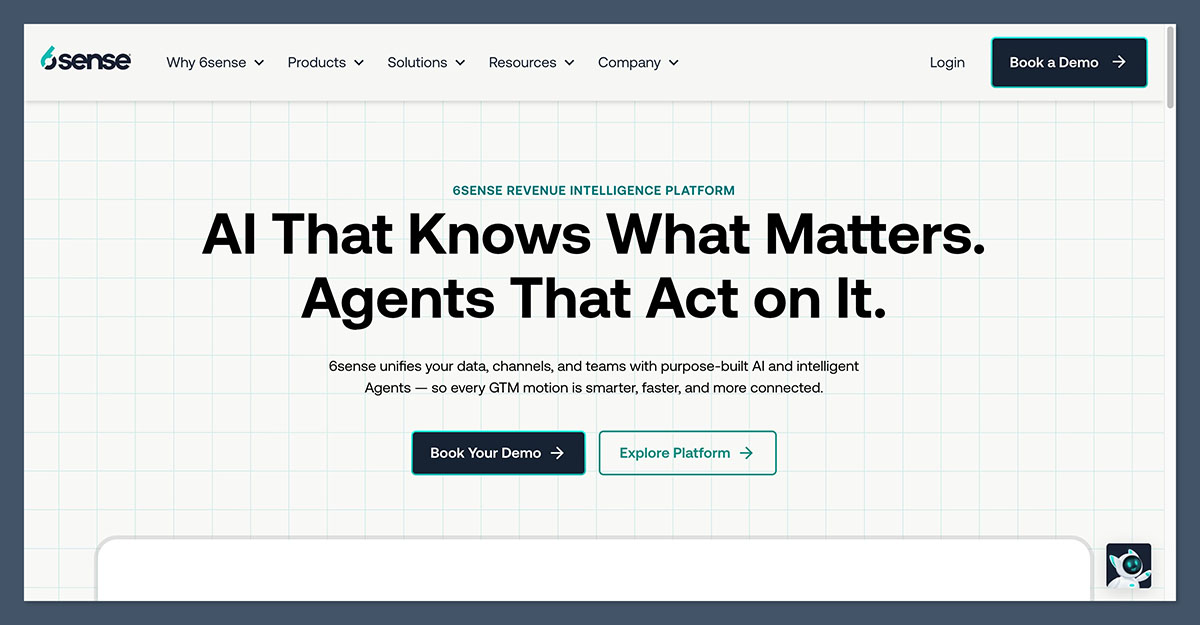
6sense is the strongest AI platform for B2B teams running account-based marketing. Instead of treating AI as a content co-pilot, 6sense applies machine learning to the buyer journey itself — identifying which accounts are in-market, which keywords they’re researching, and when they’re most likely to convert.
For enterprise sales cycles that span 60+ days and multiple stakeholders, this kind of intelligence is structurally different from what content or CRM tools provide.
The Revenue AI engine sits at the center of the platform, scoring accounts against your ICP and surfacing intent signals from across the open web. When a target account starts researching your category — even anonymously — 6sense flags it, prioritizes it, and triggers orchestrated campaigns across email, ads, and sales outreach.
For ABM teams, this is the difference between chasing shadows and working accounts that are actually in a buying cycle.
Pros
- Industry-leading intent data across the open web
- Revenue AI scores accounts against your ICP in real time
- Orchestrates multi-channel campaigns based on account stage
- Free tier available for initial evaluation
Cons
- Enterprise pricing — not a fit for SMBs or early-stage startups
- Custom quotes only, no transparent pricing
- Requires significant implementation and ops investment
- Limited value without a dedicated ABM function
2026 Update: 6sense expanded its Revenue AI capabilities with deeper generative AI for account research summaries and personalized outreach drafting.
6sense is not a tool you pilot casually — it’s a platform-level decision that requires aligning marketing, sales, and ops around a single account strategy.
For companies that have that alignment, the ROI can be substantial: teams consistently report faster account qualification, higher meeting conversion rates, and tighter marketing-to-sales handoffs.
For companies still building that foundation, 6sense can feel like overkill, and cheaper intent tools may be the better starting point.
How Much Does 6sense Cost?
- Free tier: limited access to intent data and account scoring
- Paid plans: custom-quoted based on company size, account volume, and features
- Typical enterprise contracts range from $60,000 to $200,000+ per year
- Implementation and onboarding fees may apply separately
Why Use 6sense in 2026?
B2B buying committees are larger, more anonymous, and research across dozens of sources before entering a sales conversation.
6sense gives you visibility into that journey before a form fill ever happens — which, for enterprise teams, is the single most valuable signal in modern marketing.
It’s also the B2B category where AI has the clearest ROI: identifying in-market accounts is a measurable, revenue-linked use case.
6sense is suitable for:
- Enterprise B2B companies with defined ABM programs
- Sales-led organizations with long, multi-stakeholder deal cycles
- Marketing teams aligned with sales on a shared account list
6sense isn’t suitable for:
- Early-stage startups without an ICP or account list
- PLG companies relying on self-serve signups
- Teams without dedicated ABM or RevOps resources
5. Zapier: Best for Automation and AI Orchestration
- Starting price: $19.99/month (Professional, billed annually)
- AI capabilities: Zapier Agents, AI-powered workflow actions
- Best for: RevOps and marketing ops teams orchestrating AI across the stack
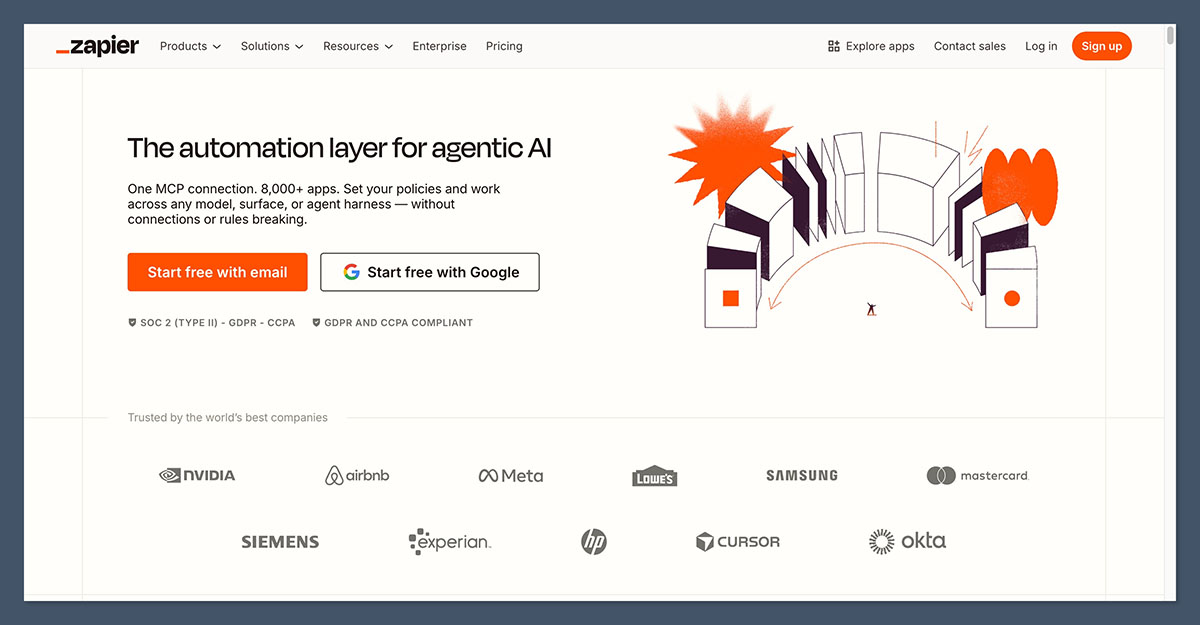
Zapier is the tool that ties the rest of the stack together. With integrations across 8,000+ apps and the new Zapier Agents layer, it connects CRMs, content tools, ads platforms, and AI models into multi-step workflows that run without a developer.
For B2B teams, this is where AI stops being a novelty and starts becoming an operating layer — lead enrichment, handoffs, scoring, and notifications all happen automatically, based on signals from across your stack.
The Agents update is the most interesting 2026 development. Instead of just moving data from app A to app B, Zapier Agents can make decisions — reading a lead’s LinkedIn profile, deciding whether it fits your ICP, enriching with firmographic data, and routing to the right SDR with context.
For marketing ops teams that used to spend weeks building brittle Python scripts, this collapses workflow complexity into a visual canvas.
Pros
- 8,000+ app integrations — the broadest in the category
- AI Agents for multi-step decisions, not just data movement
- No-code interface — accessible to marketing ops teams
- Generous free plan for testing and simple workflows
Cons
- Costs scale quickly with task volume
- Complex workflows can become hard to debug
- Not a reporting or analytics tool in its own right
- Dependency risk — if Zapier breaks, your stack stalls
2026 Update: Zapier rolled out expanded Agent capabilities with native AI decision-making, research actions, and memory across workflow steps.
In practice, Zapier is the glue that makes every other tool on this list more useful.
A typical B2B workflow looks like this: form submission hits a landing page, Zapier enriches the lead with Clearbit data, runs it through an AI scoring agent, pushes qualified leads into HubSpot with a tagged lifecycle stage, notifies the assigned AE in Slack, and triggers a personalized sequence.
That kind of orchestration used to require engineering support. Now it’s a 30-minute build for an ops-minded marketer.
How Much Does Zapier Cost?
- Free plan: limited Zaps and single-step workflows
- Professional: from $19.99/month (annual) — multi-step Zaps, premium apps
- Team: from $69/month (annual) — shared workspace, unlimited users
- Company: custom pricing — advanced security, SSO, analytics
- Zapier Agents: usage-based pricing on top of base plan
Why Use Zapier in 2026?
AI tools in isolation don’t move pipeline — AI tools connected to your CRM, your enrichment data, and your sales team do.
Zapier is the fastest way for B2B marketing teams to operationalize AI across the stack without hiring engineers. In 2026, the teams winning on AI aren’t the ones with the best single tool — they’re the ones who’ve stitched AI into the flow of work.
Zapier is suitable for:
- Marketing ops and RevOps teams without dedicated engineering
- B2B companies with multi-tool stacks that need coordination
- Teams piloting AI agents across enrichment, scoring, and outreach
Zapier isn’t suitable for:
- Companies with heavy engineering resources and custom APIs
- Teams that need deep analytics or reporting
- Use cases requiring real-time, sub-second latency
How Do I Choose the Right AI Tool for B2B Marketing?
Choosing the right AI tool means evaluating your team’s bottleneck, not chasing category leaders. The tools on this list solve different problems, and stacking all five would be expensive and operationally unwieldy for most B2B teams. Below is a checklist of the factors that should drive the decision.
Identify your bottleneck first. Is it content volume, lead scoring, account identification, or workflow sprawl? The strongest AI investments solve a concrete, measurable bottleneck — not a generic “we need AI” mandate. A content team drowning in brief-to-publish cycles benefits most from Jasper and Surfer. A RevOps team stitching together a fragmented stack benefits most from Zapier. An ABM team chasing anonymous accounts benefits most from 6sense.
Match tool depth to team maturity. HubSpot and 6sense are platform bets that require operational maturity to unlock. Jasper, Surfer, and Zapier are point tools that deliver faster ROI with lower commitment. Early-stage B2B teams should default to point tools and graduate to platforms as they scale.
Check data quality before signing. AI is only as good as the data it sits on top of. CRMs with messy contact data, inconsistent lifecycle stages, or orphaned accounts will produce bad AI outputs no matter which tool you pick. Budget for a data cleanup sprint before or during your AI rollout.
Pilot with measurable outcomes. Before committing to any AI tool, define what success looks like: hours saved per week, additional MQLs, content velocity, pipeline influenced. Run 60-day pilots against those metrics and kill tools that don’t move them.
Plan for AEO, not just SEO. In 2026, visibility in AI-driven search (ChatGPT, Perplexity, Google AI Overviews) is a meaningful share of B2B buyer research. Any content or SEO tool you pick should have a point of view on AEO — or you should pair it with a tool that does. Surfer’s AI Tracker is the clearest signal of this shift inside a mainstream SEO platform.
How We Test AI Marketing Tools for B2B
This year, we evaluated 25+ leading AI marketing platforms through a combination of hands-on testing, client deployments across our network, and interviews with B2B marketing operators using each tool in production.
Our research team spent over 200 hours analyzing these platforms, covering 180+ areas of investigation in total.
We focused on six core categories — each weighted to reflect what B2B marketing teams actually care about:
| Category | Weight | What We Evaluate |
|---|---|---|
| B2B Functionality | 30% | CRM fit, lead scoring, account targeting, B2B-specific features |
| AI Capabilities | 25% | Quality of AI outputs, agent depth, grounding in real data |
| Integration Depth | 15% | CRM, data warehouse, ad platform, and stack connectivity |
| Pricing and Scalability | 15% | Entry price, tier transitions, total cost of ownership |
| User Experience | 10% | Onboarding, daily usability, accessibility for non-technical users |
| Reputation and Reviews | 5% | Operator feedback, G2 reviews, public case studies |
Our evaluation draws on hands-on testing across client programs, real deployments in the 10+ publishing properties we operate, and direct feedback from B2B marketing leaders using these tools to drive pipeline.
You can rely on our recommendations because they reflect what actually works in production — not what works in a vendor demo.
Mostash Research Team
AEO & SEO Agency Est. 2007 — 300+ SaaS clients served, 10+ publishing sites operated.
Key Takeaways
- HubSpot AI is our top-rated B2B marketing platform for the third year in a row, combining Smart CRM, automation, and the Breeze AI agents into one workflow
- Pricing ranges from $15 to $1,000+ per month depending on the tool and tier — Zapier and HubSpot Starter are the cheapest entry points, while 6sense and HubSpot Professional sit at the top of the range
- Most tools on this list offer free plans or trials, making it easy to pilot an AI marketing stack before committing
- AI-first B2B marketing is no longer just about content generation — 6sense, Zapier, and HubSpot Breeze show how AI is reshaping lead scoring, orchestration, and account targeting
- For SaaS brands focused on AEO (Answer Engine Optimization), Surfer SEO is the most aligned optimization tool — it now includes AI search visibility tracking alongside traditional SERP data
Final Verdict: Which AI Tool Do We Recommend?
Our research process has produced the top five AI tools for B2B marketing in 2026, and HubSpot AI is the most defensible all-in-one bet. For teams that want AI tied directly to pipeline and CRM, nothing else on this list gives you the same breadth under one roof.
Each tool on this list solves a different problem. HubSpot is the platform bet. Jasper is the content velocity play.
Surfer is the SEO and AEO optimization layer. 6sense is the enterprise ABM intelligence layer. Zapier is the connective tissue that makes the rest of the stack compound.
If you’re unsure where to start, we recommend beginning with the tool that addresses your biggest bottleneck and piloting it for 60 days with measurable KPIs. Stack from there, and don’t add a tool until the previous one is delivering measurable value. In B2B marketing, the goal isn’t more AI — it’s AI that moves pipeline.

