

AI-referred sessions jumped 527% between January and May 2025. Visitors from ChatGPT, Perplexity, and Claude convert 4.4x better than organic search. If you’re not tracking where your brand appears in AI answers, you’re ignoring the fastest-growing acquisition channel in a decade.
Half the best AEO trackers on the market are rebranded SEO dashboards with “AI” bolted on. A real AEO tracker monitors your citation rate across ChatGPT, Perplexity, Gemini, Claude, and Copilot, tracking which prompts surface your content and how your share of voice compares to competitors.
The tools split on methodology: API-based trackers query AI engines programmatically; UI scrapers simulate browser sessions to capture what users see. As Conductor’s CPO Wei Zheng puts it, “The claim that crawling is the only way to get accurate behavior is just flat-out not true.” I tested 10 tools across the $29 to $773/month range and flag the trade-offs in each review.
Key Takeaways
- Best budget pick: Otterly AI ($29/mo) for solo SEOs and small teams
- Best for agencies: Cairrot ($39/mo) with free API on every plan
- Best for revenue attribution: AthenaHQ ($295/mo) with documented case studies
- Best for international teams: Peec AI (EUR 89/mo) with 115+ languages
- Best enterprise option: Profound ($499/mo) with SOC 2 and 10+ engines
Quick Comparison Table
| Tool | Starting Price | Engines Tracked | Method | Best For |
|---|---|---|---|---|
| Semrush AI Toolkit | $99/mo add-on | 5 | Keyword-based | Existing Semrush users |
| Otterly AI | $29/mo | 5 | Prompt-based | Budget-conscious small teams |
| Cairrot | $39/mo | 5 | Prompt-based | Agencies needing API access |
| Peec AI | EUR 89/mo | 8 | UI scraping | Multi-language campaigns |
| SE Ranking | $129/mo | 5 | Hybrid | Unified SEO + AEO workflow |
| Scrunch AI | $250/mo | 7+ | Hybrid | Content strategy integration |
| AthenaHQ | $295/mo | 8+ | Hybrid | Revenue-focused B2B teams |
| Profound | $499/mo | 10+ | API-based | Enterprise compliance needs |
| Qwairy | Free trial | 15+ crawlers | Attribution | AI traffic measurement |
| Ahrefs Brand Radar | EUR 773/mo | Multiple | Dataset | Existing Ahrefs enterprise users |
Ordered by utility-to-price ratio, not alphabetically.
1. Semrush AI Toolkit: Best AEO Add-On for Existing Semrush Users
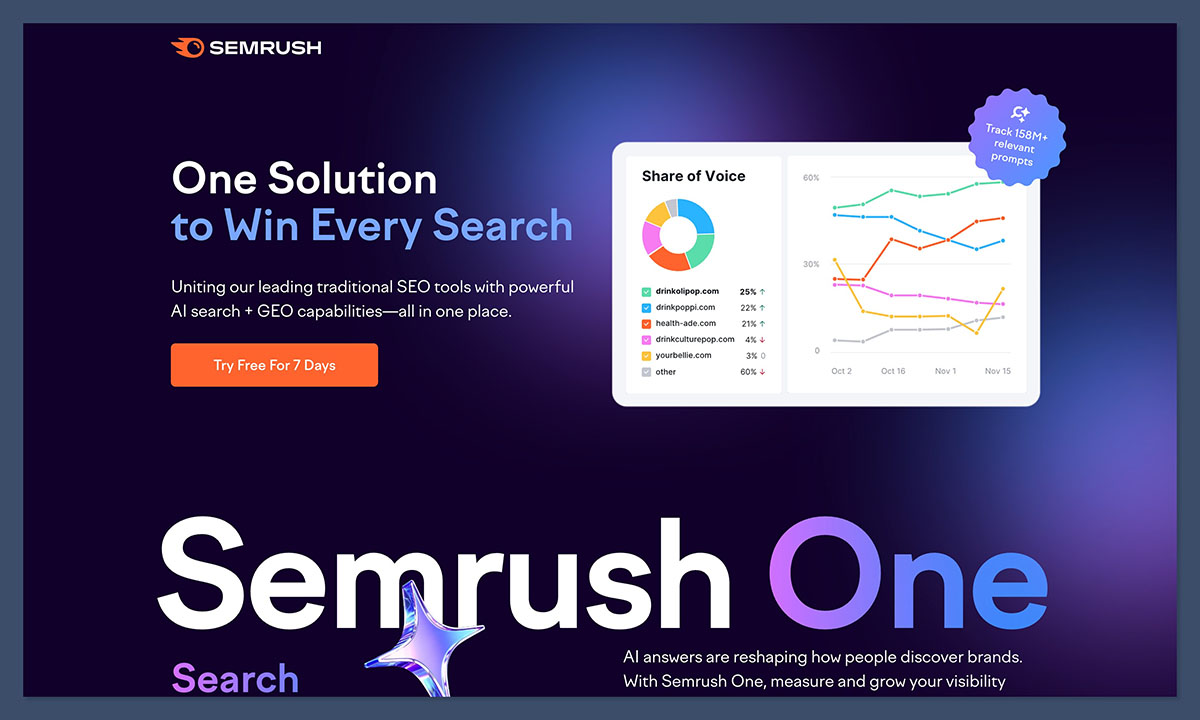
If you already run Semrush, adding AI visibility tracking takes about five minutes. No new login, no separate dashboard, no data export gymnastics. The keyword-based approach has a critical blind spot, though, so understand it before committing.
Semrush launched its AI Toolkit in September 2025, adding tracking for ChatGPT, Gemini, Perplexity, Google AI Overviews, and Microsoft Copilot. It lives inside the familiar Semrush interface, a genuine advantage for the 10M+ users already on the platform. Your AEO data sits alongside your organic rankings, backlink profiles, and competitor research.
The catch: Semrush monitors keyword visibility in AI results, not specific prompts. This is a fundamental distinction. LLM users ask conversational, multi-turn questions. A keyword like “best CRM software” tells you something. The prompt “I’m a 20-person SaaS startup looking for a CRM that integrates with Slack and costs under $50 per seat” tells you far more. Kevin Indig’s research shows classic SEO metrics have weak correlations with AI citations, and keyword-based tracking inherits that limitation.
Pricing is $99/month per domain on top of your existing Semrush subscription (starting at $165.17/month). That adds up fast for multi-domain operations.
Best for: Semrush power users who want directional AEO data without switching dashboards.
Skip if: You need prompt-level tracking or manage many domains.
2. Otterly AI: Best Budget-Friendly AEO Tracker for Small Teams
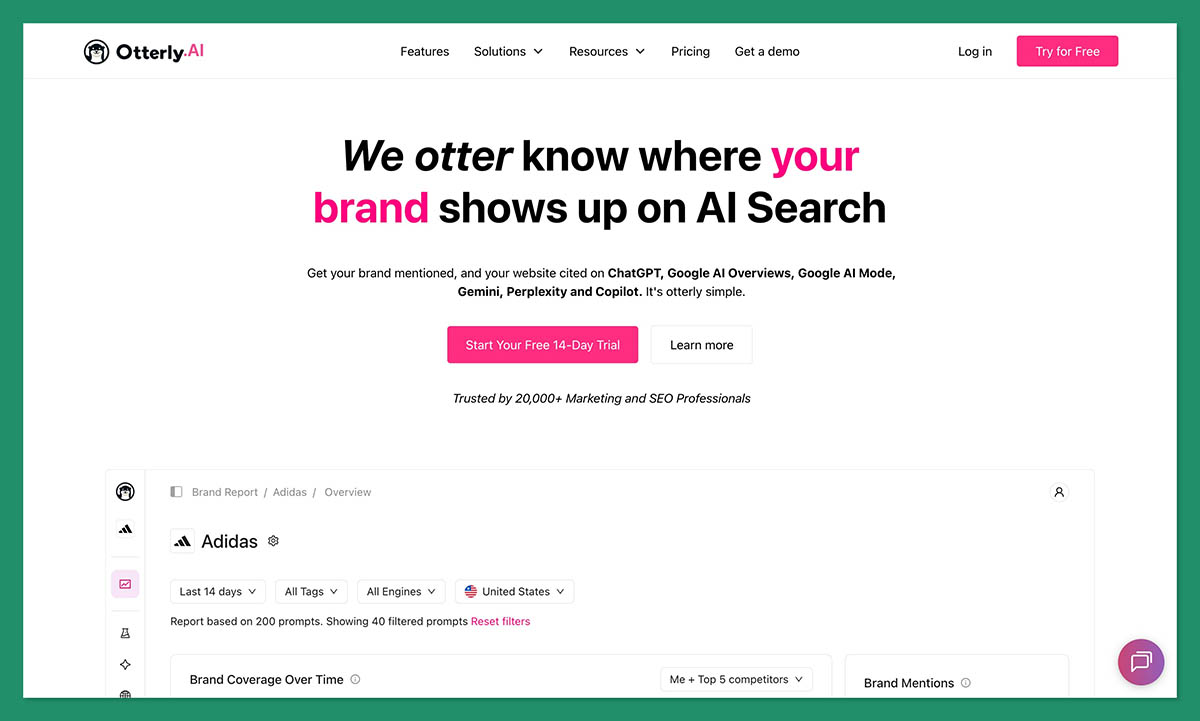
At $29/month, Otterly AI removes the budget objection for testing AEO tracking entirely. It earned Gartner Cool Vendor recognition in 2025 and holds a 4.9/5 rating across 250+ G2 reviews, the highest satisfaction score in the category.
Otterly uses a prompt-based monitoring approach. You define the questions your buyers actually ask, and Otterly checks whether your brand appears in responses from ChatGPT, Perplexity, Google AI Overviews, Gemini, and Microsoft Copilot. The GEO Audit feature stands out. Roman Kalkowski, Head of Marketing at Vaadin, noted it “helped us identify and fix issues we didn’t even know existed.”
The Lite plan ($29/mo) covers 10-15 prompts, enough for initial baseline testing. The Standard plan ($189/mo) scales to 100 prompts, and Pro ($989/mo) handles 1,000. You also get a Looker Studio connector and a hallucination detection feature unique to Otterly. G2 rates its support quality 9.7/10. The 14-day free trial requires no credit card.
Where it falls short: the dashboard gets cluttered once you scale past a few dozen prompts. There’s no API access for custom reporting pipelines, and the small support team raises scaling concerns. Sentiment accuracy gets mixed reviews from users needing granular brand perception data.
Best for: Solo SEOs and small teams entering AEO tracking for the first time.
Skip if: You need API access or manage 50+ brands.
3. Cairrot: Best AEO Tracker for Agencies on a Budget
Most competitor roundups ignore Cairrot entirely. That’s a mistake. At $39/month, it’s the only sub-$50 AEO tracker offering free API access on every plan, making it the clear pick for agencies that need custom reporting without enterprise pricing.
Cairrot tracks five LLMs: ChatGPT, Perplexity, Grok, Claude, and DeepSeek. The API-on-every-plan model means you can pipe data into white-label dashboards, client reports, or Looker without upgrading to a premium tier. Multi-Brand Management lets you run separate tracking for each client from one account.
The tool also includes an AI Readiness Score that benchmarks your content’s citation potential, a competitor heatmap for visualizing share of voice, and a WordPress plugin for crawl logging. The support team is responsive, which matters for agencies on client timelines.
The trade-off is engine breadth. Five LLMs is fewer than Profound’s 10+ or Peec AI’s eight. If you need Meta AI, DeepSeek, and Llama tracking in a single tool, you’ll outgrow Cairrot. It’s also a newer entrant with less independent review data than established competitors.
Verdict: If you’re an agency billing clients for AEO reporting, Cairrot’s API-on-every-plan model means you can build custom deliverables without enterprise pricing. The $39/mo starting cost makes it easy to justify per client.
4. Peec AI: Best AEO Tracker for Global and Multi-Language Campaigns
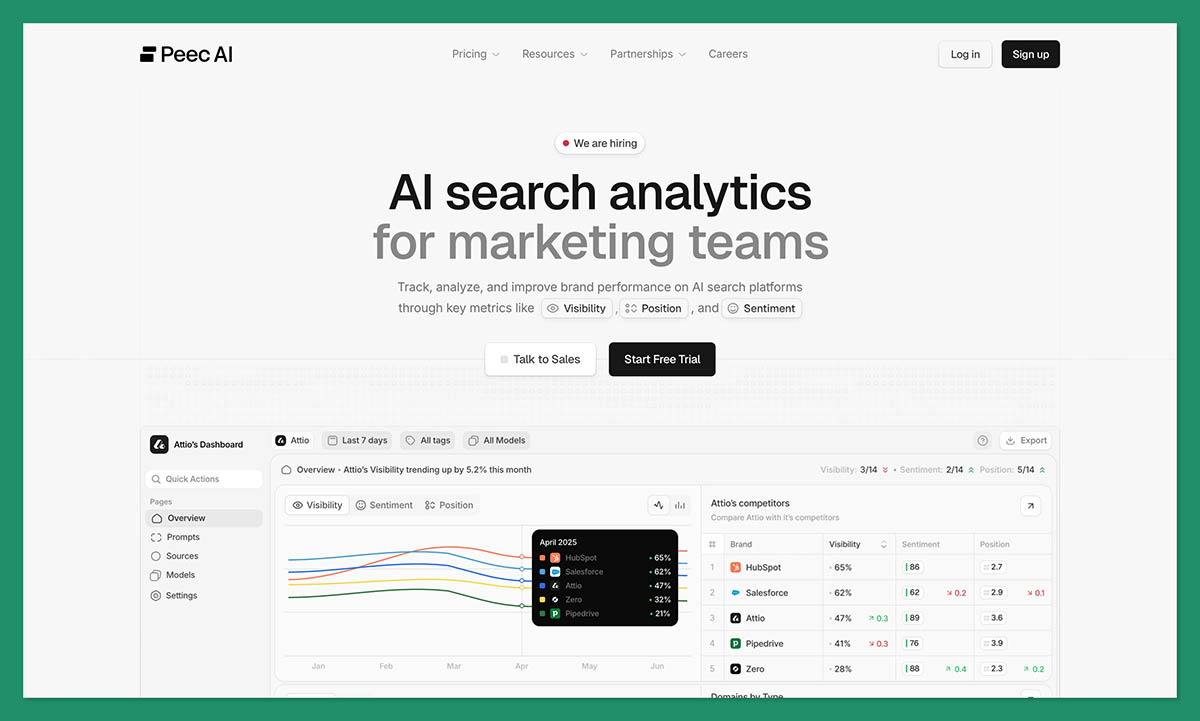
If your brand operates in 10+ markets, most AEO trackers are functionally blind outside English. Peec AI covers 115+ languages, the broadest support in the category by a wide margin.
Peec uses a UI scraping methodology, simulating real browser sessions rather than calling APIs. The argument: scraping captures what users actually see, including UI-specific features like source cards and follow-up suggestions. Crystal Carter, Head of SEO Communications at Wix, said Peec allows her team to “pinpoint the exact types of content that are surfaced in specific LLMs.” That kind of platform-specific content analysis is critical for multi-market strategies.
Pricing starts at EUR 89/month for the Starter plan (25 prompts, 3-country tracking). The Pro tier at EUR 199/month unlocks 100 prompts. The $21M Series A raised in November 2025, following a EUR 5.2M seed round, signals long-term viability. Peec hit EUR 650K ARR within four months of launch.
The limitations are real. No content optimization tools built in. Monitoring only. The pay-per-platform pricing model escalates quickly for teams tracking five or more engines. API access requires the EUR 499/month Enterprise tier, eliminating Peec for agencies needing programmatic data on a budget.
Quick comparison:
- vs Otterly: More languages, higher price, no API on lower tiers
- vs Profound: Fewer engines, better language coverage, lower entry price
5. SE Ranking: Best Unified SEO and AEO Platform
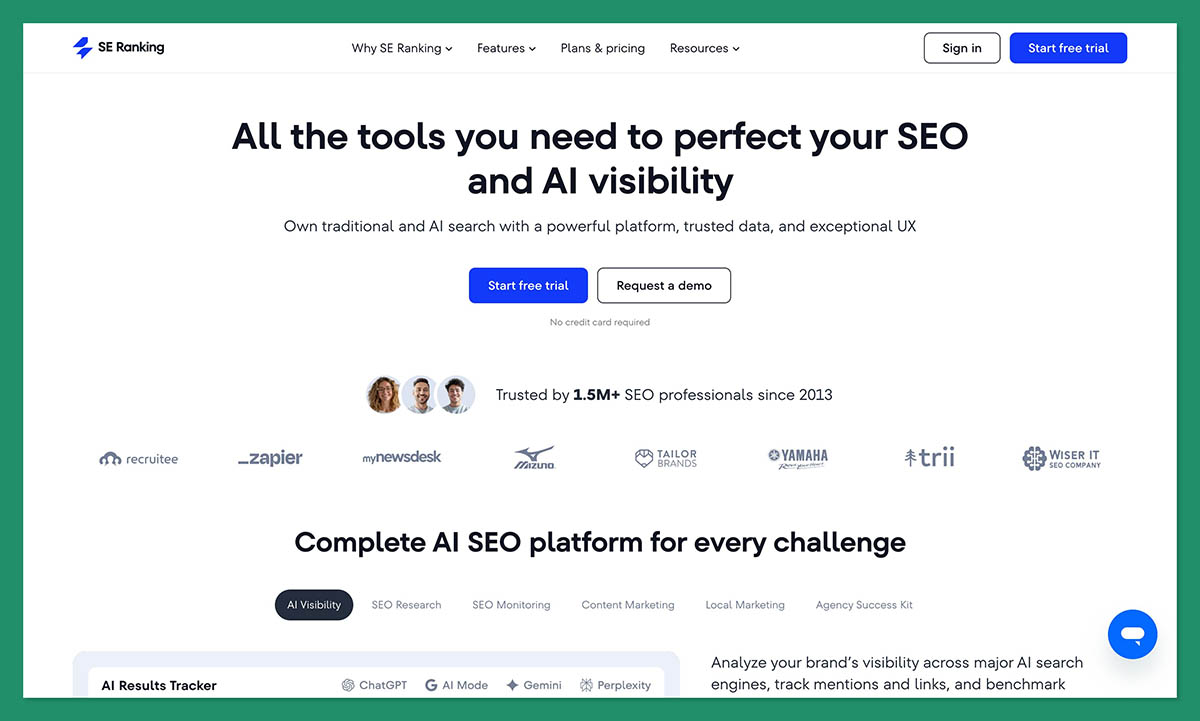
Running SEO in one tool and AEO in another means double the dashboards and half the context. SE Ranking merges both into a single interface, and the combined view genuinely helps you understand how traditional rankings interact with AI citations.
At $129/month, SE Ranking covers AI Overviews, AI Mode, ChatGPT, Gemini, and Perplexity. The platform tracks your brand mentions and links within AI responses, with position analysis showing whether you’re in the top-3 cited sources for a given prompt. Competitor visibility comparison lets you benchmark your AEO performance against direct rivals. The 14-day free trial gives you enough time to run a meaningful pilot.
When your traditional ranking for a keyword drops but your AI citation rate rises, that’s a signal worth catching. SE Ranking surfaces these correlations without requiring CSV exports from two tools and manual cross-referencing.
Limitations: the SE Visible add-on costs $89/month extra for brand-level analysis, pushing the all-in price closer to $218/month. The AEO module is newer and less mature than dedicated trackers like Profound or Peec. Engine coverage is narrower at five platforms versus Profound’s ten-plus.
Recommendation: The best pick for mid-size SEO teams that want to avoid tool sprawl but need more depth than Semrush’s AI add-on provides.
6. Scrunch AI: Best AEO Tracker for Content Strategy Integration
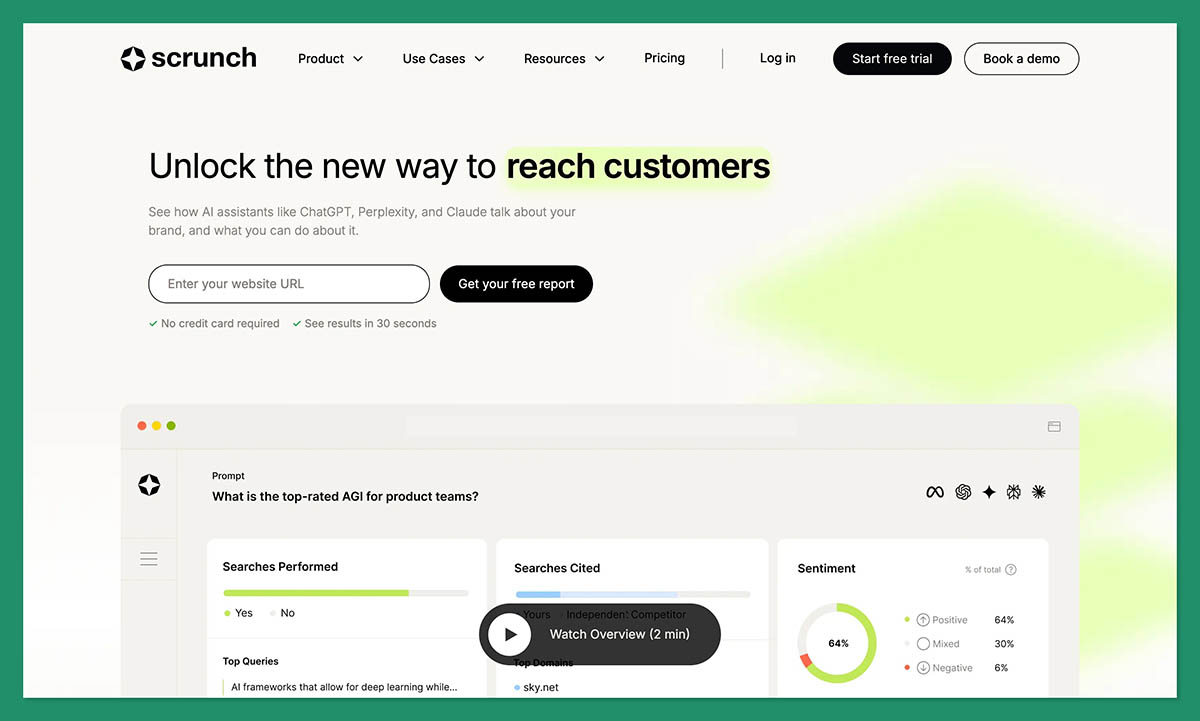
Most AEO trackers diagnose but don’t treat. They’ll tell you ChatGPT isn’t citing your brand for a target prompt, but they won’t tell you what to do about it. Scrunch AI’s Answer Experience Platform (AXP) closes that gap.
AXP is middleware that sits at the CDN edge through a Cloudflare integration. It detects AI crawlers visiting your site and serves pre-rendered, AI-optimized page versions. This bridges monitoring and execution in one platform, directly addressing the biggest complaint across the AEO tracker category. Scrunch also tracks seven-plus AI engines and includes GA4 integration for measuring actual AI referral traffic, not just citation counts.
The problem: AXP is still in limited pilot as of early 2026. The “Insights” and “Site Audits” features remain in beta. The credit-based pricing model depletes quickly when tracking across multiple engines, and misconfiguration produces misleading results.
Pricing starts at $250/month for the Core plan, which covers only four LLMs. The Agency Core plan at $500/month expands coverage. Enterprise pricing is custom.
Verdict: High-potential tool if AXP delivers on its promise. Worth a pilot if your team’s biggest pain is translating monitoring data into content actions. Wait for AXP to exit pilot before committing long-term budgets.
7. AthenaHQ: Best AEO Tracker for Revenue-Focused Teams
Rootly increased AI-driven leads 10x with $126K in incremental media value. Lago got 50% more demo bookings. Gruns went from 2.0% to 12.6% share of voice in 60 days. AthenaHQ publishes the kind of case studies that make CFOs approve tracking budgets.
Founded by AI experts from Google and DeepMind, AthenaHQ emerged from stealth in 2025 with a focus on connecting AI visibility to pipeline metrics. The self-serve plan at $295/month includes unlimited responses, team seats, languages, and regions. That’s a meaningful structural advantage over Profound, where multi-language and multi-region tracking requires expensive tier upgrades. The Action Center provides concrete optimization recommendations, not just dashboards.
The case studies are specific and attributable. AutoRFP.ai achieved 10x ChatGPT traffic growth in eight weeks, with 30% of demo bookings attributed to AI discovery. Verito reached 36% share of voice against competitors 25x their size. These are pipeline numbers, not vanity metrics.
The downside: $295/month with no free trial. You’re buying in blind at a premium price point. There’s no test-before-commit option, which is unusual for a tool at this level. Occasional software bugs surface in reviews, and the self-serve plan limits you to a single region and language.
Best for: B2B SaaS teams that need to tie AI visibility directly to pipeline and revenue.
Skip if: You need a free trial period or your budget is under $300/mo.
8. Profound: Most Comprehensive AEO Tracker for Enterprise Teams
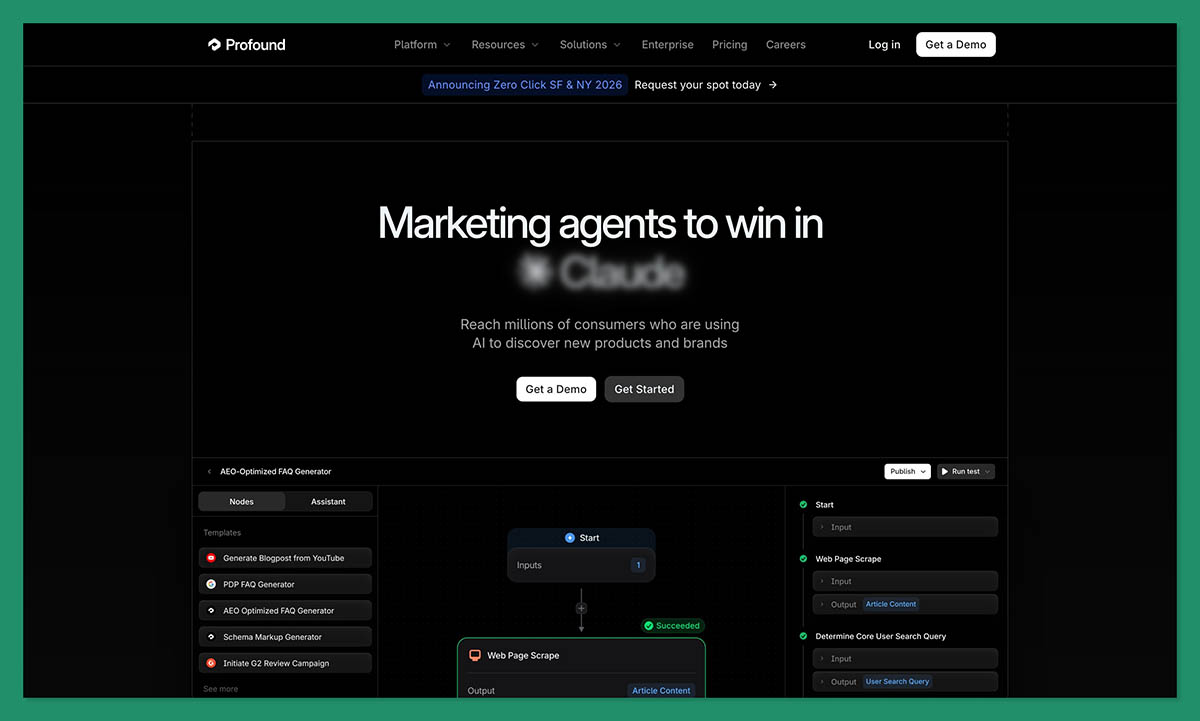
Profound tracks more AI engines than any competitor and holds SOC 2 Type II and HIPAA certifications. It’s the enterprise default for procurement teams that need compliance documentation. “Default” doesn’t always mean “best fit,” though.
With $58.5M raised from Khosla Ventures, Kleiner Perkins, and Sequoia, Profound has the deepest feature set in the category. It monitors 10+ AI engines including ChatGPT, Claude, Perplexity, Gemini, DeepSeek, Meta AI, and Microsoft Copilot. The G2 Winter 2026 Leader badge and an independent AEO score of 92/100 back up the positioning. Unique features include prompt volume data (showing which prompts users actually submit) and ChatGPT Shopping tracking.
The complexity problem is real. G2 reviewers describe the platform as having “become unstable, slow and tedious lately.” Independent ease-of-use testing scored it 3.2 out of 5. For a $499/month tool, onboarding friction is a tangible cost. The Starter plan is intentionally limited; multi-platform tracking requires the $399+/month tiers. Users also report difficulty transitioning from traditional keywords to prompt-based conversation tracking.
Profound fits teams that need SOC 2 compliance, maximum engine coverage, and analyst-grade data depth. It’s the wrong tool for teams under 10 people or without dedicated analytics resources.
Quick comparison:
- vs AthenaHQ: More engines, higher price, better compliance, worse onboarding
- vs Peec AI: More engines, fewer languages, API-based vs UI scraping
9. Qwairy: Best AEO Tool for AI Traffic Attribution
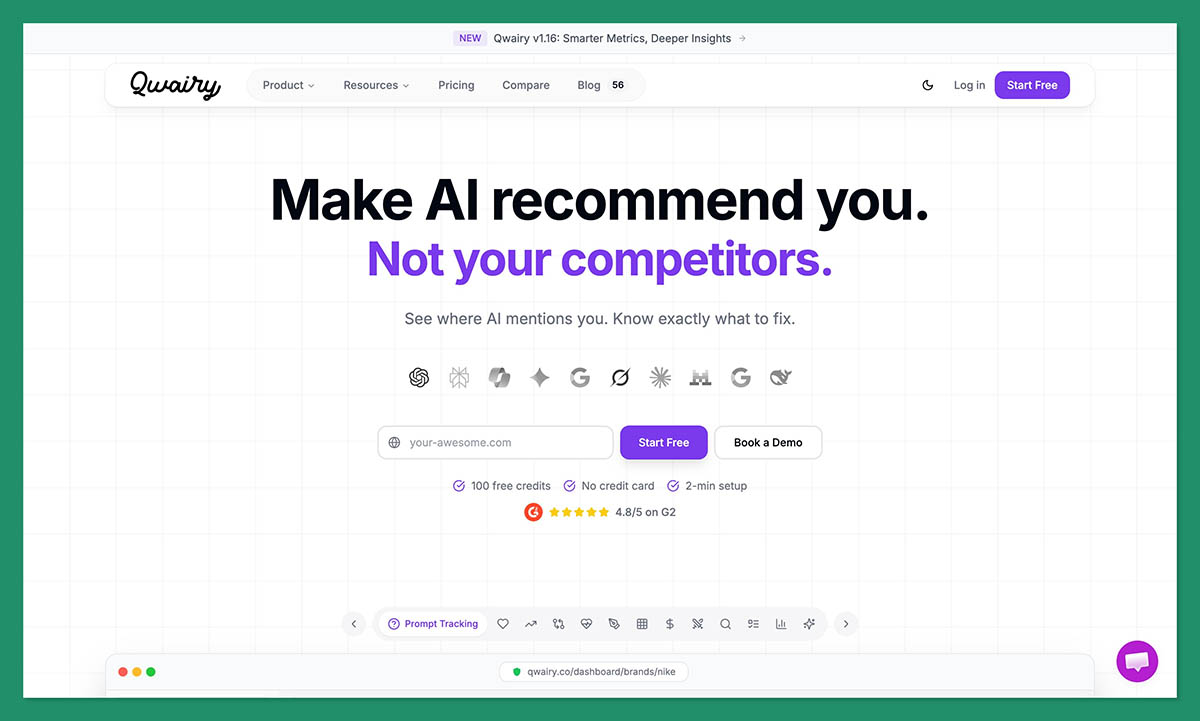
Tracking where you appear in AI answers is step one. Knowing which AI engines actually send traffic that converts is step two. Most tools stop at step one. Qwairy focuses on step two.
Qwairy uses a three-layer identification system: user agent analysis, referrer pattern recognition, and behavioral fingerprinting. This lets it identify traffic from 15+ AI crawlers, connecting AI visibility to actual site visits rather than just citation counts. That distinction matters because 93% of AI search sessions end without a click (per Superlines Q1 2026 data). For the 7% that do click through, you need to know which engines drive them.
The GA4 blind spot makes this especially important. Free ChatGPT users show up as “Direct” traffic in Google Analytics because of missing referrer data, creating systematic undercounting of AI-referred sessions. Qwairy’s crawler identification helps close that attribution gap. The tool integrates with both GA4 and Looker Studio, and offers a free trial with no credit card required.
The caveat: users report lag issues with the Looker Studio connector. Attribution accuracy also evolves as AI engines change their crawler infrastructure, so the 15+ crawler identification requires ongoing maintenance from Qwairy’s team.
Recommendation: If your executive team asks “How much traffic do we actually get from AI engines?” and you can’t answer, Qwairy fills that specific gap.
10. Ahrefs Brand Radar: Why the Biggest Name Has the Biggest Blind Spot
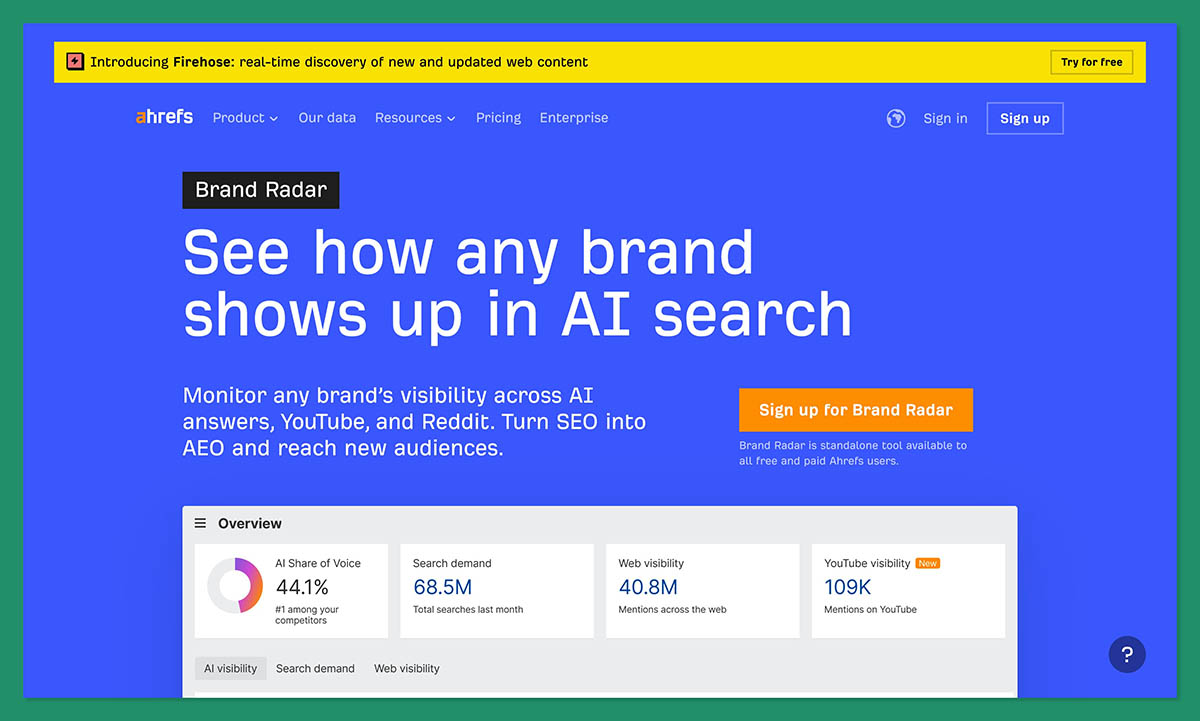
Independent testing found Ahrefs Brand Radar undercounts AI citations by 97%. For a tool starting at EUR 773/month, that’s an expensive blind spot.
Ahrefs built Brand Radar on top of a 253M+ monthly prompts dataset with industry segmentation and historical trend data. On paper, it sounds comprehensive. In practice, a 97% undercounting rate means if your brand gets cited 100 times across AI engines, Brand Radar might report three. That’s not a rounding error. That’s a fundamental measurement failure.
The problem traces to architecture. Brand Radar is an add-on to a platform built for backlink analysis and traditional rank tracking. AEO tracking requires fundamentally different data collection infrastructure. Yext’s study of 17.2 million citations found that 86% of AI citations come from brand-managed sources, making accurate citation tracking even more critical for brands investing in content optimization.
When Brand Radar still makes sense: if you already pay for Ahrefs at the enterprise tier and want rough directional data without adding another vendor. It can supplement your primary AEO tracker with industry-level benchmarks and trend lines. It cannot serve as your primary source of AI visibility data.
Verdict: Don’t cancel Ahrefs. Do add a dedicated AEO tracker alongside it. Brand Radar is a supplement, not a solution.
AEO Tracker FAQs: Workflows, Attribution, and Tool Selection
How do I set up a weekly AEO monitoring workflow?
Build 20-30 prompts from actual buyer language, not keywords. Pull long-tail queries (5+ words) from Search Console, Reddit, and Perplexity’s related questions. Keep a 75/25 unbranded-to-branded ratio. Run weekly: AI responses are non-deterministic, so consistent tracking with the same prompt set is the only way to establish reliable trends.
How do I track AI traffic in Google Analytics 4?
Create a custom channel group in GA4 Admin with this source regex: chatgpt\.com|openai\.com|perplexity\.ai|claude\.ai|copilot\.microsoft\.com|gemini\.google\.com. Use a minimum 90-day exploration window. Critical gap: free ChatGPT users show as “Direct” traffic due to missing referrer data. Qwairy or UTM parameters can partially close that gap.
API monitoring vs UI scraping: which is more accurate?
Neither is definitively better. API-based monitoring (Profound, Conductor) scales efficiently and detects whether responses are grounded in web search or hallucinated. UI scraping (Peec AI) captures what users actually see, including source cards. The trade-off: scraping often captures logged-out sessions running legacy models. Pick based on whether you prioritize scale (API) or visual accuracy (scraping).
What’s the best AEO tracker for my budget?
Under $50/month: Otterly AI ($29) or Cairrot ($39). Between $100 and $300/month: SE Ranking ($129), Scrunch AI ($250), or AthenaHQ ($295). Over $500/month with compliance needs: Profound ($499). Already paying for Semrush: start with the $99/domain AI Toolkit add-on, then supplement with a dedicated tracker once you outgrow keyword-based monitoring.
Do pages need to rank on Google to get cited by AI engines?
No. Pages at Google position 21 and beyond account for roughly 90% of ChatGPT citations. Content structure, entity clarity, and format matter more. Listicles make up 25.37% of AI citations; video content accounts for just 1.74%.
Dennis Yu of BlitzMetrics landed two $100,000 clients who found his agency through ChatGPT. Whatever tool you pick, the cost of not tracking is higher.

