

At Mostash, AI search is the whole job. We run an AEO and SEO agency, and we have been doing content marketing since 2007, so tracking how AI answer engines actually behave is not a side project for us. We watch ChatGPT, Gemini, Perplexity, and Google AI Mode for changes every week, because AI visibility shifts faster than any algorithm cycle traditional SEO ever dealt with. Most of those changes are minor. On May 7, 2026, one was not.
For three years, the running complaint about AI search was simple: the model answers the question, the user never clicks, and your referral traffic dries up. That day, ChatGPT changed the math. It started turning the brand names inside its answers into clickable links, usually pointing straight at the company homepage. Within a day, referral traffic to brand sites roughly doubled and held there.
This is the shift the industry has started calling the branded link update. It did not change which brands ChatGPT recommends. It changed where those recommendations send people. A mention that used to dead-end as bold text now routes a user to your front door. For SaaS brands, that converts AI visibility from a perception metric into a measurable traffic channel almost overnight.
Here is what actually changed, what the numbers say across multiple data panels, and the practical work that decides whether ChatGPT names and links you or your competitor.
Key takeaways
- On May 7, 2026, ChatGPT began placing clickable brand links inside the body of its answers instead of tucking sources into footnote-style citation chips.
- Similarweb measured total ChatGPT referrals up 157.7% week over week, with homepage referrals up 354.7%. The homepage share of clicks roughly doubled from about 30% to about 60%.
- The links favor brand homepages, so ChatGPT is now acting as a discovery layer. Entity strength and a clear homepage matter more than any single landing page.
- The lift landed unevenly. B2B software and SaaS gained the most; ecommerce stayed roughly flat.
- You cannot buy these links. They follow from being retrievable, a clear entity, and consistently described across the third-party sources models trust.
What changed on May 7
For most of its life, ChatGPT treated links as an afterthought. Source links sat below the answer in citation chips, or behind a sources toggle most people never opened. The brand might be named in the answer, but there was nowhere obvious to click through to the brand itself.
That flipped on May 7. ChatGPT started rendering brand names as inline hyperlinks, placed next to the relevant claim, pointing to the brand root domain. Similarweb described it plainly: brand names became clickable callouts placed front and center in responses rather than buried in footnotes. The change was abrupt enough to look like a switch being flipped, not a gradual rollout.
The crucial detail is where those links point. These are brand links, not traditional citations. ChatGPT names a company and hyperlinks that name to its homepage, rather than to the specific page a fact came from. The model started behaving less like a footnoted research tool and more like a recommendation engine that hands users off to brands.
The numbers
The headline figures come from Similarweb, which tracked ChatGPT referral traffic across a clickstream panel and compared the week before May 7 to the week after.
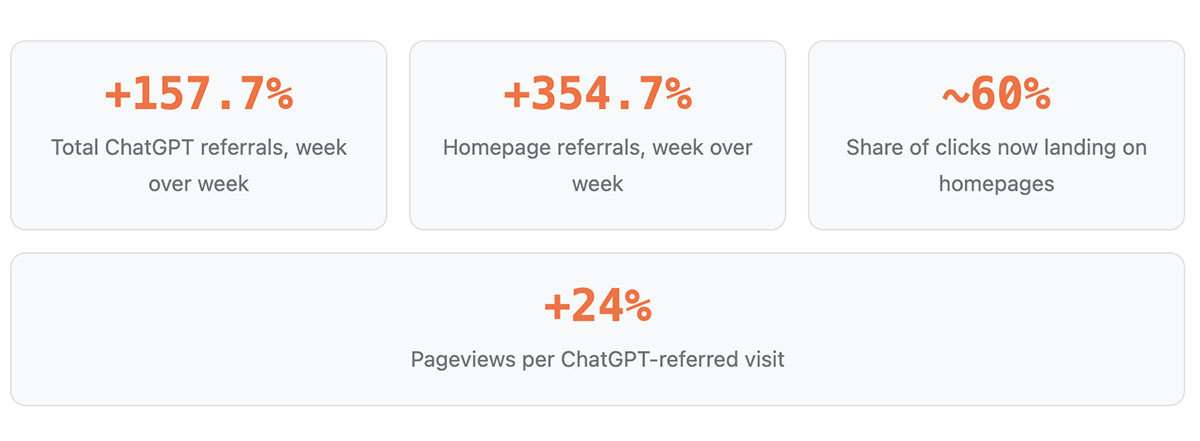
Source: Similarweb clickstream data, April 30 to May 20, 2026.
Two things stand out. First, the gap between the 157.7% total lift and the 354.7% homepage lift is the real story: homepage traffic grew roughly twice as fast as referrals overall, because the new links point at root domains. Second, the engagement held up. Pageviews per visit rose 24% and average time on site rose 11%, so this was not a wave of low-quality bounce traffic.
A second firm, Profound, measured the same event against its own panel of monitored brands and reported a roughly 60% to 65% overnight lift, with the share of ChatGPT responses containing a URL climbing from about 4.5% to 20% to 24%.
The absolute numbers differ from Similarweb’s because the two firms watch different sites against different baselines, a useful reminder to treat any single vendor stat as directional rather than gospel. What matters is that two independent panels caught the same sharp, durable jump on the same day.
It helped some categories far more than others
The branded link update showed up across most industries, but not evenly. Profound’s breakdown maps the pattern cleanly: categories where ChatGPT recommends companies gained, and categories where it recommends products did not.
| Industry | Change in ChatGPT referrals | Read |
|---|---|---|
| B2B software and SaaS | +200% (daily, vs pre-May 7) | Largest gainer |
| Financial services and fintech | ~+60% | Solid lift |
| Ecommerce and retail | ~Flat | Routes through shopping surface |
Source: Profound, brand-panel referral data, May 2026.
The likely reason ecommerce stayed flat: retail recommendations flow through ChatGPT’s product and shopping surface, not the branded recommendation flow that got the hyperlink treatment.
People ask ChatGPT to explain and compare far more than they ask it to buy. If your business is informational or consideration-heavy, this is a real new channel worth instrumenting today. If you sell physical products, the upside exists but is muted for now.
Why OpenAI likely shipped this
OpenAI has not published a detailed rationale, but a few threads are worth flagging.
The simplest read is product experience: actionable recommendations are more useful than dead-end ones. There is also a relationship angle. The loudest complaint from publishers and commercial brands since launch has been that AI answers cannibalize their traffic.
For the first time, a meaningful share of ChatGPT answers now end in clickable links to the brands being recommended. That does not replace Google-scale referral volume, but it reframes AI from a pure traffic sink into a growing traffic source, which matters for OpenAI’s standing with publishers, brands, and regulators.
There is a competitive dimension too. ChatGPT is still the largest AI answer engine, but its share of measurable brand referrals has been slipping as Gemini and Claude grow. Sending more traffic to brands is one way to make ChatGPT more valuable to the businesses whose content feeds it, right as the field gets more crowded.
What this means for SaaS brands
The conceptual shift is the part to internalize. For most of the AI era, being mentioned by ChatGPT was a vanity signal. You could see your brand in an answer, but you could not connect it to anything that showed up in your analytics. Post May 7, a named-and-linked mention converts into measurable referral sessions. This is the clearest version yet of an idea AEO practitioners have argued for two years: citations beat mentions. A mention is awareness. A citation that links is traffic.
That changes a few priorities in practice:
AI visibility is now a traffic line item, not a perception score
The “is anyone actually clicking?” objection just got much weaker. Share of voice in AI answers now maps to a quantifiable referral coefficient. The brands that treat this as infrastructure will compound the advantage as OpenAI inevitably moves the number again.
Your homepage is a landing page again
With roughly one in four ChatGPT referral clicks now hitting the root domain, your homepage has to work for cold, AI-driven traffic: visitors who arrived because ChatGPT recommended you and may know nothing else about your brand. A homepage written for people who already know who you are will leak most of this traffic.
Referral attribution is table stakes
Any brand not tracking chatgpt.com and openai.com as named referral channels right now is flying blind. You need a system of record for whether you were mentioned, whether it landed, and whether it converted.
How ChatGPT decides which brands to link
The most argued-about question here is how much your Google ranking carries over, and the honest answer is some, but less than most people assume. Plenty of SEOs report a real correlation, and in the largest published analysis to date (OppAlerts, 105,000+ prompts), search engine visibility was the single strongest external signal predicting LLM recommendations.
The catch: that strongest external signal still explained only about 6% of the outcome, because most of what drives a recommendation lives inside the model. Pulling the other way, controlled studies find page-level overlap is loose. Semrush found roughly 90% of ChatGPT citations come from pages ranking position 21 or lower on Google, Ahrefs found only about 12% of cited URLs rank in Google’s top 10, and Search Atlas measured ChatGPT-to-Google domain overlap around 10% to 15%. The reconciliation that fits the data: broad search presence helps you enter the retrieval pool, but your specific Google position does not decide who gets cited. Three inputs drive the rest.
1. Retrievability
If your pages are not crawlable and indexable, you cannot be retrieved at answer time. Make sure you are not blocking OpenAI’s crawlers (OAI-SearchBot and GPTBot) in robots.txt, and confirm you are indexed in Bing as well as Google, since Bing has been ChatGPT’s primary documented retrieval source and verifying it costs ten minutes in Bing Webmaster Tools. Clean status codes, no accidental noindex, and a valid sitemap are the price of entry.
2. Entity consistency
Models name a brand with confidence when every source agrees on what it is. When Wikipedia, G2, Crunchbase, your review platforms, and the trade press all describe your company the same way, the model has a low-uncertainty entity to surface. When those descriptions conflict, different categories, different value propositions, an outdated name, the model hedges and is less likely to name you. This is the single most fixable reason a model will skip you.
3. Machine-readable clarity
Structured data and clean on-page semantics help models parse what you do without guessing. Organization schema, clear Article and FAQ markup, and an unambiguous homepage all reduce the model’s uncertainty. It is the same discipline that wins rich results, pointed at the entity layer.
Quick diagnostic
Ask ChatGPT directly: “What does [your brand] do, and who is it for?” The answer shows you exactly how the model understands your entity right now. If it is vague, wrong, or conflates you with a competitor, that is your entity-consistency to-do list, straight from the source.
How to earn the link: a four-step sequence
You cannot buy an inline link, and there is no schema hack that forces one. Vendors promising guaranteed AI citations are selling the snake oil of 2026. What you can do is make yourself the obvious brand for ChatGPT to name. Work these in order, because the later steps do nothing if the earlier ones are broken.
- Make yourself retrievable. Allow OpenAI’s crawlers (OAI-SearchBot, GPTBot) in robots.txt, confirm you are indexed in Bing as well as Google, check for accidental noindex tags and blocked paths, and validate your sitemap. None of the entity work matters if you cannot be fetched.
- Tighten your brand entity. Make your homepage state plainly who you are, what you do, and who you serve, with no clever-but-vague tagline a model cannot resolve into a category. Then align your third-party profiles so they tell the same story.
- Add structured data and clear content. Implement Organization schema sitewide, mark up your articles and FAQs, and keep your most important pages clearly written. Clarity for readers and clarity for models are increasingly the same thing.
- Measure, then iterate. Track how often you surface in AI answers, watch referral traffic by source, and re-check your brand description every quarter as your category and competitors shift. AI systems change weekly; a static strategy goes stale fast.
Don’t chase the link past the fundamentals
There is no magic phrase that forces ChatGPT to link you. Inline links are a downstream effect of being retrievable, being a clear entity, and being genuinely useful. Invest there, not in shortcuts.
How to track ChatGPT referral traffic
Measurement used to be the headache. ChatGPT, Gemini, and Claude visits all dumped into the generic referral bucket, and separating them meant hand-built regex channel groups most teams never set up. That changed on May 13, 2026, when Google added a native AI Assistant channel to GA4’s Default Channel Group.
Now, when GA4 recognizes an AI referrer such as ChatGPT, Gemini, or Claude, it automatically assigns the medium ai-assistant and groups the session under the AI Assistant channel, with no configuration required. If you want to see whether the May 7 jump reached your site, that channel is the first place to look. A spike in homepage sessions inside it is the fingerprint of exactly the inline-link behavior described here.
One caveat
GA4 still undercounts AI traffic. Only an estimated 60% to 80% of AI-originated visits carry a clean referrer header. Clicks from AI mobile apps and some in-app browsers arrive with no referrer and still land in Direct, so treat the AI Assistant number as a floor, not the full picture, and watch for correlated lifts in Direct.
What to expect next
Read the May 7 change as a direction, not a one-off. OpenAI has strong incentives to keep linking out: it makes ChatGPT more useful to businesses, strengthens its case with publishers, and differentiates it as competitors close the gap. Expect the share of linked answers to keep climbing from its initial low single digits, and expect rivals to copy the pattern.
Three things worth watching over the next few months: whether the linked-answer share keeps rising or settles, whether ecommerce ever gets a comparable lift as shopping features mature, and whether other engines adopt inline brand links wholesale. None of those outcomes changes the underlying work. The brands that win this channel will not be the ones with the cleverest hack. They will be the ones ChatGPT can confidently retrieve, understand, and name.
Frequently asked questions
What exactly changed with ChatGPT links in May 2026?
On May 7, 2026, ChatGPT began placing clickable brand links inside the body of its answers, usually pointing to the brand’s homepage, instead of relegating sources to footnote-style citation chips. The model still recommends the same brands; it now sends users directly to them.
How much did ChatGPT referral traffic actually increase?
Similarweb measured total ChatGPT referrals up 157.7% week over week, with homepage referrals up 354.7%, and the homepage share of clicks roughly doubling to about 60%. Profound, measuring a different panel, reported a 60% to 65% overnight lift. The exact figures vary by data source, but two independent panels caught the same sharp jump on the same day.
Why is ChatGPT sending traffic to homepages instead of specific pages?
The new links attach to brand names, and a brand name resolves to its root domain. So the model behaves like a recommendation engine pointing users at a company’s front door, rather than a research tool citing the exact page a fact came from. That is why homepage traffic grew faster than referrals overall.
Does my Google ranking decide whether ChatGPT links me?
It helps, but it does not transfer cleanly. Search visibility is the strongest external signal SEOs have found for AI citations, so it correlates and is worth having. Yet multiple studies show most ChatGPT citations come from pages outside Google’s top 10 (Semrush put it near 90% from position 21 or lower), and rank-to-citation overlap is loose. Treat strong search presence as helpful context, not a guarantee, and make sure you are crawlable by OpenAI’s bots and indexed in both Bing and Google.
How do I get ChatGPT to link to my brand?
There is no guaranteed method, but the inputs are clear: be retrievable (crawlable by OpenAI’s bots, indexed in Bing, no blocked paths), be a consistent entity (your homepage and third-party profiles describe you the same way), and be machine-readable (Organization and FAQ schema, clear content). Links follow from being the obvious, low-uncertainty brand for the model to name.
How do I track ChatGPT referral traffic in Google Analytics?
As of May 13, 2026, GA4 has a native AI Assistant channel in its Default Channel Group that automatically separates ChatGPT, Gemini, and Claude referrals, no setup required. Watch for homepage spikes in that channel, and remember it undercounts visits from AI apps that arrive without a referrer.
Does this mean zero-click search is over?
Not quite. Inside Google’s AI Overviews, the zero-click dynamic largely holds. What ChatGPT’s move shows is that an answer engine can deliberately choose to send traffic out. The lesson is not that zero-click is dead; it is that being named and linked inside the answer is now the prize.

