

Based on our 240+ hours of testing and analyzing the AI marketing stack used by automotive brands, HubSpot is the best all-around AI marketing platform for dealerships and OEMs because it ties lead capture, predictive scoring, and lifecycle automation into one system that the sales floor will actually use.
For visual inventory work, Spyne is the strongest vertical pick, and for attribution across multi-location dealer groups, Improvado is the cleanest answer.
In this guide, I’ll walk through the AI marketing tools automotive brands are using in 2026, where each one fits in the stack, and the trade-offs to consider before adding another platform to your tech bill.
Our Top 7 AI Marketing Tools for Automotive
- HubSpot – Best AI CRM and lifecycle automation for dealers
- Spyne – Best AI visuals for vehicle listings and VDPs
- Improvado – Best multi-channel attribution for dealer groups
- Jasper – Best AI copy for vehicle listings and ad creative
- Drift – Best conversational AI for lead qualification
- Surfer SEO – Best for organic visibility on model and service pages
- ChatGPT (Enterprise) – Best AI assistant for strategy and workflow design
AI Marketing Tools for Automotive Comparison Table
Take a look at our top picks side-by-side to see which fits your stack:
| Tool | Best For | Starting Price | AI Features | Automotive Fit |
|---|---|---|---|---|
| HubSpot | CRM and lifecycle | From $20/mo | Predictive scoring, AI email, conversation intelligence | Strong |
| Spyne | Vehicle photos and VDP | Custom quote | AI background removal, 360 spins, virtual showrooms | Built for it |
| Improvado | Attribution and analytics | Custom quote | AI attribution, marketing data aggregation | Strong for groups |
| Jasper | Listings and ad copy | From $39/mo | Templates, brand voice, multi-variant generation | Strong |
| Drift | Lead qualification | Custom quote | Conversational AI, intent routing, test-drive booking | Strong |
| Surfer SEO | Search content | From $89/mo | Content scoring, keyword research, AI outlines | Useful |
| ChatGPT Enterprise | Strategy and workflows | Custom quote | Assistants, custom GPTs, data analysis | Useful |
How AI Is Used in Automotive Marketing
Before getting into specific tools, it helps to map the actual jobs AI is doing in dealer and OEM marketing in 2026. Most stacks are built around six recurring use-cases:
- Lead capture and qualification through chatbots and conversational AI on dealer sites and classifieds.
- Predictive scoring that flags who is likely to buy, when, and which model or service.
- Multi-channel attribution tying ad spend back to test drives and signed contracts.
- Automated content for vehicle descriptions, ads, emails, and service reminders.
- Visual AI for background removal, retouching, and visual uniformity across inventory photos.
- SEO and AI search visibility for model pages, used-car listings, and after-sales content.
The strongest stacks combine vertical tools built specifically for dealers and OEMs with horizontal AI platforms that cover content, CRM, and analytics. The list below is structured around that split.
1. HubSpot: Best AI CRM and Lifecycle Automation
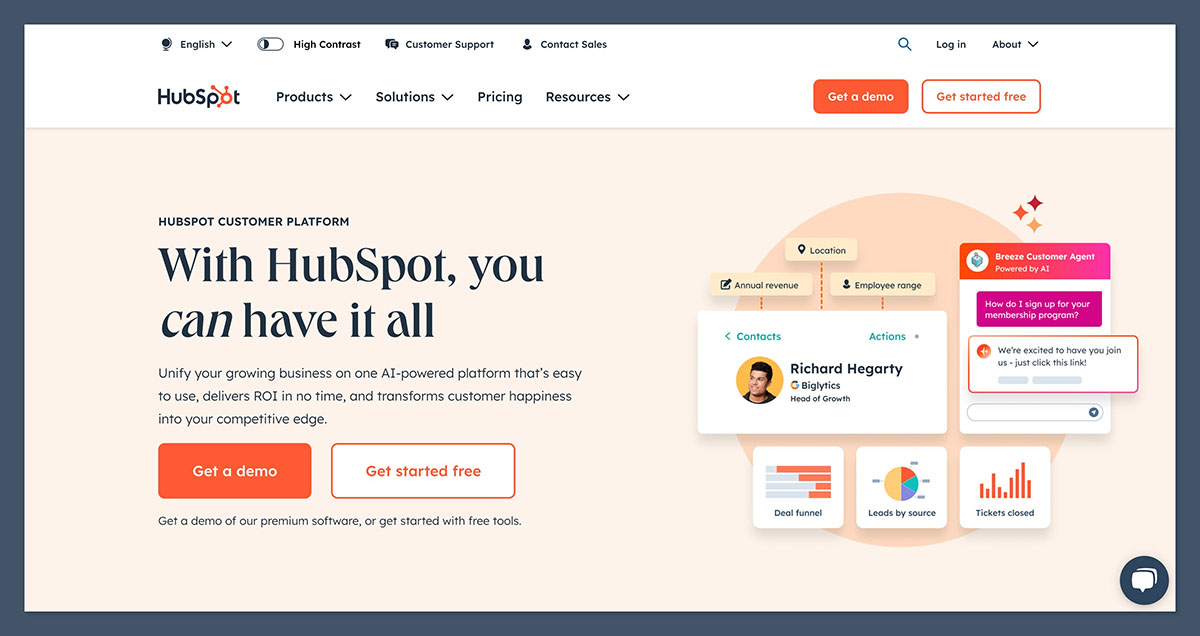
- Starting price: Free, paid plans from $20 per month
- AI features: Predictive lead scoring, AI email assistant, conversation intelligence, content suggestions
- Best for: Dealer groups and OEMs that need a central hub for leads, sales sequences, and after-sales marketing
HubSpot is our top pick because it does the unglamorous work that most AI tools skip: it pulls leads from every channel into one place, scores them, and triggers the right follow-up automatically.
For a dealership, that translates into fewer dropped leads from portal listings, fewer “I’ll call them tomorrow” missed opportunities, and a clearer view of which campaigns actually drive contracts.
Pros
- Centralizes leads from website, chat, classifieds, and forms
- Predictive scoring and next-best-action recommendations
- AI email and content suggestions built into the editor
- Strong native integrations with Drift, ad platforms, and call tracking
Cons
- Costs scale quickly as contacts and seats grow
- Not automotive-specific, so DMS and inventory feeds need integration work
- Reporting depth on attribution is good, but not at Improvado’s level
2026 update: HubSpot’s AI assistant now drafts full email sequences from a single brief and surfaces conversation summaries from sales calls, which is useful for managers reviewing rep activity across multiple rooftops.
How HubSpot Fits Into an Automotive Stack
HubSpot sits in the middle of the stack.
Spyne and the dealer’s site feed inventory and visuals into it. Drift or a similar conversational AI captures and qualifies leads, then hands them to HubSpot for routing.
Improvado pulls reporting from ad platforms back into the same pipeline. The CRM is what turns all of this into a sales process instead of a stack of disconnected tools.
HubSpot is suitable for:
- Dealer groups managing multiple rooftops
- OEM marketing teams running national campaigns
- After-sales teams running service reminder programs
HubSpot is not suitable for:
- Single-location dealers with very tight budgets
- Teams that need DMS-native CRM features out of the box
- Stores running purely on classifieds and walk-ins
2. Spyne: Best AI Visuals for Vehicle Listings
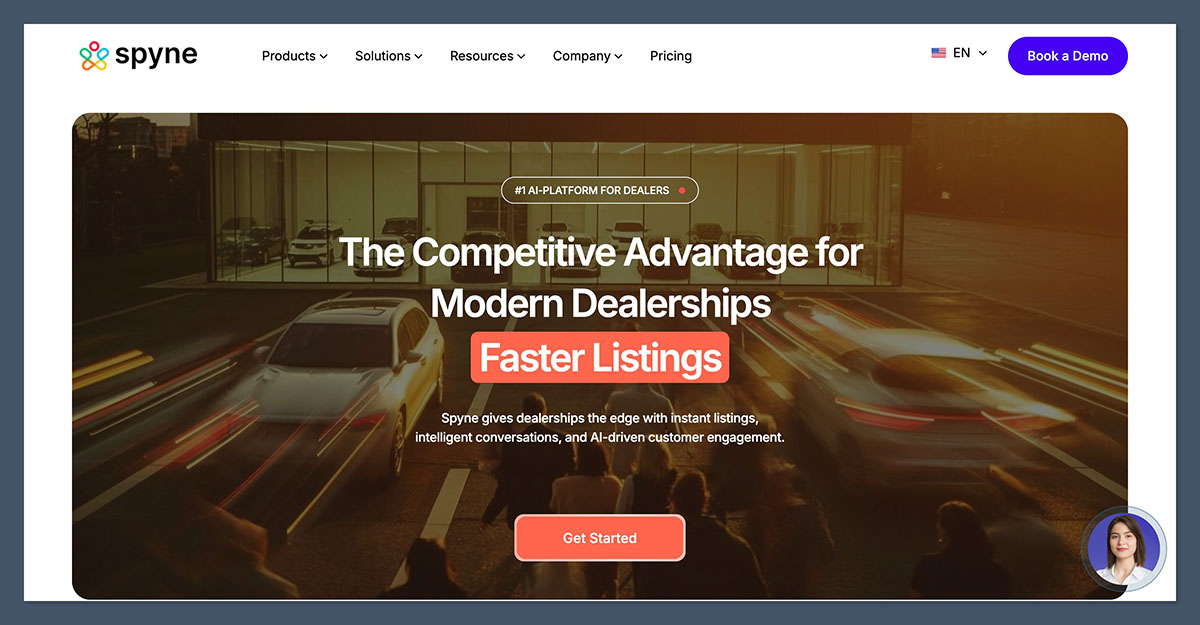
- Starting price: Custom pricing based on volume
- AI features: Background removal, virtual showrooms, 360 spins, automated retouching
- Best for: Used-car dealers, marketplaces, and groups managing high inventory turnover
Spyne is the cleanest example of a vertical AI tool that earns its place. Inventory photos are one of the highest-impact assets in automotive ecommerce, and Spyne automates the parts that used to eat hours of in-house photography time.
Background replacement, lighting normalization, and 360-degree spin generation happen in minutes instead of days, with output that looks consistent across the lot.
Pros
- Purpose-built for car dealerships and marketplaces
- AI background removal and virtual showrooms drive higher CTR on listings
- 360 spins and uniform visuals improve trust on used-car VDPs
- Pushes enhanced media directly into dealer websites and classifieds
Cons
- Pricing is quote-based, less transparent than horizontal tools
- Heavy ROI for dealers with low monthly inventory turnover is harder to justify
- Requires reasonable input photo quality to perform well
Where Spyne Fits
Spyne sits at the top of the funnel, before HubSpot and before any ad platform. The visual output is what determines whether a listing gets clicked at all.
For dealer groups running 200 plus VDPs at any time, Spyne replaces a meaningful chunk of in-house photography work, and the visual uniformity makes brand presentation across rooftops look intentional instead of accidental.
Spyne is suitable for:
- Used-car dealers with high inventory turnover
- Marketplaces and aggregators
- Multi-rooftop groups standardizing visual identity
Spyne is not suitable for:
- Independents with very small monthly volume
- OEMs with existing studio photography pipelines
- Teams that need print-grade output
3. Improvado: Best Attribution for Dealer Groups
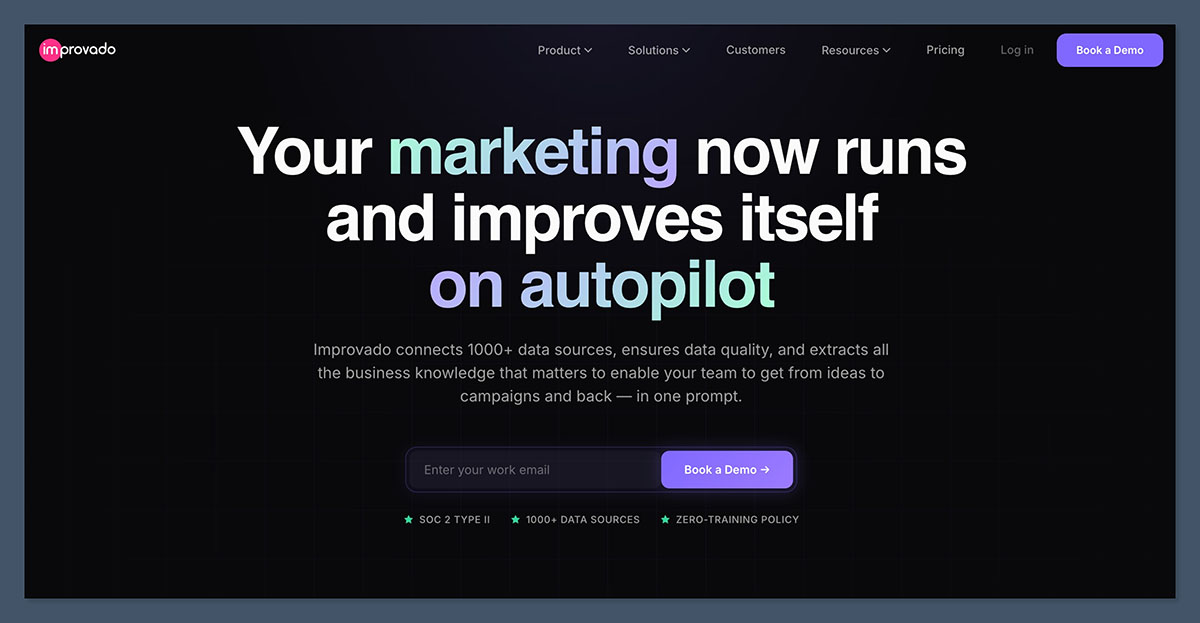
- Starting price: Custom pricing
- AI features: Marketing data aggregation, AI-assisted attribution modeling, executive dashboards
- Best for: Multi-location dealer groups and OEMs with complex media spend
Improvado answers a question most dealer groups can’t answer cleanly: which channels actually produce test drives and contracts, not just leads.
It pulls data from Google Ads, Meta, programmatic, classifieds, and offline sales into one model, then uses AI-driven attribution to show ROAS by model line, region, and campaign.
Pros
- Connects online ad spend to offline outcomes like test drives and signed contracts
- Strong fit for multi-location groups managing shared media budgets
- Executive dashboards make budget reallocation conversations cleaner
- Handles classifieds and dealer-specific data sources most BI tools don’t
Cons
- Implementation requires real data engineering effort
- Pricing puts it out of reach for small dealers
- Value depends on having clean upstream lead and sales data
Where Improvado Fits
Improvado is the analytics layer behind everything else. It only earns its keep when there’s enough media spend and enough lead volume to make attribution decisions actually move budget.
For groups in that bracket, it replaces the spreadsheet-and-screenshot reporting that most marketing managers default to.
4. Jasper: Best AI Copy for Listings and Ads
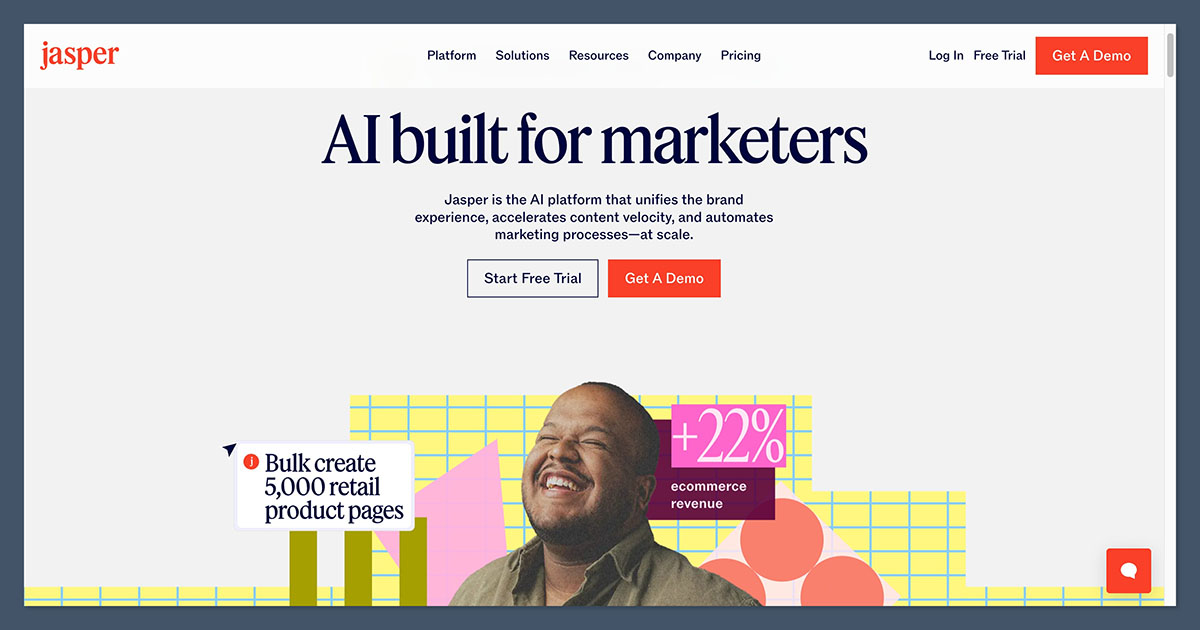
- Starting price: From $39 per month
- AI features: Templates, brand voice training, multi-variant generation, SEO mode
- Best for: Dealers producing high volumes of vehicle descriptions, landing pages, and ad creative
Jasper is a practical pick for the writing work that comes with running a dealership at scale: vehicle descriptions for new and used inventory, ad variants for Meta and Google Search, and landing page copy for financing offers, trade-in promos, and seasonal campaigns.
Brand voice training keeps the output consistent enough that a small team can maintain dozens of campaigns without sounding generic.
Pros
- Templates designed for marketing copy, not generic writing
- Brand voice training keeps tone consistent across teams
- Multi-variant generation speeds up A/B testing on ads
- Reasonable price for the volume of output
Cons
- Output still needs human editing, especially on technical specs
- Less useful for long-form editorial content than for short-form ads
- Not a replacement for proper SEO or AEO strategy
Where Jasper Fits
Jasper sits next to your CRM and CMS as a content production layer. For VDPs, you can pipe spec data into a Jasper template to generate first-draft descriptions, then have a human editor polish them.
For paid media, it’s the volume engine behind multi-variant testing.
5. Drift: Best Conversational AI for Lead Qualification
- Starting price: Custom pricing
- AI features: Conversational AI, intent routing, meeting booking, CRM handoff
- Best for: Dealer websites and OEM landing pages that need 24/7 qualification
Drift is the example we keep coming back to for conversational AI on dealer sites, but the category is broader than one tool.
The job is the same regardless of vendor: greet the visitor, ask qualifying questions about budget, model, and location, answer common questions about availability and finance, and book a test-drive appointment or hand off a warm lead to a sales rep.
Pros
- 24/7 response on dealer sites, including outside business hours
- Qualifies visitors before a human rep gets involved
- Books test drives directly into the calendar
- Hands off warm leads to CRM with full conversation context
Cons
- Pricing is enterprise-tier and not always justified for low-traffic sites
- Bot tone needs careful tuning to avoid sounding generic
- Works best when integrated tightly with the CRM, which adds setup time
Where Drift Fits
Drift sits at the top of the lead funnel, alongside the website. The conversation it captures is the data HubSpot then uses to score and route the lead.
Dealer sites that don’t have any conversational layer typically convert at much lower rates, especially during nights and weekends when people are actually researching cars.
6. Surfer SEO: Best for Model and Service Page Content
- Starting price: From $89 per month
- AI features: Content scoring, AI outlines, keyword research, NLP optimization
- Best for: Dealers and OEMs serious about organic traffic to model, comparison, and service pages
Surfer SEO covers the search content layer. It’s not automotive-specific, but the work it does maps directly to dealer needs: optimizing local service pages for terms like “MOT near me” or “BMW service [city]”, growing organic traffic to comparison pages, and keeping model pages aligned with what people actually search for.
Pros
- Strong content scoring against actual ranking pages
- AI outlines speed up briefing and drafting
- Useful for local service and parts content
- Pairs cleanly with Jasper for drafting
Cons
- SEO scoring is one input, not a strategy
- Doesn’t address AI search visibility directly
- Best results require an editor who understands SEO principles
Where Surfer SEO Fits
Surfer is the optimization layer for content that already exists or is being produced. It’s useful when paired with a real SEO strategy, less useful as a substitute for one.
Dealers seeing the strongest organic results pair Surfer with deliberate work on entity clarity, local schema, and AI search visibility, which we’ll come back to below.
7. ChatGPT Enterprise: Best AI Assistant for Strategy
- Starting price: Custom pricing
- AI features: Custom GPTs, code interpreter, data analysis, document understanding
- Best for: Marketing leaders building workflows, briefs, and internal tools
ChatGPT Enterprise (or any equivalent class of model: Claude, Gemini) sits across the stack rather than inside a specific channel.
Marketing teams use it for campaign ideation, writing briefs, summarizing research, building custom assistants for internal workflows, and analyzing performance data without waiting on a BI request.
Pros
- Flexible across strategy, content, and analysis tasks
- Custom GPTs let teams build internal assistants for repeatable work
- Strong data analysis capabilities for ad-hoc reporting
- Enterprise plans include privacy and admin controls
Cons
- Generalist by design, so it doesn’t replace specialized tools
- Output quality depends heavily on prompting discipline
- Easy to over-rely on for strategy work that needs human judgment
Where ChatGPT Enterprise Fits
ChatGPT Enterprise sits across the stack rather than inside any single channel. Marketing leaders use it to draft campaign briefs from performance data, summarize call transcripts, and build custom GPTs for repeatable internal work like VDP brief generation or competitor research.
It’s the layer that turns ad-hoc analysis into something the team can actually run with.
The AEO Layer: Why Visibility in AI Answers Now Matters
The list above covers the operational stack. There’s a second layer most automotive marketing teams haven’t fully addressed yet: visibility inside AI answers themselves.
Customers researching a model don’t just open Google. They ask ChatGPT for “best mid-size SUVs under £35k”, they use Perplexity to compare reliability, they check AI Overviews for finance options.
By the time they reach a dealer site, the consideration set has often already been shaped by what AI systems chose to cite.
That changes the job of marketing in two specific ways:
- Brand and model information needs to be structured for citation. AI systems pull from sources that present clear, factual, well-organized information about entities, specs, and comparisons. Listings written purely for human persuasion often don’t make it into the citation pool.
- Entity clarity beats keyword density. AI systems care about understanding what your dealership or model is. Inconsistent NAP data, vague brand descriptions, and unstructured spec data make a brand harder to cite, even when it ranks well in classic search.
None of the seven tools above solves this directly. AEO work sits alongside the marketing stack and treats AI answers as a distribution channel in their own right, with their own optimization patterns.
How to Choose the Right AI Marketing Tools for Your Dealership
The right stack depends on what kind of automotive business is buying it. A useful filter is to start from the gap, not from the tool:
| Business Type | Most Useful Stack | Lower Priority |
|---|---|---|
| Single-rooftop dealer | HubSpot Starter, Drift-style chat, Jasper | Improvado, enterprise BI |
| Multi-rooftop group | HubSpot Pro, Spyne, Improvado, Drift | Heavy custom GPTs early on |
| Used-car marketplace | Spyne, HubSpot, Surfer, AEO work | OEM-style brand campaigns |
| OEM marketing team | HubSpot Enterprise, Improvado, Jasper, AEO work | Single-rooftop CRM features |
| Independent dealer | HubSpot Free, Jasper, basic chat | Improvado, Spyne enterprise tier |
A practical rule: don’t add a new AI tool until the previous one is producing measurable lift. Stacks that grow without that discipline tend to end up paying for overlap, especially across CRM, email, and content tools.
How We Evaluate AI Marketing Tools for Automotive
We tested and assessed each tool against the work automotive marketing teams actually do. Our evaluation uses six weighted categories:
| Category | Weighting | What We Look At |
|---|---|---|
| Automotive fit | 30% | How well the tool maps to dealer or OEM workflows, inventory data, and lifecycle marketing |
| AI capability | 20% | Quality of predictive scoring, generation, attribution, or visual AI features |
| Integration depth | 15% | Native connections to CRMs, ad platforms, classifieds, and DMS |
| Pricing and ROI | 15% | Price relative to lift, transparency of pricing, and ease of justifying spend |
| Usability | 10% | Whether the sales floor and marketing team will actually use it |
| Reputation and support | 10% | Track record with automotive clients, support responsiveness, documentation |
Our research draws on hands-on testing, vendor documentation, and ongoing work with SaaS and ecommerce brands navigating the same transition from classic SEO to AI-driven search visibility.
The methodology gets adjusted as the tools and the AI search landscape change.
Key Takeaways
- HubSpot is the strongest central hub for automotive marketing because it consolidates leads, predictive scoring, and AI-assisted email into one CRM the sales floor can run on.
- Vertical tools still matter. Spyne handles AI vehicle photography and 360 spins better than any horizontal platform, and Improvado is the cleanest fit for multi-location attribution.
- Conversational AI like Drift earns its spot because dealer websites convert poorly without 24/7 qualification and test-drive booking.
- Jasper and Surfer SEO are the practical pairing for content at scale: Jasper drafts VDP copy and ad variants, Surfer optimizes model and service pages for search.
- Most dealer groups need both vertical and horizontal AI tools. Buying only one layer leaves gaps in either visuals, attribution, or lifecycle marketing.
- Service-led growth is the underrated angle. Predictive email and accessory recommendations to existing owners often outperform new-car acquisition spend.
- AI search visibility is the new layer. Customers research models in ChatGPT and Perplexity before visiting a dealer site, which means brand and inventory data need to be structured for citation, not just for Google.
Final Verdict: Which AI Marketing Tools Should Automotive Brands Use?
For most dealer groups in 2026, the strongest stack pairs HubSpot as the central CRM with Spyne for visuals, a conversational AI layer like Drift on the website, and Improvado for attribution if media spend is high enough to justify it.
Jasper handles the volume content work, Surfer SEO covers organic search, and ChatGPT Enterprise sits across the stack for strategy and workflow design.
The piece most teams are still missing is the AEO layer: making sure AI systems can actually understand and cite their inventory, models, and brand when customers ask.
That’s a different kind of work than running ads or sending emails, and it’s where the next round of competitive advantage in automotive marketing is being built.

