

After 120+ hours testing 15 of the best AI B2B lead generation tools, our team has shortlisted our top recommendations for 2026.
Apollo.io takes the top spot this year, combining the largest open B2B database with AI-driven sequencing and scoring at a price most teams can actually afford.
In this guide, I’ll walk you through the key features, pricing, and drawbacks of each top-rated tool, so you can find the right fit for how your team sources, qualifies, and converts B2B leads in the age of AI search.
Our Top 7 AI B2B Lead Gen Tools
- Apollo.io – Best all-in-one prospecting platform
- Clay – Best for AI-powered enrichment workflows
- Instantly.ai – Best budget outbound email platform
- Warmly – Best for website visitor intent
- Cognism – Best for GDPR-compliant EU data
- ZoomInfo – Best for enterprise ABM teams
- HubSpot AI – Best full-funnel CRM-native option
| 15 | AI B2B lead gen tools tested |
| 180+ | unique criteria evaluated |
| 120+ | hours spent using and analyzing platforms |
| 0 | paid placements or sponsored rankings |
I’ve updated this guide to reflect how each tool handles the new reality of B2B buying in 2026: buyers research through ChatGPT, Perplexity, and Google AI Overviews before they ever talk to sales, and the tools that win are the ones that help you act on intent signals before your competitors do.
AI B2B Lead Gen Tool Comparison Table
Take a look at our top picks side-by-side to see which best suits your team:
| Tool | Starting Price | Funnel Role | AI Superpower | Best For |
|---|---|---|---|---|
| Apollo.io | $49/user/mo | Data + outbound | AI list building + sequences | Most B2B teams |
| Clay | $149/mo | Enrichment + workflow | Claygent AI research agent | RevOps-heavy teams |
| Instantly.ai | $37/mo (annual) | Cold email outbound | AI copy + deliverability | Agencies and SDR teams |
| Warmly | Free tier; paid from $10K/yr | Website intent | Real-time visitor de-anonymization | PLG and inbound teams |
| Cognism | Custom quote | Data + intent | EU-compliant mobile data | EMEA sales orgs |
| ZoomInfo | $15K+/yr | Data + intent | Predictive account scoring | Enterprise ABM |
| HubSpot AI | $0 free; paid from $20/mo | Full-funnel CRM | Breeze AI across workflows | HubSpot-native teams |
Why AI B2B Lead Gen Tools Matter More in 2026
The traditional B2B funnel – buyer reads a blog, fills a form, gets a sales call – is breaking. In 2026, most B2B research happens inside AI answer engines like ChatGPT, Perplexity, and Google AI Overviews.
Buyers shortlist vendors before they ever identify themselves, which means the form-fill you used to rely on now arrives with the deal already half-decided.
That shift changes what “lead generation” even means. Teams that still measure success by form-fill volume are optimizing for a funnel that no longer exists. The teams winning in 2026 are the ones doing three things well:
- Identifying demand earlier, through website visitor de-anonymization and third-party intent data, before prospects raise their hand
- Enriching and scoring at machine speed, so SDRs spend time on the accounts most likely to buy rather than on list-building
- Personalizing outreach without the manual overhead, using AI copy that references real signals rather than generic firmographic merge fields
Every tool in this guide addresses at least one of those three. The best ones address all three in a single platform.
A quick note on scope: this guide covers tools that generate and qualify leads. It does not cover tools that make you visible inside AI answer engines themselves – that’s a different discipline called Answer Engine Optimization, and it’s upstream of everything here.
If AI systems aren’t citing your brand when buyers ask them for recommendations, no amount of outbound tooling will fix the pipeline gap. That’s the layer we focus on at Mostash.
1. Apollo.io: Best All-in-One Prospecting Platform
- Starting price: $49/user/month (billed annually)
- AI features: Yes – list building, email generation, lead scoring
- Free plan: Yes, with limited credits
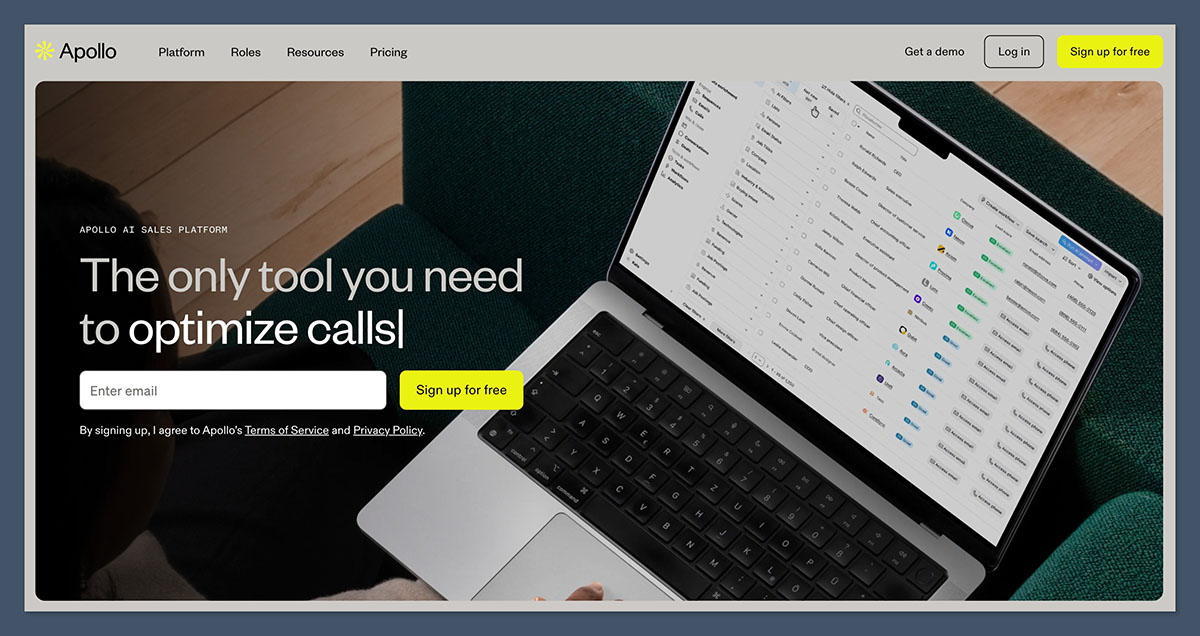
Apollo.io is the most well-rounded AI B2B lead generation tool I tested, which is why it takes the top spot this year.
It bundles a 275M+ contact database, AI-assisted list building, email sequencing, a basic dialer, and native integrations with most major CRMs – all from a single interface.
Most teams I’ve worked with end up paying for two or three tools that Apollo covers in one. That consolidation is the real story here.
The drawback is Apollo’s credit-based pricing, which can inflate spend quickly once your team starts pulling mobile numbers or exporting lists at scale.
Pros
- 275M+ contact database with solid global coverage
- AI copywriting and sequence optimization built in
- Free plan is genuinely usable for testing
- Native integrations with Salesforce, HubSpot, Outreach, SalesLoft
Cons
- Credit system can balloon real costs 2-3x advertised pricing
- Email bounce rates can run 15-25% on some segments
- No website visitor identification
- Organization plan requires a 3-user minimum
Recent update: Apollo migrated to a unified credit system in late 2025, where every data action (email reveals, phone reveals, exports) draws from a single credit pool. Credits no longer roll over between cycles.
When I tested Apollo, the onboarding was straightforward and the list-building experience felt modern – filters for technographics, headcount changes, and funding rounds are easy to layer.
The AI email writer produced passable first drafts but still needed rewriting for tone. Where Apollo really earns its place is in the workflow between “I found a prospect” and “they’re in a sequence” – that handoff is one click, and most tools on this list can’t match it.
How Much Does Apollo.io Cost?
- Apollo’s pricing ranges from $0 (Free) to $119/user/month (annual billing)
- Basic: $49/user/month; Professional: $79/user/month; Organization: $119/user/month
- Monthly billing adds roughly 20% to every tier
- Phone number reveals cost 8 credits each; email reveals cost 1 credit
- Overage credits cost $0.20 each with a 250-credit minimum purchase
Why Use Apollo.io in 2026?
Apollo is the pragmatic default for most B2B teams that need prospecting and outbound in one place. The database is good enough, the sequencing is good enough, and the AI features are good enough – which means you stop paying for four tools that each do one thing slightly better. For teams under 50 reps, that consolidation alone justifies the spend.
Apollo.io is suitable for:
- B2B teams that want data and outbound in a single platform
- Startups and scale-ups running high-volume outbound
- Teams replacing two or three point tools with one
Apollo.io isn’t suitable for:
- Teams that need website visitor identification
- EU-focused teams with strict compliance requirements (Cognism is stronger)
- RevOps teams that need flexible multi-provider enrichment (Clay is stronger)
2. Clay: Best for AI-Powered Enrichment Workflows
- Starting price: $149/month ($134 billed annually)
- AI features: Yes – Claygent AI research agent, AI formulas
- Free plan: Yes, with 100 monthly credits
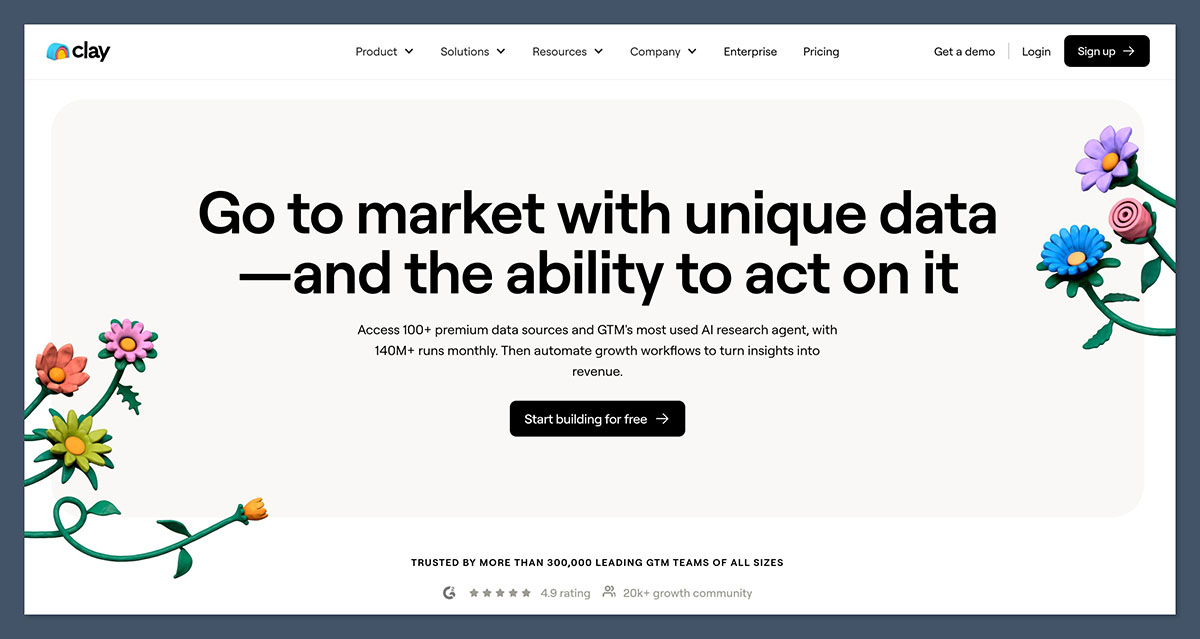
Clay is the tool that RevOps teams keep telling me about.
It’s less of a database and more of an orchestration layer – you connect 75+ data providers (Apollo, People Data Labs, Clearbit, Hunter, and others), build enrichment waterfalls, and use Claygent, Clay’s AI research agent, to pull information no single provider has.
The “supercharged spreadsheet” framing is accurate. Every row is a prospect or account; every column is an enrichment, API call, or AI prompt.
For teams with specific, non-obvious buying signals – “companies hiring three SDRs in the last 60 days” or “agencies using Shopify Plus and HubSpot together” – Clay is without peer. For teams that just want a list of VPs of Marketing, it’s overkill.
Pros
- Waterfall enrichment across 75+ providers in one workflow
- Claygent handles research tasks that would take SDRs hours
- Unlimited users on every paid plan
- Free plan is functional for workflow testing
Cons
- Steep learning curve – most teams need 2-4 weeks to get productive
- Credit system is opaque and can drain fast on failed lookups
- No outbound execution layer – you still need a sending tool
- Pro plan jumps to $800/month for serious volume
Recent update: Clay’s March 2026 pricing update introduced new Launch ($149) and Growth ($495) tiers, cut data costs 50-90% on many enrichments, and eliminated failed-lookup charges that used to silently drain 20-30% of monthly credits.
I found Clay most valuable when I stopped thinking of it as a prospecting tool and started thinking of it as infrastructure. It doesn’t replace Apollo or Cognism – it sits on top of them, pulls the best data from each, and delivers cleaner output into whatever sending tool you already use.
That’s powerful, but only if you have the operations maturity to design the workflows in the first place.
How Much Does Clay Cost?
- Clay’s pricing ranges from $0 (Free) to $800+/month on Pro tiers, with custom Enterprise pricing
- Free: 100 credits/month; Launch: $149/mo ($134 annual); Growth: $495/mo
- All plans include unlimited users
- Real cost per enriched lead: roughly $0.14 on Pro to $0.67 on Launch
- Budget for a sending tool on top (Instantly, Apollo, or similar)
Why Use Clay in 2026?
Buying signals in 2026 are more specific and more fleeting than they were two years ago. Generic “VP of Marketing at SaaS company” lists convert poorly.
Clay lets you build lists around the exact signal that predicts a close for your ICP – job change, funding round, tech stack shift, headcount trigger – and enrich those leads with data no single provider could give you alone.
Clay is suitable for:
- RevOps teams with mature prospecting processes
- Agencies building custom enrichment workflows for clients
- B2B SaaS teams with highly specific buying signals
Clay isn’t suitable for:
- Solo founders or small teams without dedicated ops time
- Teams that need a simple “data + send” workflow
- Users who want outbound execution in the same tool
3. Instantly.ai: Best Budget Outbound Email Platform
- Starting price: $37/month (billed annually)
- AI features: Yes – AI copy, AI Sales Agent, deliverability optimization
- Free plan: No, but 14-day free trial available
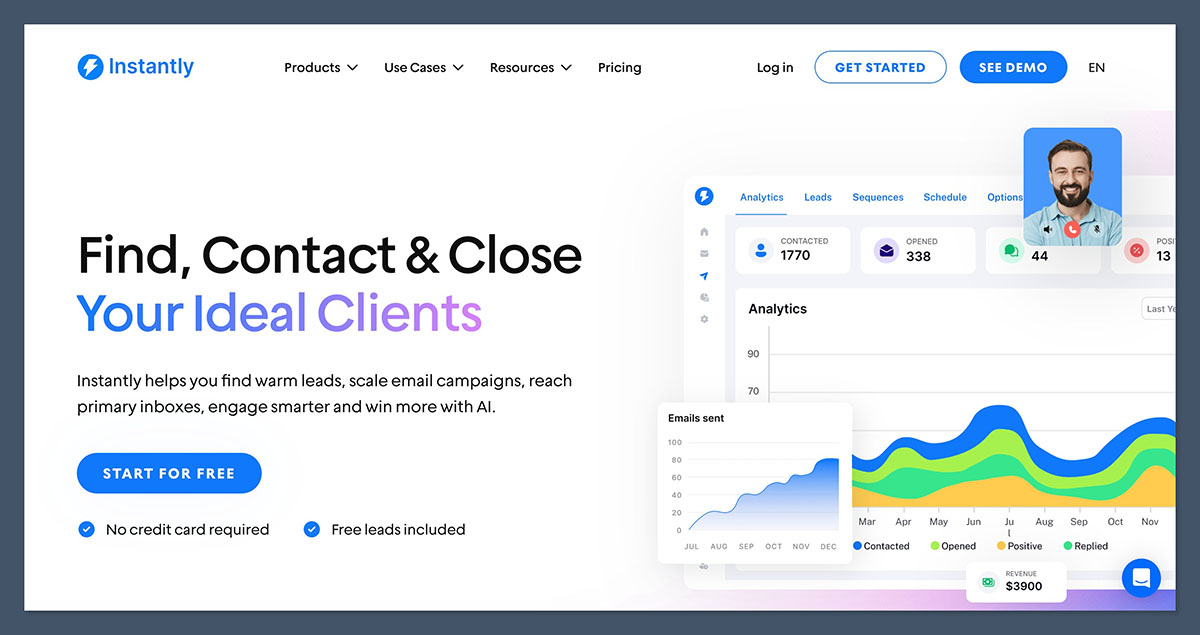
If your bottleneck is sending cold email at scale without burning domains, Instantly is the platform I’d start with.
The Growth plan starts at $37/month and includes unlimited email accounts and unlimited warmup – a combination no other major outbound tool matches at that price point.
Instantly isn’t trying to be a database or a CRM. It’s a sending engine with strong deliverability infrastructure and a clean sequence builder.
You bring the leads (from Apollo, Clay, or elsewhere), and Instantly handles the infrastructure problem of actually getting messages into inboxes.
Pros
- Unlimited email accounts and warmup on every plan
- $37/month entry price is the lowest in the category
- AI Copilot writes sequences and personalization variables
- Volume-based pricing means adding SDRs doesn’t raise cost
Cons
- Growth plan caps at 1,000 uploaded contacts total
- No native dialer or multi-channel beyond email
- Lead Finder credits don’t roll over
- Deliverability still depends on your own domain setup
Recent update: Instantly launched an AI Sales Agent that adds your domain, finds ICPs, enriches them, and sends personalized sequences automatically – closer to a full AI SDR than to a traditional cold email tool.
When I tested Instantly, the standout was inbox rotation. Connect 20 sending domains, and Instantly distributes sends across them automatically to keep any single domain from hitting spam filters.
That sounds mundane until you try to set it up manually in another tool. Combined with automated warmup, it’s the closest thing to “set and forget” deliverability I’ve seen.
The tradeoff: Instantly is a specialist. You’ll still need a data source and, for most teams, a CRM alongside it.
How Much Does Instantly.ai Cost?
- Instantly’s Outreach pricing ranges from $37 to $358/month (annual billing)
- Growth: $37/mo (5,000 emails, 1,000 contacts); Hypergrowth: $97/mo; Light Speed: $358/mo
- Separate modules for Lead Finder and CRM add $47-$97/month each
- Annual billing saves 20% across all tiers
- Full stack (Outreach + Leads + CRM) runs $180-$241/month
Why Use Instantly in 2026?
Deliverability is the unsexy problem that kills most outbound programs. Google and Microsoft’s sender reputation enforcement has only tightened, and domains get burned faster than ever.
Instantly’s unlimited-inbox model turns deliverability from a constant operational fire into a solved infrastructure layer, which is the single biggest reason teams stick with it.
Instantly is suitable for:
- Cold email agencies running multi-client campaigns
- SDR teams scaling across many sending domains
- Solo founders who need affordable email infrastructure
Instantly isn’t suitable for:
- Teams that need multi-channel (LinkedIn, phone, ads) in one tool
- Teams without their own lead source
- Enterprise buyers needing advanced CRM and reporting
4. Warmly: Best for Website Visitor Intent
- Starting price: Free tier (500 visitors/mo); paid plans from $10,000/year
- AI features: Yes – AI Prospector, AI Chat, real-time de-anonymization
- Free plan: Yes, with visitor caps
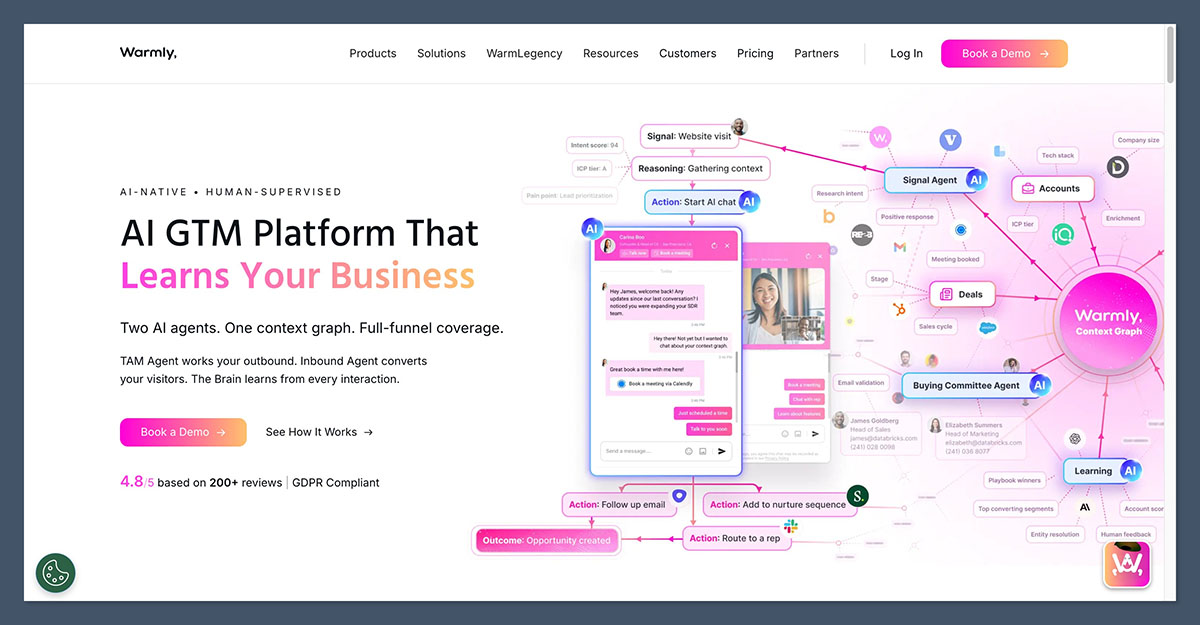
Warmly is the tool I’d reach for if the bottleneck is “we have traffic but no pipeline.” It identifies anonymous website visitors at the person level – not just the company – and scores intent based on what they’re doing on your site in real time.
When a high-fit visitor hits your pricing page, Warmly can trigger an AI chat, notify a rep in Slack, or auto-enroll the prospect in an outreach sequence.
For product-led SaaS and inbound-heavy teams, this changes the economics of the funnel.
Instead of waiting for the 2-3% who fill out a demo form, you can engage the 97% who were interested enough to visit but not quite ready to raise their hand.
Pros
- Person-level visitor de-anonymization (not just company)
- Real-time intent scoring and trigger-based workflows
- AI Chat qualifies visitors before handoff to reps
- Free tier lets you test on real traffic before committing
Cons
- Paid plans start at $10K/year – not cheap
- Requires meaningful traffic volume to justify the cost
- US-centric de-anonymization coverage (weaker in EU)
- Modular pricing can get complex quickly
I tested Warmly on a mid-traffic B2B site and what surprised me most was how much actionable intent was hiding in “anonymous” sessions. Buyers from target accounts were returning 3-4 times before anyone filled a form.
Warmly surfaced those patterns and let the sales team prioritize outreach around actual engagement rather than a vanity form-fill queue.
How Much Does Warmly Cost?
- Warmly offers a free plan identifying up to 500 visitors/month
- Paid plans are modular, priced by output rather than seats
- AI Data Agent starts at ~$10,000/year (10,000 credits + CRM integration)
- Additional modules available for AI Prospector, AI Chat, and revenue orchestration
- Custom enterprise pricing for full-stack deployments
Why Use Warmly in 2026?
As AI answer engines take over top-of-funnel research, the “dark funnel” – buyers who research you without ever identifying themselves – has grown dramatically.
Warmly is the clearest way to turn that dark traffic into named prospects you can actually sell to, and it’s one of the few tools genuinely built for this new inbound reality rather than retrofitted from a 2020 playbook.
Warmly is suitable for:
- PLG and inbound-heavy B2B SaaS teams
- Mid-market and enterprise teams with strong website traffic
- Revenue teams wanting real-time intent activation
Warmly isn’t suitable for:
- Early-stage companies with low traffic volume
- Teams on tight budgets (entry price is $10K/yr)
- EU-focused teams needing person-level de-anonymization at scale
5. Cognism: Best for GDPR-Compliant EU Data
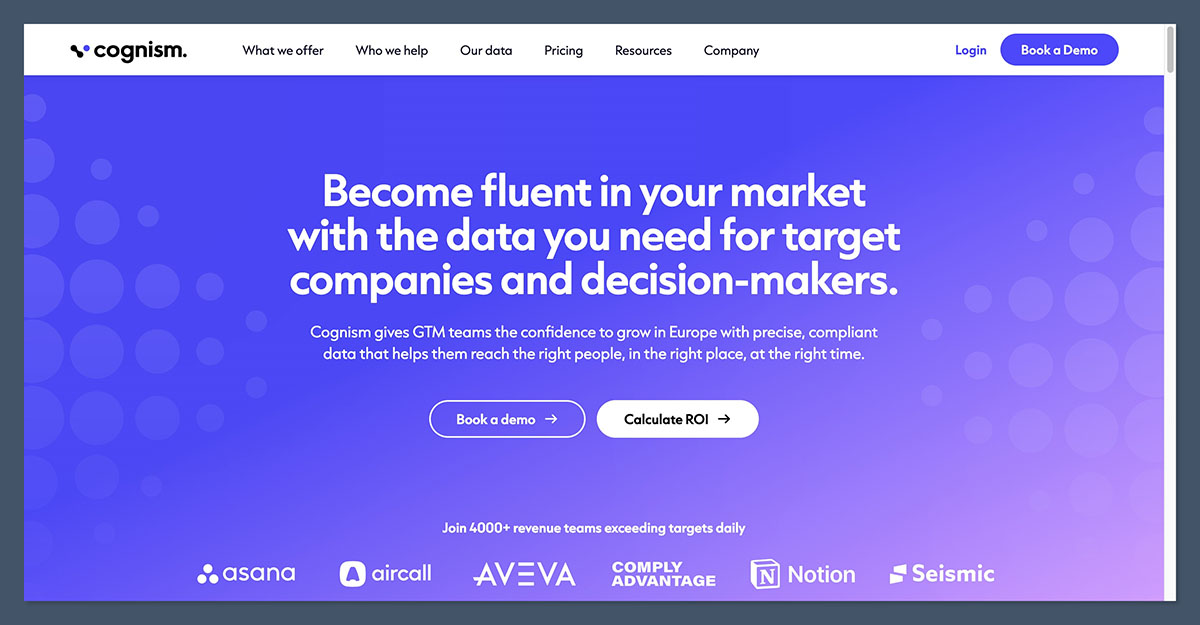
- Starting price: Custom quote (typically $15,000+/year)
- AI features: Yes – intent data, AI-powered filtering, Diamond Data verification
- Free plan: No, demo only
For European B2B teams, Cognism is the data provider that keeps coming up in conversations about compliance.
It provides phone-verified mobile numbers across EMEA, GDPR-aligned data processing, and intent signals tuned for the European market – three things US-first databases often handle poorly.
The tradeoff is predictable: Cognism is expensive and sold through annual contracts negotiated with a sales team. There’s no free trial and no self-serve entry point.
But if your ICP is European mid-market or enterprise, the data quality and compliance posture are genuinely better than Apollo or ZoomInfo for that segment.
Pros
- Phone-verified mobile numbers (Diamond Data) with higher accuracy rates
- GDPR-aligned data processing and opt-out workflows
- Strong EU intent data from Bombora and in-house signals
- Do Not Call list screening built in
Cons
- Expensive; annual contracts only, no self-serve pricing
- No free trial – demo required to see the product
- US coverage is thinner than ZoomInfo or Apollo
- Best-used alongside a sequencing tool, not as an all-in-one
In my testing, Cognism’s mobile data was the clear differentiator.
Pulling 100 mobile numbers from Apollo and 100 from Cognism on the same EU contact list, Cognism’s connect rates were meaningfully higher – which matters more than the sticker price when your cost-per-meeting math is honest about phone outreach.
How Much Does Cognism Cost?
- Cognism uses custom quote-based pricing, typically starting around $15,000/year
- Annual contracts only; no monthly or self-serve option
- Pricing scales with seat count, credits, and module selection
- Intent data is a paid add-on in most packages
- Contact sales to see pricing tied to your specific use case
Why Use Cognism in 2026?
The EU’s regulatory posture on B2B data has only tightened, and the penalties for getting it wrong have grown.
Cognism is the one major data provider that was built EU-first rather than retrofitted for compliance, and for teams selling into regulated industries – finance, healthcare, legal – that foundational difference matters more than any feature comparison.
Cognism is suitable for:
- EMEA-focused B2B sales teams
- Mid-market and enterprise orgs with compliance requirements
- Teams that prioritize phone-verified mobile data
Cognism isn’t suitable for:
- US-focused teams (Apollo and ZoomInfo are stronger)
- Early-stage teams on tight budgets
- Teams that want self-serve signup and monthly billing
6. ZoomInfo: Best for Enterprise ABM Teams
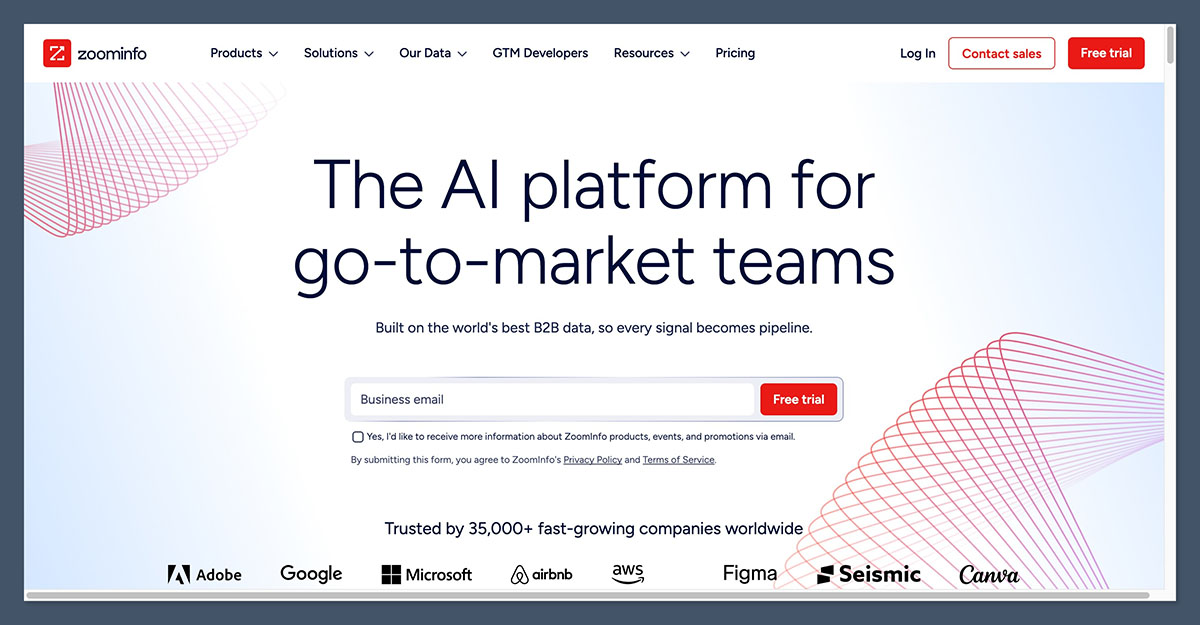
- Starting price: Custom quote (typically $15,000+/year)
- AI features: Yes – Copilot, predictive scoring, intent data via Streaming Intent
- Free plan: No, demo only
ZoomInfo remains the enterprise incumbent. Its database is the largest and most deeply verified in the US market, and its intent product (Streaming Intent) surfaces buying signals at the account level that few competitors can match.
If you run a large ABM motion, ZoomInfo is often already in the stack – or about to be.
The tradeoff is cost and complexity. Pricing starts around $15,000/year and scales quickly into six figures once you add intent, scoops, and engage modules. For enterprise teams, that spend is usually justified. For anyone under 50 reps, it rarely is.
Pros
- Largest verified B2B contact database in the US market
- Streaming Intent surfaces account-level buying signals daily
- ZoomInfo Copilot delivers AI-generated account insights and email drafts
- Deep integrations with Salesforce, HubSpot, and major MAPs
Cons
- Expensive; typical deals are $25-50K+/year
- Long sales cycles and annual contracts only
- Auto-renewal and cancellation terms have drawn criticism
- Overkill for teams under 50 reps
When I looked at ZoomInfo recently, what struck me wasn’t the database – competitors have narrowed that gap – but the intent layer.
Streaming Intent combined with ZoomInfo’s account data gives ABM teams something genuinely hard to replicate: a prioritized list of accounts researching your category this week. For an enterprise motion, that’s the signal the whole GTM runs on.
How Much Does ZoomInfo Cost?
- ZoomInfo uses custom quote pricing, typically starting around $15,000/year
- Annual contracts only; no monthly billing or self-serve option
- Pricing scales with seat count, credits, and module selection
- Add-ons include Intent, Engage, Operations Hub, and Chorus
- Typical enterprise deployments run $25,000-$150,000+/year
Why Use ZoomInfo in 2026?
ABM motions live or die on account-level signal quality.
ZoomInfo’s combination of deep US data and streaming intent is still the gold standard for enterprise revenue teams running account-based plays, and the Copilot AI layer added in 2024-2025 finally makes that data usable at rep speed rather than in quarterly planning cycles.
ZoomInfo is suitable for:
- Enterprise sales teams running ABM at scale
- US-focused B2B orgs with 50+ reps
- Teams that need deep integrations with Salesforce and Marketo
ZoomInfo isn’t suitable for:
- Startups and small teams (Apollo covers the same job for 10x less)
- EU-heavy sales motions (Cognism is stronger there)
- Teams that want flexible contracts and self-serve billing
7. HubSpot AI: Best Full-Funnel CRM-Native Option
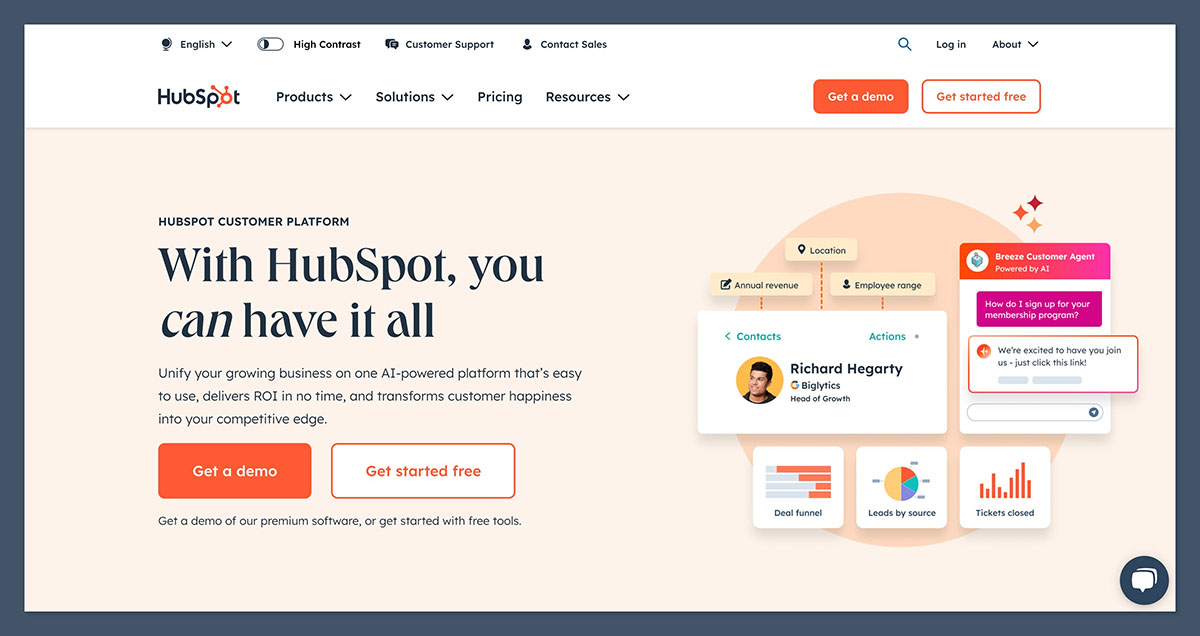
- Starting price: Free CRM; paid plans from $20/user/month
- AI features: Yes – Breeze AI across Sales, Marketing, and Service Hubs
- Free plan: Yes, genuinely useful
HubSpot’s AI features (branded as Breeze) aren’t best-in-class at any single thing. But if you already run your CRM, marketing automation, and reporting inside HubSpot, Breeze AI is almost certainly the most practical place to add AI-assisted lead gen, because it sits inside the same data your team is already using.
Breeze includes AI content generation, lead scoring, Breeze Copilot (an in-app AI assistant), and Breeze Intelligence (enrichment and buyer intent data).
None of these are reasons to leave another tool for HubSpot, but if you’re already here, they close most of the gaps you’d otherwise fill with separate point tools.
Pros
- Free CRM is genuinely useful for early-stage teams
- Breeze AI operates on the data you already have in HubSpot
- No context-switching between tools
- Workflow automation is mature and reliable
Cons
- Breeze AI features lag best-in-class specialists
- Pricing scales sharply once you add Marketing + Sales Pro Hubs
- Breeze Intelligence credits are an add-on cost on top of Hub pricing
- Lock-in risk as more data and workflows migrate into HubSpot
Across dozens of client conversations, I’ve noticed HubSpot AI rarely wins head-to-head feature comparisons – but it often wins the total-cost-of-operations comparison.
Adding a specialist tool means a new login, a new data silo, and a new integration to maintain. Breeze removes all three at the cost of being merely good rather than excellent at any given feature.
How Much Does HubSpot Cost?
- HubSpot CRM is free forever with core contact management
- Sales Hub Starter starts at $20/user/month; Professional at $100/user/month
- Marketing Hub Starter starts at $20/month; Professional at $890/month
- Breeze Intelligence credits are priced separately as add-ons
- Full-stack enterprise deployments typically run $30,000-$100,000+/year
Why Use HubSpot AI in 2026?
The hidden cost of any tool stack is integration overhead and team training. HubSpot’s value in 2026 isn’t that Breeze is the best AI on the market – it’s that HubSpot already has your contacts, your deals, your forms, and your reporting.
Breeze adds AI to that foundation without asking your team to learn anything new, which is often the right tradeoff even if a specialist tool would score 15% higher on features.
HubSpot AI is suitable for:
- Teams already running HubSpot as their core CRM
- Marketing-led orgs that want AI across the full funnel
- Early-stage companies using the free CRM tier
HubSpot AI isn’t suitable for:
- Teams running Salesforce as the system of record
- High-volume outbound specialists (use Instantly or Apollo)
- RevOps teams wanting flexible multi-provider enrichment (use Clay)
How Do I Choose the Right AI B2B Lead Gen Tool?
The most common mistake I see teams make is buying for features they think they’ll need rather than the bottleneck they actually have.
If you’re pipeline-starved, a better database won’t fix that – a better outbound motion will. If you’re drowning in leads that don’t convert, a bigger list tool only makes it worse; you need better scoring and qualification.
Before you evaluate tools, diagnose where the funnel is actually leaking. Then use the criteria below to shortlist.
- Funnel role: Are you buying for data, enrichment, intent, outbound, or scoring? Tools that try to do everything often do nothing exceptionally well.
- Data quality and region: US-first databases (Apollo, ZoomInfo) underperform in EMEA. EU-first providers (Cognism) underperform in the US. Match the tool to where your ICP actually lives.
- AI transparency: Ask vendors how their scoring and copy generation actually work. If they can’t explain the inputs and weights, assume the output is generic.
- Integrations: Will this tool read from and write to your existing CRM cleanly? A tool that creates a parallel data silo is a future tech-debt problem.
- Pricing model: Per-seat, per-credit, and per-volume pricing each have failure modes. Model out 12 months of realistic usage – including growth – before signing.
- Compliance: For EU-facing teams, GDPR-aligned data handling isn’t optional. Ask for the vendor’s Data Processing Agreement before committing.
- Trial or pilot: Any tool worth buying should let you test it on real data for at least two weeks before the annual contract conversation.
Most importantly, remember that tools don’t generate leads – positioning, content, and signal do. A great tool applied to weak positioning produces more noise.
A great tool applied to a brand that AI systems already recognize and cite produces compounding returns. That’s why we think about lead gen tooling as one layer of a larger visibility stack, not a standalone solution.
Can I Switch AI B2B Lead Gen Tools?
Yes, but switching is rarely as clean as vendors make it sound. All the tools in this guide let you export your data and cancel your contract – though several (ZoomInfo, Cognism) require written notice 60-90 days before renewal.
The real switching cost is operational. Moving from Apollo to Clay (or vice versa) means rebuilding workflows, retraining SDRs, and re-integrating with your CRM.
Moving between data providers usually means dealing with different credit systems, different data schemas, and different integration quirks. Budget 3-6 weeks of ramp time for any significant tool change, and avoid switching in the middle of a quarter.
How We Test AI B2B Lead Gen Tools
This year we put 15 leading AI B2B lead gen tools through an in-depth testing process. Our research team spent over 120 hours analyzing each tool, covering 180+ evaluation criteria across seven core categories.
- Data quality and coverage (25%): Database size, accuracy, regional coverage, and refresh frequency.
- AI capabilities (20%): Depth of AI features – scoring, copywriting, research agents, intent signals – and how transparent the models are.
- Outbound and execution (15%): Sequencing, multi-channel support, deliverability infrastructure, and workflow automation.
- Integrations (15%): Native CRM integrations, API access, and compatibility with common sales tech stacks.
- Pricing and scalability (10%): Transparency of pricing, hidden costs, and how cleanly the tool scales from small teams to enterprise.
- Compliance (10%): GDPR alignment, opt-out workflows, and suitability for regulated EU markets.
- User experience (5%): Onboarding, daily workflow ergonomics, and reporting.
Key Takeaways
- Apollo.io is our top-rated tool for 2026, combining 275M+ contacts with AI sequences and built-in scoring at a starting price most teams can absorb
- Pricing ranges from free to $15,000+ per year – Instantly and HubSpot offer the lowest entry points, while ZoomInfo and Warmly’s full stack sit at the enterprise end
- Every tool on this list now ships AI copilots or AI SDR features – the differentiator is no longer whether AI is included, but how well it uses your data and signals
- Intent data has overtaken raw contact volume as the core value driver – tools like Warmly, Cognism, and ZoomInfo win by telling you who to contact right now, not just who exists
- Full-funnel platforms (Apollo, HubSpot) are pulling spend away from point tools, but best-in-class enrichment (Clay) and deliverability (Instantly) still win specialist budgets
Final Verdict: Which Tool Do I Recommend?
For most B2B teams in 2026, Apollo.io is the pragmatic starting point – it covers 80% of what you need at a price point that lets you scale without committing to enterprise contracts.
Layer Instantly on top if email deliverability becomes the bottleneck, and add Clay once your RevOps maturity justifies custom enrichment workflows.
EU-focused teams should start with Cognism instead of Apollo. Teams with meaningful website traffic should pair whatever they pick with Warmly to activate their dark funnel.
Each tool has strengths and blind spots. If you’re unsure where to start, lean on free plans and trials – most of these let you test with real data before signing anything annual.

