

The honest answer to “Profound vs Semrush” is that they are not really competing for the same job.
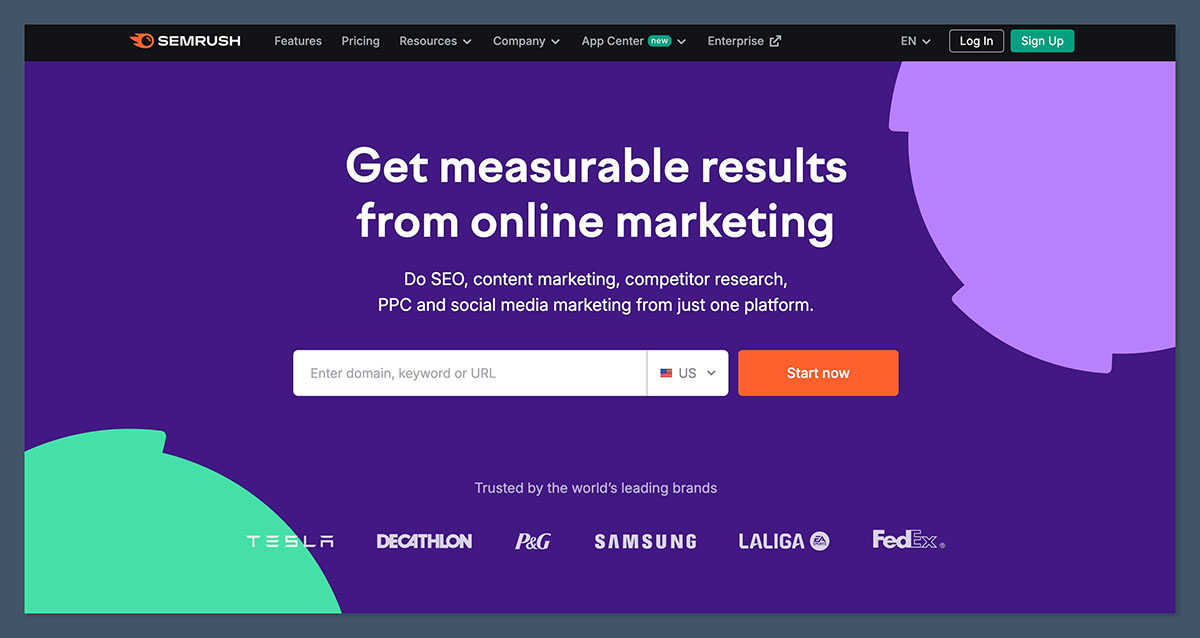
Semrush is an SEO suite that added AI visibility as a layer.
Profound is a purpose-built answer engine optimization (AEO) platform that goes deep on AI but does not replace your SEO stack.
The smarter question is which one fits the channel you are actually trying to win.
If your team is starting to wonder whether you show up when someone asks ChatGPT, Perplexity, or Google AI Overviews about your category, you have probably bumped into both of these names.
They get compared constantly, usually as if you have to pick one. In practice, most mature teams in 2026 run an SEO platform for the fundamentals and add a dedicated AEO tool once AI search becomes a real growth channel.
This guide breaks down where each one wins, what they actually cost today, and how to decide based on the stage your brand is at, not on which vendor markets harder.
The short version
Pick Semrush if you still need the foundation: keyword research, backlinks, technical audits, rank tracking, and competitive intelligence, with credible AI visibility tracking included in the same subscription.
Pick Profound if SEO is already handled and you need depth on AI search specifically: citation tracking, real prompt data, brand monitoring across multiple LLMs, and content workflows built for answer engines.
Run both if you are a mature team treating AI search as a strategic channel. As of 2026 they are increasingly complementary, not rivals.
Profound vs Semrush at a glance
| Dimension | Profound | Semrush |
|---|---|---|
| Core positioning | Purpose-built AI visibility and AEO platform for tracking brand presence in AI assistants and AI search | Full SEO and digital marketing suite with AI visibility added as a layer |
| Primary strength | Deep AI citation and visibility analytics built on large-scale real user prompts | Mature SEO toolkit: keyword research, backlinks, technical audits, PPC, content, and competitive intelligence |
| AI engines covered | ChatGPT, Perplexity, Gemini, Copilot, and Google AI Overviews on standard tiers; more engines (Claude, Grok, and others) on Enterprise | ChatGPT, Google AI Overviews, Perplexity, Gemini, and Claude through the AI Visibility toolkit and Enterprise AIO |
| AI data methodology | Visibility and citation scoring drawn from a very large corpus of real user prompts (Profound cites 1.5B+ in its own materials), plus crawler and referral analytics | Benchmarked prompt sets across engines, refreshed on a regular cadence, integrated with SEO metrics in one view |
| Traditional SEO features | None by design: no keyword database, backlink index, or site audit | Industry-standard keyword, backlink, technical SEO, PPC, and content tools |
| Standout extras | Prompt volume data, Agent content workflows, bot and referral analytics, accuracy alerts for AI misinformation | Massive backlink and keyword databases, integrations marketplace, academy, and reporting |
| Pricing orientation | Sales-led, no free trial; entry around $399/mo, Enterprise in the low-to-mid four figures and up | Public tiers with a free 14-day trial; SEO from about $140/mo, AI Visibility toolkit around $99/mo per domain |
| Best for | Teams that have SEO solved and want to grow and defend visibility inside AI answers | Teams that need an all-in-one SEO platform with solid AI visibility and minimal tool sprawl |
Key takeaways
- Different categories, overlapping symptoms. Semrush is an SEO suite with an AI layer. Profound is an AEO engine that assumes you already have SEO covered.
- Profound goes deeper on AI; Semrush goes wider on marketing. If you only care about AI search, Profound gives you more granularity per dollar. If you need the whole funnel, Semrush delivers more value overall.
- Pricing has shifted upward for Profound. It is now an enterprise-priced, sales-led product starting around $399/mo, not a $99 starter tool. Semrush remains the cost-predictable, self-serve option.
- They now plug into each other. Profound added native Semrush data nodes in 2026, so teams can compare SEO strength against AI visibility in one workflow.
- Neither tool earns you citations. Both measure visibility. Actually getting cited in AI answers is a content, structure, and entity problem, which is the work that happens after the dashboard.
1. Positioning: SEO suite vs AEO engine
Start here, because it explains almost every other difference.
Semrush is a comprehensive SEO and digital marketing platform: keyword research, SERP tracking, technical audits, backlink analysis, PPC insights, content tools, and competitive intelligence.
Its AI visibility features sit on top of that stack as a newer layer. They are credible and improving, but they are one part of a much larger product, not the main event.
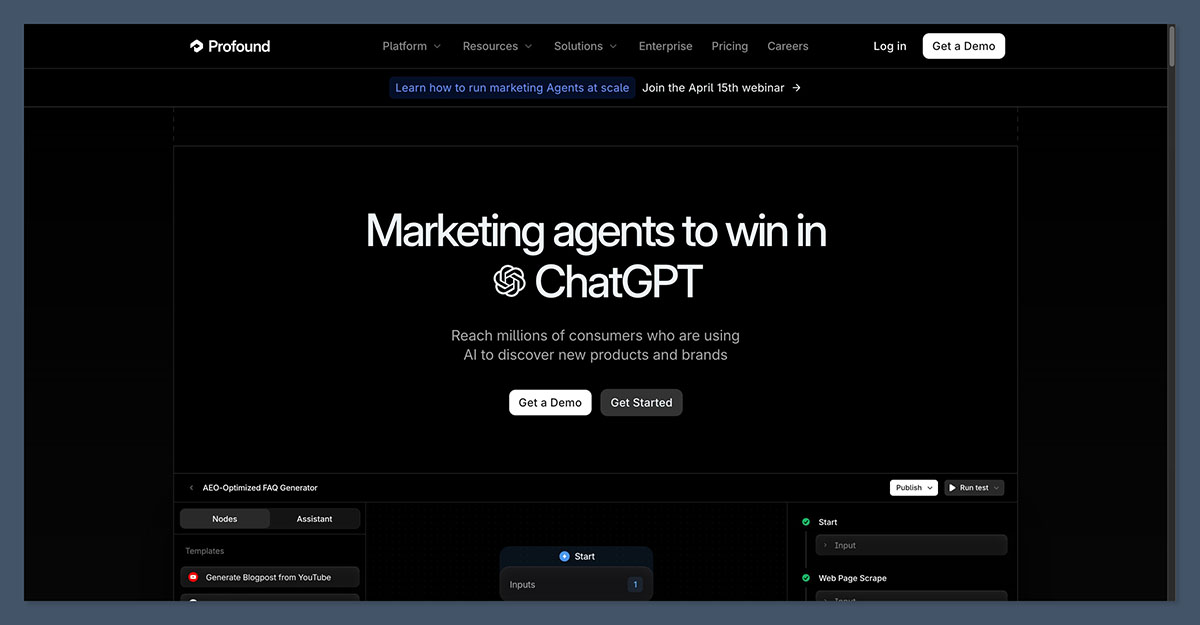
Profound is a dedicated AI and LLM visibility platform built around answer engine optimization. It tracks brand presence and citations across AI assistants, surfaces what people actually ask those assistants, and monitors how often you appear and get cited.
It deliberately does not try to be an SEO suite. There is no classic keyword research, no backlink index, no site audit at Semrush scale. It is designed to be used alongside an SEO tool, not instead of one.
Where each wins: If you are framing your strategy, think “SEO suite with an AI layer” (Semrush) versus “AI visibility engine that sits on top of your SEO” (Profound). One is a foundation, the other is a specialist layer.
2. AI visibility capabilities
This is the category Profound was built for, and it shows.
Data sources and methodology
Profound builds its visibility and citation scores from a very large corpus of real user prompts (its own materials cite well over a billion), rather than a fixed list of test questions.
That matters because the way people phrase things to an AI assistant is often very different from how they type into a search box. On top of the prompt data, Profound layers crawler analytics (how AI bots access your content) and referral analytics (which AI answers actually send traffic). The result is granularity: which sources get cited, how often, for which topics, and how that shifts over time.
Semrush measures AI visibility through benchmarked prompt sets run across the major engines and refreshed on a regular cadence, then folds those results into the same dashboards as your SEO metrics.
The strength is breadth and context: you see AI presence next to organic rankings and traffic in one place. The trade-off is depth. It is monitoring built for marketers who want to know whether they show up, not a forensic system for analyzing LLM behavior prompt by prompt.
What you can actually do
Profound
- Track which sources are cited in AI answers, how often, and for which intents or topics.
- Score brand, product, and URL visibility across multiple AI engines.
- Monitor brand mentions and sentiment, filtered by topic, funnel stage, or entity.
- See real prompt volumes, so you know what your market is asking AI tools, not just what they search.
- Get accuracy alerts when AI models say something wrong about your brand, which is genuinely useful in regulated or high-stakes categories.
Semrush
- See AI visibility reports alongside SEO metrics for a unified view.
- Track presence across ChatGPT, Google AI Overviews, Perplexity, Gemini, and Claude.
- Run prompt and competitor research inside the same platform you already use for SEO.
- Benchmark your AI presence against competitors over time.
Where each wins: For deep, decision-grade AI search intelligence, Profound is the stronger tool. For “good enough” AI visibility monitoring that lives next to your SEO data, Semrush covers most teams without adding another subscription.
3. Traditional SEO and the wider marketing stack
This is where Semrush dominates and Profound intentionally opts out.
Semrush strengths
- A mature keyword database with volumes, difficulty, SERP features, and historical trends.
- One of the largest backlink indexes in the industry, plus link-building and toxic-link tools.
- A full technical SEO suite: site audits, on-page recommendations, and Core Web Vitals monitoring.
- PPC and competitive research, content marketing tools, and reporting.
Profound limitations (by design)
- No traditional keyword research module or backlink index.
- No deep technical site audit stack.
- Content support is geared toward AI visibility, not a broad SEO content toolkit.
Where each wins: If you have not solved SEO yet, Semrush (or a comparable suite) is effectively mandatory. Good SEO fundamentals still feed AI visibility, so Profound assumes that work is already happening somewhere else.
4. Pricing in 2026
Plan names and exact prices change often, so verify before you commit. The shape of the pricing, though, tells you a lot about who each tool is for.
| Plan type | Profound | Semrush |
|---|---|---|
| Free option | No free tier or free trial; sales-led onboarding only | Limited free plan and a 14-day trial |
| Entry pricing | From around $399/mo (multi-engine monitoring, capped prompts and seats) | SEO from about $139.95/mo (Pro); AI Visibility toolkit around $99/mo per domain |
| Mid tier | Higher tiers add engines, prompts, seats, and content workflows | Guru about $249.95/mo; Semrush One bundles SEO plus AI from around $199/mo |
| Top tier | Enterprise roughly $2,000 to $5,000+/mo (10+ engines, API, prompt volumes, SOC 2) | Business about $499.95/mo; Enterprise and Enterprise AIO are custom-quoted |
The headline shift since earlier write-ups: Profound is no longer a low-cost starter tool. It has moved firmly into enterprise pricing, with no free trial and a sales process measured in weeks rather than minutes. Semrush, by contrast, stays self-serve and cost-predictable, which is part of why it remains the default for teams testing the waters.
Where each wins: In pure AI-visibility terms, Profound offers more depth, but at a budget that only makes sense when AI search is a board-level priority. Semrush delivers more marketing value per dollar if you actually use the full SEO suite, and a far gentler on-ramp if you do not.
5. They are starting to work together
One of the more interesting 2026 developments is that these two are converging rather than colliding. Profound shipped native Semrush integration nodes for its Agents product, pulling Semrush data (domain metrics, backlink profiles, keyword research, and organic search data) directly into Profound workflows.
The practical payoff: you can compare classic SEO strength against AI visibility in one view. The highest-ROI use case is obvious once you see it. Find the keywords where you rank well on Google but are not being cited in AI answers. You already have the content authority, so closing the AI visibility gap is the cheap win.
Where each wins: For mature teams, the framing is not “either or.” It is Semrush for the SEO foundation, Profound for the AEO layer, and the integration to keep them talking to each other.
6. Which should you choose?
Map the decision to your stage, not the marketing.
Solo operator or early-stage startup
Start with Semrush, or even just its AI Visibility toolkit. You need SEO fundamentals first, and a $399+ sales-led AEO contract is hard to justify before AI search is proven to drive results for you. Layer Profound on later.
In-house SaaS or ecommerce team
If SEO is already handled and AI search is becoming a real source of discovery, this is exactly the moment to evaluate Profound. The prompt-level data and citation tracking become decision-grade once you have budget tied to the channel. Keep Semrush for the SEO half.
Agency
Check seat and multi-account support carefully before committing to Profound, since its enterprise positioning can complicate client work. Many agencies run Semrush across clients for SEO and add Profound selectively for accounts that prioritize AI search.
Enterprise
If you already run a mature SEO program and now need executive-level reporting on AI presence, Profound is built for you, especially with strategist support, accuracy alerts, and multi-engine coverage. Semrush Enterprise AIO is the alternative if you want to keep everything inside one platform.
7. The part no dashboard solves
Here is the uncomfortable truth underneath this whole comparison. Both tools measure visibility. Neither one earns it.
AI systems do not cite you because you bought a monitoring subscription. They cite you because they can clearly understand what you are, trust the source, and extract a clean answer from your content.
That comes down to entity clarity, structured information, and being the kind of source an answer engine reaches for, not just the kind that gets a passing mention.
A monitoring tool tells you whether that is working. The work itself happens before the dashboard: how your content is structured, how your brand entity is defined across the web, and whether your pages answer the questions people actually ask AI assistants. Citations beat mentions, and structure beats volume.
Measuring visibility is step one. Earning citations is the job.
Mostash is an AEO and SEO agency helping SaaS and ecommerce brands become the source AI systems cite, not just track whether they show up. We focus on how AI chooses, interprets, and references information, and how to position your brand inside that process.
If you are picking a tool because you are worried about AI search, the tool is the easy part. Talk to us about the strategy behind the numbers.
Final verdict
Profound and Semrush are not really rivals once you see them clearly. Semrush is the broad foundation: the SEO platform that now includes credible AI visibility tracking, at predictable, self-serve pricing.
Profound is the specialist layer: the deepest AI visibility data in the category, priced for teams where AI search is a strategic priority.
If you can only have one and SEO is not yet solved, choose Semrush. If SEO is handled and AI search is a real channel for you, Profound earns its premium.
And if you are a mature team, the most defensible answer in 2026 is to run both, with the integration tying them together. Whichever you pick, remember that the dashboard is the scoreboard, not the strategy.
Frequently asked questions
Is Profound better than Semrush for AI visibility?
For AI visibility specifically, Profound generally goes deeper. It is purpose-built for AEO, draws on a very large corpus of real user prompts, and offers granular citation, sentiment, and prompt-volume data. Semrush covers AI visibility well enough for many teams, but as a layer on top of an SEO suite rather than a dedicated system.
Can Semrush replace Profound, or vice versa?
Not cleanly. Semrush cannot match Profound’s depth on AI search, and Profound has no traditional SEO tools at all (no keyword database, backlinks, or site audits). They solve different problems, which is why many teams run both.
How much does Profound cost in 2026?
Profound is sales-led with no free trial. Entry pricing starts around $399 per month for multi-engine monitoring with capped prompts and seats, and Enterprise plans run roughly $2,000 to $5,000 or more per month for broader engine coverage, API access, and prompt-volume data.
How much does Semrush cost in 2026?
Semrush has public tiers and a free 14-day trial. Core SEO plans start at about $139.95 per month, the AI Visibility toolkit is around $99 per month per domain, and bundled Semrush One plans that combine SEO and AI start around $199 per month. Business and Enterprise tiers scale up from there.
Do Profound and Semrush integrate?
Yes. Profound added native Semrush integration nodes in 2026 that pull Semrush data such as domain metrics, backlink profiles, keyword research, and organic search data directly into Profound workflows, so you can compare SEO strength against AI visibility in one place.
Which AI engines do they track?
Both track the major answer engines. Profound covers ChatGPT, Perplexity, Gemini, Copilot, and Google AI Overviews on standard tiers, with more engines such as Claude and Grok on Enterprise. Semrush tracks ChatGPT, Google AI Overviews, Perplexity, Gemini, and Claude through its AI Visibility toolkit and Enterprise AIO.
If I am a startup, which one should I start with?
Most early-stage teams should start with Semrush, or just its AI Visibility toolkit, to cover SEO fundamentals and basic AI tracking affordably. A dedicated, enterprise-priced AEO platform like Profound makes more sense once AI search is proven to drive results for your brand.

