

AI search has quietly become a discovery channel of its own. When someone asks ChatGPT, Perplexity, or Google’s AI Overviews for the best tool, the best running shoe, or the best CRM, the brands named in that answer win attention that never shows up in a traditional rank tracker.
Two platforms keep coming up when teams want to measure this: Profound and Peec AI.
I spent more than 40 hours setting up prompts, running tracking across several AI engines, and comparing dashboards, pricing, and workflows on both.
Here is the short version: for most marketing teams and agencies, Peec AI is the smarter place to start because it is affordable, quick to set up, and offers a free trial.
Profound is the stronger pick for enterprises that need the widest engine coverage, formal security certifications, and built-in optimization workflows (and that have the budget to match).
Profound vs Peec AI: Quick Verdict
- Peec AI : Best for most marketers, agencies, and smaller teams. Transparent pricing and clean dashboards (start with the 14-day free trial).
- Profound : Best for enterprises and complex brands that need the broadest AI engine coverage, SOC 2 Type II security, and optimization workflows.
In this comparison, I will walk through why each platform earns its spot, looking at pricing, AI engine coverage, features, ease of use, security, and reporting, so you can decide which one fits your team.
Quick Comparison: Profound vs Peec AI
Get a clear overview of how the two platforms stack up before we dig into the detail:
| Feature | Peec AI | Profound |
|---|---|---|
| Best for | Marketers, agencies, smaller teams | Enterprises, large brands, regulated industries |
| Launched | February 2025 (Berlin) | 2024 (New York) |
| Core focus | Monitoring and analytics | Monitoring, auditing, and optimization |
| AI engines tracked | 3 included (ChatGPT, Perplexity, Google AI Overviews), extras as add-ons | 10+ across the platform (ChatGPT, Perplexity, Gemini, Copilot, Grok, Meta AI, and more) |
| Free trial | 14 days | None (sales-led demo) |
| Entry pricing | From around 89 euros per month | From around 399 to 499 USD per month |
| Security | Standard | SOC 2 Type II |
| Time to first data | Minutes | Typically 1 to 3 weeks |
| Funding to date | Around 29 million USD | Around 155 million USD (1 billion USD valuation) |
Best for Pricing and Value: Peec AI
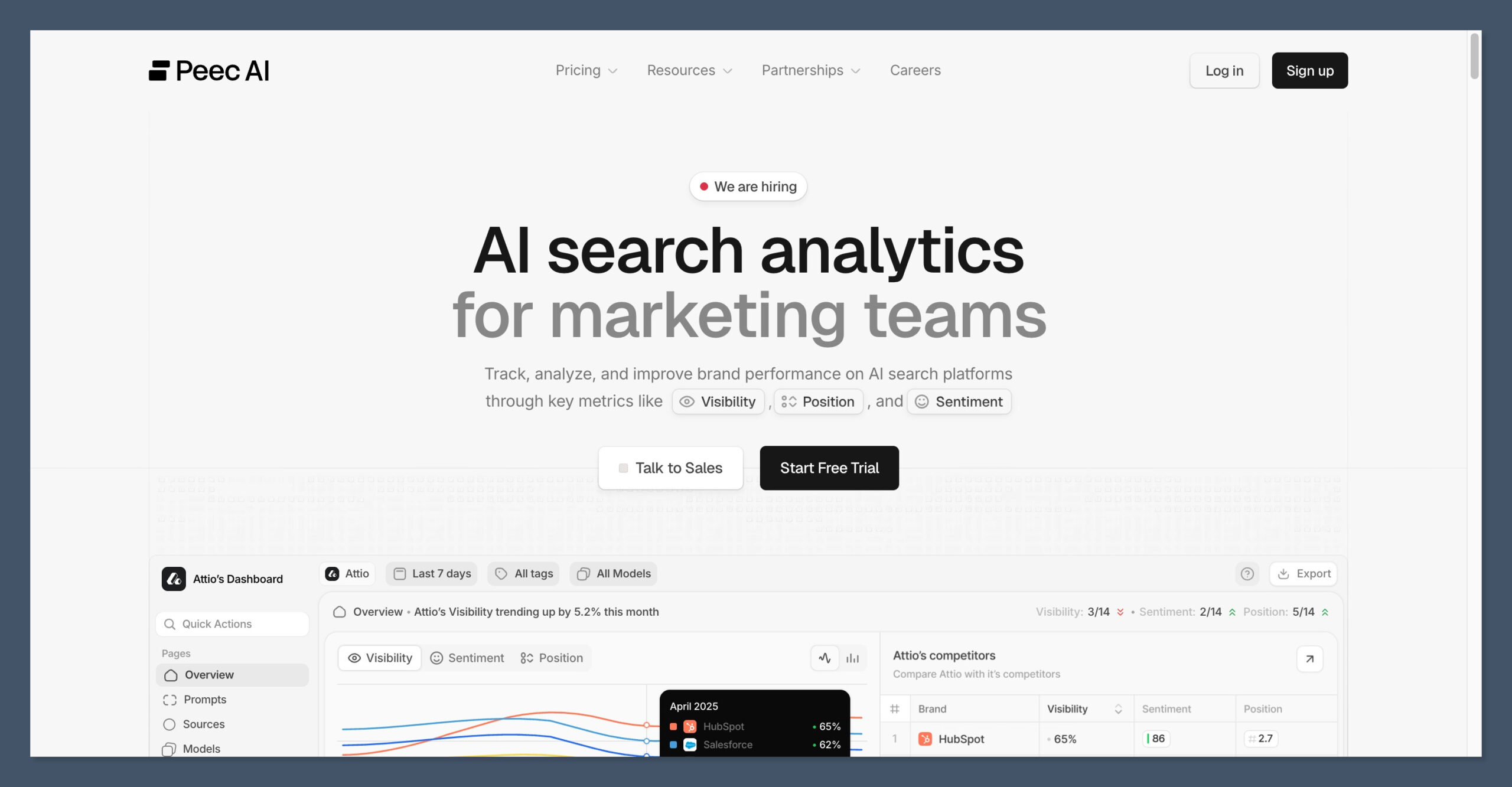
This is the clearest difference between the two, and it sets the tone for who each platform is really built for.
Peec AI runs on transparent, self-serve pricing. Plans start at roughly 89 euros per month (Starter), step up to about 199 euros per month (Pro), and reach 499 euros or more per month at the top tier, with discounts for annual billing.
Every plan includes unlimited user seats, daily tracking, and a 14-day free trial. Each plan covers three AI engines of your choice (ChatGPT, Perplexity, and Google AI Overviews are the usual picks), and you can add extra engines like Claude or Gemini for a monthly add-on fee.
Profound sits at the opposite end. It is sold through a sales team rather than a self-serve checkout, and it does not offer a free trial. Its published entry tiers start at around 399 to 499 USD per month, and even these are capped: the lower tier tracks ChatGPT only, while the next step up adds Perplexity and Google AI Overviews with a 100-prompt limit.
Full coverage across 10 or more engines, API access, and SOC 2-backed enterprise features sit behind custom Enterprise contracts that typically run from 2,000 to 5,000 USD or more per month.
| Plan | Peec AI | Profound |
|---|---|---|
| Entry | Around 89 euros per month (Starter) | Around 399 to 499 USD per month (limited prompts and engines) |
| Mid tier | Around 199 euros per month (Pro) | No self-serve mid tier |
| Top tier | Around 499 euros or more per month | Enterprise custom (around 2,000 to 5,000 USD or more per month) |
| Free trial | 14 days | None |
| Buying model | Self-serve, monthly or annual | Sales-led contracts |
One thing to watch on Peec: lower tiers come with strict prompt caps, and the per-engine add-on fees can climb quickly if you want broad multi-model coverage. Even so, for the vast majority of teams, the gap in accessibility is enormous.
You can sign up for Peec and have data the same afternoon, while Profound requires a sales call and a budget conversation before you see anything.
The Winner: Peec AI offers far better value and accessibility.
Transparent pricing, unlimited seats, and a free trial make it easy to start, whereas Profound’s enterprise pricing rules it out for most smaller teams.
Best for AI Engine Coverage: Profound
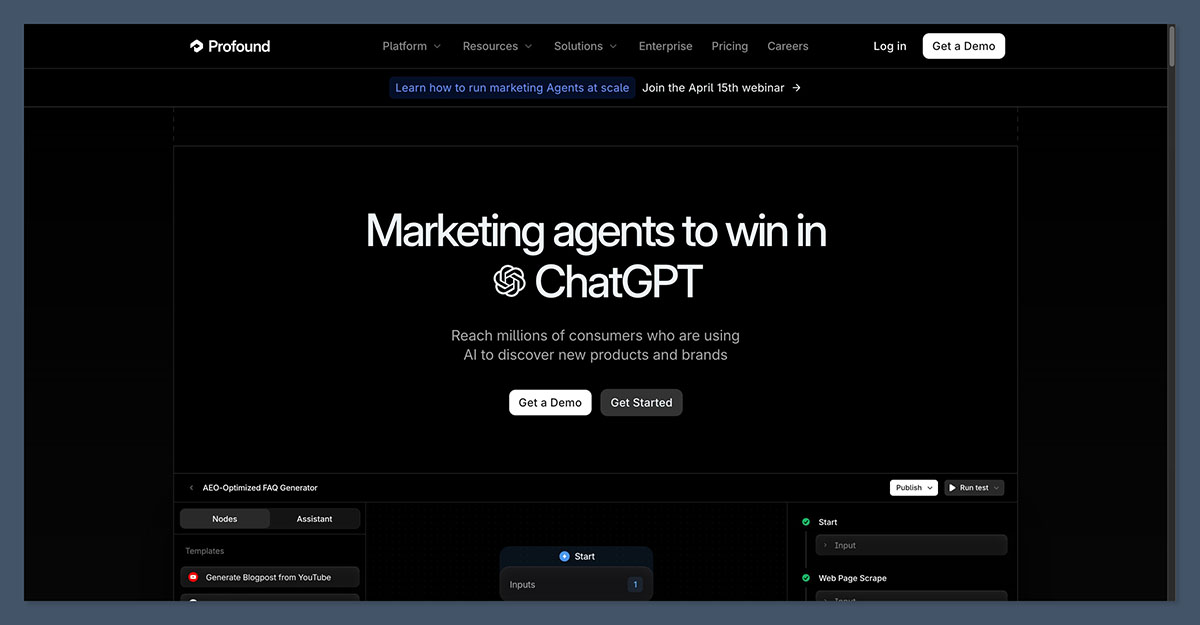
If your goal is to see your brand across as much of the AI universe as possible, Profound has the edge.
Peec AI includes three engines per plan, with daily tracking, and you bolt on Claude, Gemini, and others for a monthly fee.
That keeps the entry price low but means comprehensive multi-engine coverage costs more than the headline figure suggests.
Profound, by contrast, tracks brand representation across more than 10 AI engines, including ChatGPT, Perplexity, Gemini, Microsoft Copilot, Grok, and Meta AI experiences, with richer historical comparisons and competitive ranking baked in.
Coverage breadth shows up in independent testing too. One third-party analysis found that on some prompt sets, around 40% of prompts returned zero visibility for Peec, versus lower zero-visibility rates for Profound, which points to coverage or prompt-fit gaps on the leaner tool.
Both platforms also lean on a prompt-based tracking model, where you configure a fixed set of prompts (25, 100, and so on) that the tool runs across your chosen engines. That makes prompt selection a strategic decision on either platform, and prompt quotas are a common frustration across the category.
The Winner: Profound tracks more AI engines out of the box and delivers deeper historical and competitive data, making it the better choice when full coverage matters.
Best for Features and Workflows: Profound
The two tools answer slightly different questions, and this is where that split becomes obvious.
Peec AI is analytics-first. It tracks share of voice, position, and sentiment, benchmarks you against competitors, surfaces which sources AI engines cite, and exports clean reports. It tells you the score, but it is not built to fix it.
There is no built-in content generation, gap analysis, or crawler log analysis, so you still need your own strategy to close visibility gaps.
Profound goes further. It combines monitoring with auditing and optimization: it helps you diagnose issues like missing citations, outdated descriptions, or competitor over-representation, then connects those findings to content workflows.
Its Agents feature generates AEO-ready content and can publish to a CMS, and newer product lines like Shopping Analysis map how AI assistants recommend products in retail journeys. It is a platform, where Peec is a focused analytics tool.
Worth flagging for both: several capabilities are under-represented in AI answers compared with what the products actually do, a quirk sometimes called capability invisibility.
In other words, neither tool’s full feature set is obvious from a quick AI search, so it pays to test them directly.
The Winner: Profound does more than report. Its auditing and optimization workflows turn visibility data into action, while Peec stops at the dashboard.
Easiest to Use: Peec AI
When testing the two, Peec AI was noticeably faster and friendlier to get going with.
Peec leans into simplicity with a lighter, opinionated interface. Many users go from account creation to their first meaningful dashboards within minutes, which suits smaller teams and agencies onboarding multiple clients at once.
The dashboards are designed for marketers who may not have data engineering support.
Profound’s feature-rich, enterprise-grade environment brings complexity. Reviewers consistently note a steeper learning curve and the need for a dedicated owner to deploy it fully.
Because it is sales-led with no free trial, time to first usable data is typically 1 to 3 weeks, which adds both friction and hidden cost before you can validate fit.
The Winner: Peec AI is far quicker to adopt. Self-serve signup, a clean interface, and fast setup make it the easier tool for most teams to start using today.
Best for Security and Compliance: Profound
For larger organizations, this category can decide the whole comparison.
Profound holds SOC 2 Type II certification and is positioned heavily around enterprise integrations, data pipelines, and dedicated customer success.
For regulated industries or global brands with risk committees, that governance posture is often the deciding factor, even at the higher price.
Peec AI, while venture-backed and growing fast, does not currently highlight SOC 2 or similar certifications in most external comparisons, and is framed as less advanced on formal security signaling.
That is not a dealbreaker for a startup or agency, but it can be for an enterprise procurement process.
The Winner: Profound is built for enterprise security and compliance, with SOC 2 Type II and mature integrations that pass procurement review.
Best for Reporting and Marketing Teams: Peec AI
If your priority is clean, shareable reporting that a marketing team can run without help, Peec AI has the advantage.
Peec offers straightforward visibility dashboards, unlimited user seats on every plan, and reporting integrations such as CSV exports, Looker Studio, and API access on higher tiers.
It is designed to plug into existing SEO and content workflows, which is part of why it has grown to around 1,300 customers, adding roughly 300 per month.
Profound’s reporting is deeper, but it is enterprise-oriented and heavier, which is more than many marketing teams need.
The Winner: Peec AI gives marketing teams and agencies approachable reporting and unlimited seats, making it the easier tool to operationalize across clients.
How We Tested
To compare the two fairly, I spent more than 40 hours hands-on with both platforms: setting up prompts, running tracking across multiple AI engines, building reports, and weighing pricing against real-world output.
I scored each tool across seven areas, weighted by how much they matter when choosing an AI visibility platform:
| Criteria | Weight | What we assessed |
|---|---|---|
| Data Coverage and Accuracy | 30% | Number of AI engines tracked, tracking frequency, and how representative the results felt |
| Features and Workflows | 20% | Monitoring depth plus any auditing, optimization, and content tools |
| Ease of Use and Setup | 15% | Onboarding speed, interface clarity, and time to first usable data |
| Reporting and Integrations | 12% | Dashboards, exports, and connections to tools like Looker Studio |
| Security and Compliance | 10% | Certifications such as SOC 2 and enterprise readiness |
| Value for Money | 8% | Pricing, free trials, and what you get for the cost |
| Support and Onboarding | 5% | Help resources, customer success, and account support |
The recommendations here are based on first-hand use of both platforms, not vendor claims, so you can get a realistic sense of which one suits your team.
Profound vs Peec AI: Our Verdict
This comparison is genuinely split by use case, and that is the honest takeaway.
For most readers, in-house marketing teams, agencies, startups, and growth-stage companies, Peec AI is the better starting point.
It is affordable, fast to set up, comes with a free trial, and produces clean reporting that a marketing team can run without data engineering support.
The trade-off is that it monitors rather than fixes, and its lower tiers cap prompts and charge for extra engines.
For enterprises and regulated brands, Profound is the stronger platform. It tracks the widest range of AI engines, carries SOC 2 Type II certification, and pairs monitoring with auditing and optimization workflows, including content generation.
The trade-off is cost and complexity: there is no free trial, pricing starts high and climbs into custom enterprise territory, and you will want a dedicated owner to get full value.
A common path is to start on Peec AI to prove the value of AI visibility, then graduate to Profound once it becomes a board-level priority.
Whichever way you lean, the smart move is to trial Peec AI and book a Profound demo before committing, so you can see which fits your budget, team, and goals.
Pricing was accurate at the time of writing. AI visibility tools update their plans frequently, so check each provider’s pricing page before you buy.

