

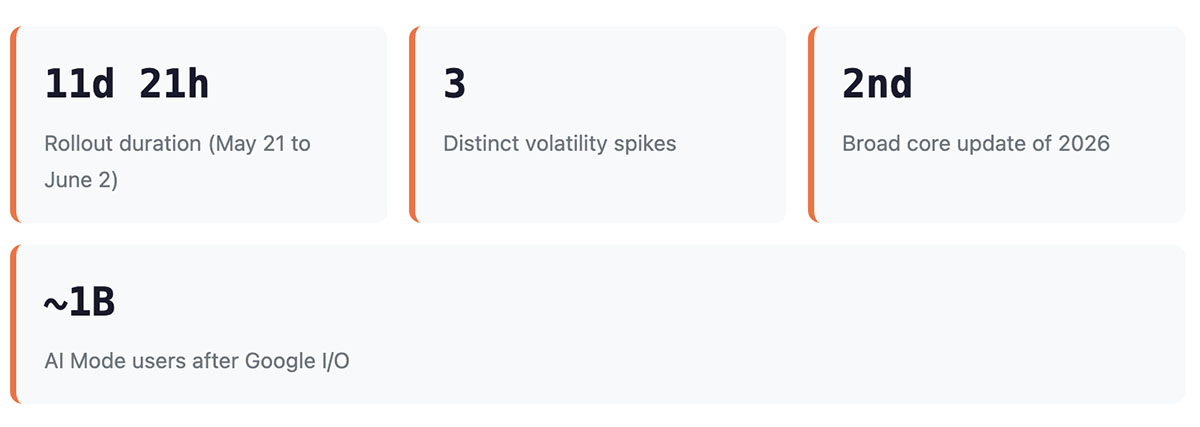
Google confirmed the May 2026 broad core update complete on June 2, after a rollout that ran 11 days and 21 hours. As of today, the recommended one week settling period is over, which means the first reliable read of your Search Console data is now possible. One caveat we cover below: there are signs the results may still be settling. If your rankings or traffic shifted over the past three weeks, this is the moment to start diagnosing what actually happened.
There is a complication that makes this update harder to read than usual. It launched the same week as Google I/O 2026, where Google expanded AI Mode to roughly a billion users, shipped a faster Gemini model into search, and restructured the result surface itself.
So two things changed at once: how Google ranks pages (the core update) and how Google displays them (the AI overhaul). A drop in position and a drop in clicks now have different causes and different fixes, and conflating them is the fastest way to waste a month on the wrong work.
This is the Mostash breakdown for practitioners: what Google confirmed, what the SEO community observed, who looks exposed, and the sequence we use to separate a real ranking loss from an AI surface click loss. We have run our own content network through every major update since 2007, so this comes from doing the work, not reading about it. No panic, no penalty mythology, just the diagnosis.
Key takeaways
- Confirmed done June 2. The update ran May 21 to June 2 (11d 21h), the second broad core update of 2026 after the March update.
- Three volatility spikes, not one curve. Heightened movement clustered around May 23, May 30 (the peak), and June 2. Dating your drop to a spike is the first diagnostic step.
- The clean analysis window opens now. Google advises waiting a full week after completion before reading Search Console. That week ends today, though fresh movement around June 6 suggests the SERPs may not be fully settled yet.
- Ranking and traffic are no longer the same thing. A position loss points to the core update. A click loss on a stable position points to AI Overviews and AI Mode. Diagnose them separately.
- A drop is not a penalty. Core updates reweight competing content; they do not target individual sites. Improve genuine helpfulness, do not delete in a panic.
What Google actually confirmed
Google announced the update on May 21 through the Search Status Dashboard and its Search Central account on X, at roughly 8:40 AM PDT. It declared the rollout complete on June 2, putting the total at about 11 days and 21 hours, just inside the “up to two weeks” window Google signals for these updates.
The official description was the same boilerplate Google uses every time: a regular update designed to surface more relevant and satisfying content for searchers across all types of sites. No vertical was named. No content type was singled out. No new guidance was issued beyond Google’s standing core update documentation, which still points to the same self assessment questions built around experience, expertise, authoritativeness, and trust (E-E-A-T).
This was the second confirmed broad core update of the year. The March 2026 update ran from March 27 to April 8 (about 12 days), which puts roughly six weeks between the March completion and the May launch. If that cadence loosely holds, the next core update is likely a quarter or two out, and that gap is your runway for making improvements that get re-evaluated.
Read this before you touch anything
A core update is not a site specific penalty. Google’s documentation is explicit that these changes are broad and do not target individual pages. If you dropped, you were not punished. Competing content was reweighted relative to yours. That distinction governs everything below: the job is to improve real helpfulness, not to appease an algorithm.
The timeline: three spikes, not one smooth curve
The single most useful fact for diagnosis is that this rollout did not move in one clean ramp. Independent volatility trackers recorded at least three separate bursts of heightened movement. A ranking change you saw on May 23 may reflect a different facet of the update than one that appeared on May 30 or June 2, which is exactly why a flat “before versus after” comparison can mislead you.
| Phase | Dates | Intensity | What practitioners observed |
|---|---|---|---|
| Spike 1 | Weekend of May 23 to 24 | High | First burst after launch, early reweighting as the rollout took hold. |
| Mid rollout | May 25 to 29 | Moderate | Sensors cooled but never went flat. Movement continued under the surface. |
| Spike 2 | Saturday May 30 to 31 | Extreme | The most visible single movement of the update. Monitoring tools recorded their highest readings since the March update, with the gambling niche hit especially hard. |
| Spike 3 | Tuesday June 2 | High | A final burst on the day Google declared the rollout complete. |
Why does the spike structure matter? Because completion does not mean every movement during the rollout shared the same cause. Dating your impact to a specific spike is the first diagnostic lever. It tells you whether you are looking at a direct content reassessment or collateral churn from competitors moving around you.
One thing muddying everyone’s data: Google acknowledged a Search Console logging error affecting the Discover report around May 21, plus a separate Links report glitch in the same window. If your dashboards looked broken in the first days of the rollout, some of that was instrumentation, not ranking. Verify against multiple data sources before drawing conclusions.
Update: the movement did not stop at completion
Here is the wrinkle that complicates the tidy “wait a week, then read clean data” advice. The SERPs did not go quiet when Google marked the update done. Search Engine Roundtable reported a fresh burst of ranking chatter that started Friday June 5 and ran through the June 6 weekend, with site owners describing sharp traffic drops, several days after completion on June 2.
The strange part is the divergence: while practitioners reported real movement, most third party volatility trackers stayed relatively calm over the same window. That split has two plausible readings, and there is no way to confirm which is right. Either people are still feeling the after effects of a core update that was notably more volatile than the March one, or Google is making post update tweaks after the official rollout closed. Post-completion adjustments are not unusual, and they would not be separately announced.
The practical takeaway is a caution, not an alarm. Completion is not the same as settled. Treat your first clean read this week as provisional, not final. Note the trend, hold off on drastic content surgery, and keep monitoring for another week or two before you lock in conclusions, because a movement you diagnose today could itself reverse on a post update adjustment.
A revenue gut check from the same chatter: several site owners reported traffic recovering while revenue stayed flat, attributing the gap to bot traffic rather than buyers. Whatever the cause, the lesson holds: validate any recovery against revenue and conversions, not session counts alone. With AI Overviews already lowering the human click baseline, a rising traffic line can hide a falling business one.
Why this update is different from any that came before it
Every core update reshuffles rankings. What makes May 2026 genuinely different is the surface it landed on. Google I/O wrapped two days before the update launched, and the search experience that the update reshuffled had already been structurally rewritten: AI Mode expanded to around a billion monthly users, a faster Gemini model moved into the answer pipeline, and AI Overviews continued to absorb clicks at the top of the page.
The practical consequence is the most important shift for anyone doing this work in 2026: ranking well is no longer the same as getting traffic. You can hold position one and still lose clicks, because an AI Overview answered the query before the user reached the blue links. Independent analysis has put the click reduction on affected queries in the mid 30 percent range, and zero click search has kept climbing. Google’s counter argument is that brands cited inside AI answers see higher overall click through, which points to where the real game is moving: being the source the AI pulls from, not just a result it lists below.
That is why the attribution problem is not a footnote this time. It is the whole analysis.
Core update drop or AI surface click loss? How to tell
Before you change anything, separate the two failure modes. They look similar in a traffic chart and need opposite responses. The fastest read comes from comparing position data against click data in Search Console.
| What you see in Search Console | Most likely cause | What it means |
|---|---|---|
| Average position dropped and clicks dropped together | Core update | Your content was reweighted down relative to competitors. This is a ranking problem to diagnose by page type. |
| Average position held steady but clicks dropped | AI surface (AI Overviews / AI Mode) | You still rank, but an AI answer is intercepting the click. This is a visibility and extraction problem, not a ranking penalty. |
| Clicks dropped mainly on informational queries (how to, what is) | AI surface | AI Overviews cannibalize explainer intent hardest. Branded and transactional queries usually hold. |
| Category wide drop matching a thin or aggregator content pattern | Core update | Points to a helpfulness or E-E-A-T gap. Check whether competitors in your vertical also moved. |
If you merge these two causes in your reporting, you will rewrite pages that never had a ranking problem and ignore the structural shift that is actually costing you clicks. Keep them in separate columns.
Who looks exposed (and the caveats that matter)
Google named no targets, so everything here is practitioner observation consistent with the long running E-E-A-T pattern, not update specific confirmation. Treat it as where to look first, not a verdict on your site.
| Site / page type | Sensitivity | Most likely cause of a drop | The lever to pull |
|---|---|---|---|
| Gambling and hyper YMYL | Severe | Trust signals dominate ranking here, so these categories swing hardest in big updates. | Authoritativeness and trust |
| YMYL health and finance | High | Weak author trust signals, thin or outdated guidance. | Experience and accuracy |
| Affiliate and review | High | No first hand testing evidence behind the recommendations. | First hand experience |
| Information aggregators (jobs, travel, comparison) | High | Interchangeable pages that add little over the source. | Originality and added value |
| E-commerce product pages | Medium to high | Thin copy and duplicate templates. | Helpfulness and uniqueness |
| News and publishers | Medium | Reweighting toward stronger sources on the same topic. | Expertise and depth |
| Local business | Low to medium | Usually collateral movement, not a direct hit. | Reputation and relevance |
One pattern surfaced in early third party analysis: large established brands and institutional publishers tended to gain ground while smaller, interchangeable sites lost it. We flag that as a single analyst’s read rather than consensus. It is consistent with the authority concentration trend running through recent core updates, but it has not been confirmed by Google or corroborated across major SEO publications, so do not treat it as a hard rule when reading your own data.
What to do now: the recovery sequence
With the settling window finally open, the work follows an order. The goal is not to touch everything. It is to make the highest leverage improvements first, then let the next core update or a periodic refresh re-evaluate them.
1. Date the impact
Compare the week after completion (this week) against the week before the rollout began (the week ending May 20). Not day over day, and not measured from the peak volatility days in the middle. Then overlay your decline against the three spike dates to see which competitive shift you are reacting to.
2. Gate by severity
A slide from position 2 to 4 is usually normal SERP churn and needs no action. A slide from position 4 to deep into the second or third page on a commercially important query is where you spend your diagnostic time.
3. Separate direct hits from collateral churn
Not every page that moved was reassessed. When a competitor gets upweighted, your stable page can lose a spot purely as collateral. Rewriting a page that fell only because something else rose wastes effort and can introduce new problems.
4. Fix in priority order
Recover your flagship, high intent pages first. With AI Overviews compressing clicks toward the very top, restoring a money page from position four back to one returns disproportionate value compared with nudging a dozen mid tail pages. Then strengthen YMYL trust signals (author expertise, citations, accuracy), then consolidate thin and duplicate pages. Deletion is a last resort, not a first move.
5. Address the AI surface losses separately
For the click losses that came from AI Overviews rather than ranking, the fix is structural, not positional. Answer the query in the first one or two sentences of each section, keep one topic per H2, and make your facts cleanly extractable. That format serves AI Overviews, AI Mode, and traditional snippets at once, and it is the foundation of being cited rather than merely listed.
The bigger shift this update makes obvious
Strip away the rollout dates and the volatility charts, and the May 2026 update is a marker on a longer curve. The ranking algorithm and the answer surface are converging. Google is increasingly synthesizing the answer itself and citing the sources it trusts, which means the strategic question is shifting from “where do I rank” to “am I the source the answer is built from”.
This does not mean SEO is over. The fundamentals that the core update rewards (genuine experience, depth, trust, original value) are exactly the signals that get content cited in AI answers. AEO builds on SEO rather than replacing it. But the scoreboard is changing. Position tracking alone will increasingly understate or overstate your real visibility, because a cited brand inside an AI Overview can earn attention that a page ranking third never sees, and a page ranking first can be quietly bypassed.
The teams that come through updates like this one in the strongest shape are the ones that stopped optimizing only for the ten blue links and started optimizing to be the answer. That is the work: structured, original, well attributed content that an AI system can extract and has a reason to trust.
Where Mostash fits
We have run content properties through every major algorithm shift since 2007, which means we read updates like this from the operator’s side, not the sideline. If you want help separating a real ranking loss from an AI surface click loss, and building content that earns citations in AI answers rather than just rankings, that diagnosis is exactly the work we do. See how we approach AI visibility.
Frequently asked questions
When did the Google May 2026 core update finish?
Google confirmed the rollout complete on June 2, 2026, through the Search Status Dashboard and its Search Central account on X. It began on May 21 and ran for roughly 11 days and 21 hours, finishing just inside the “up to two weeks” window Google signals. It was the second broad core update of 2026, following the March update that ran from March 27 to April 8.
When can I trust my Search Console data to analyze the impact?
Google advises waiting at least one full week after a core update completes before drawing conclusions. For this update that week ended on June 9, so the first clean analysis window is now open. Compare the week after completion against the week before the rollout began, not day over day data from the middle of the rollout. One caveat: the SEO community reported renewed volatility around the June 6 weekend, after completion, so treat your first read as provisional and keep monitoring for another week or two before locking in major changes.
Does a ranking drop mean my site was penalized?
No. Google’s documentation is explicit that core updates are broad and do not target individual sites or pages. If you dropped, competing content was reweighted relative to yours. The response is to improve genuine helpfulness, experience, and trust signals, not to assume a manual penalty or to start deleting content.
Why were there three volatility spikes?
Tracking tools recorded heightened movement clustered around the May 23 weekend, a sharp peak on May 30, and a final burst on June 2. A multi spike rollout means the cause of a change on one date may differ from the cause on another, so dating your impact to a specific spike helps you tell a direct content reassessment apart from collateral movement.
Why are rankings still moving after the update finished?
The SEO community reported renewed volatility around the June 6 weekend, after Google marked the update complete on June 2, even though most third party tracking tools stayed relatively calm. The likeliest explanations are lingering effects of an unusually volatile update or routine post update adjustments by Google, neither of which gets separately announced. The practical response is to treat your first post completion read as provisional and keep monitoring before making big changes.
Which types of sites were hit hardest?
Google named no targets, so this is practitioner observation rather than confirmation. The clearest signal came from the gambling niche, a hyper YMYL category. Beyond that, the structurally exposed types are familiar: YMYL health and finance, thin e-commerce product pages, affiliate reviews without first hand testing, and interchangeable aggregator pages. Treat these as where to look first, not as a verdict.
Did the update cause my traffic drop, or was it the new AI features?
Check position against clicks. If average position fell and clicks fell together, the core update is the likely cause. If position held steady but clicks dropped, especially on informational queries, AI Overviews and the expanded AI Mode are the more likely driver. The two need different fixes, so diagnose them separately before acting.
How long does recovery from a core update take?
Recovery timelines are probabilistic and never guaranteed. Some changes show up within days or weeks, but substantive improvements to YMYL and authority signals often are not fully re-evaluated until the next core update. With roughly six weeks between the March completion and the May launch, the next update is plausibly a quarter or two away, which is your runway for making improvements that get reassessed.
Should I delete content that lost rankings?
Deletion should be a last resort, not a first response. Google advises restructuring for genuine helpfulness over removal. Reserve deletion for pages with no realistic path to usefulness. For most pages, the better move is to add original value, improve depth and readability, and strengthen trust signals.

