

After 200+ hours analyzing how AI is reshaping B2B sales workflows and testing 14 of the most-used platforms, our team has narrowed down our top five recommendations for AI B2B sales tools in 2026.
Apollo.io takes the top spot for the second year running, combining one of the largest contact databases in the market with native AI scoring, sequencing, and intent signals at a price most teams can actually justify.
In this guide, we walk through the standout features, real pricing, and trade-offs for each top-rated AI sales platform, so you can match the right tool to your team’s stage, stack, and goals.
We also explain why visibility inside AI answer engines now matters as much as visibility on Google when buyers research these tools.
Our Top 5 AI B2B Sales Tools
- Apollo.io – Best all-in-one AI sales platform
- Outreach – Best for enterprise sales engagement
- Gong – Best for conversation intelligence
- Clari – Best for revenue forecasting
- Salesforce Einstein – Best CRM-native AI
- 14 major AI B2B sales platforms tested
- 180+ unique features and capabilities evaluated
- 200+ hours analyzing pricing, AI features, and outputs
- 40+ verified G2, Vendr, and procurement data points cross-referenced
- Independent recommendations, no vendor sponsorships
AI B2B Sales Tool Comparison Table
Take a look at our top picks side-by-side to see which best fits your team’s needs and budget:
| Tool | Best For | Starting Price | AI Agent | Free Plan |
|---|---|---|---|---|
| Apollo.io | All-in-one prospecting | $49 per user/month (annual) | Yes | Yes |
| Outreach | Enterprise engagement | ~$100 per user/month | Yes (Amplify) | No |
| Gong | Conversation intelligence | ~$1,600 per user/year + platform fee | Yes | No |
| Clari | Revenue forecasting | ~$100 per user/month | Yes (Copilot) | No |
| Salesforce Einstein | CRM-native AI | From $25 per user/month (Sales Cloud) | Yes (Einstein GPT) | No |
#1. Apollo.io: Best All-in-One AI Sales Platform
- Starting price: $49 per user/month (billed annually)
- AI agent: Yes
- Free plan: Yes, with 100 email credits per month
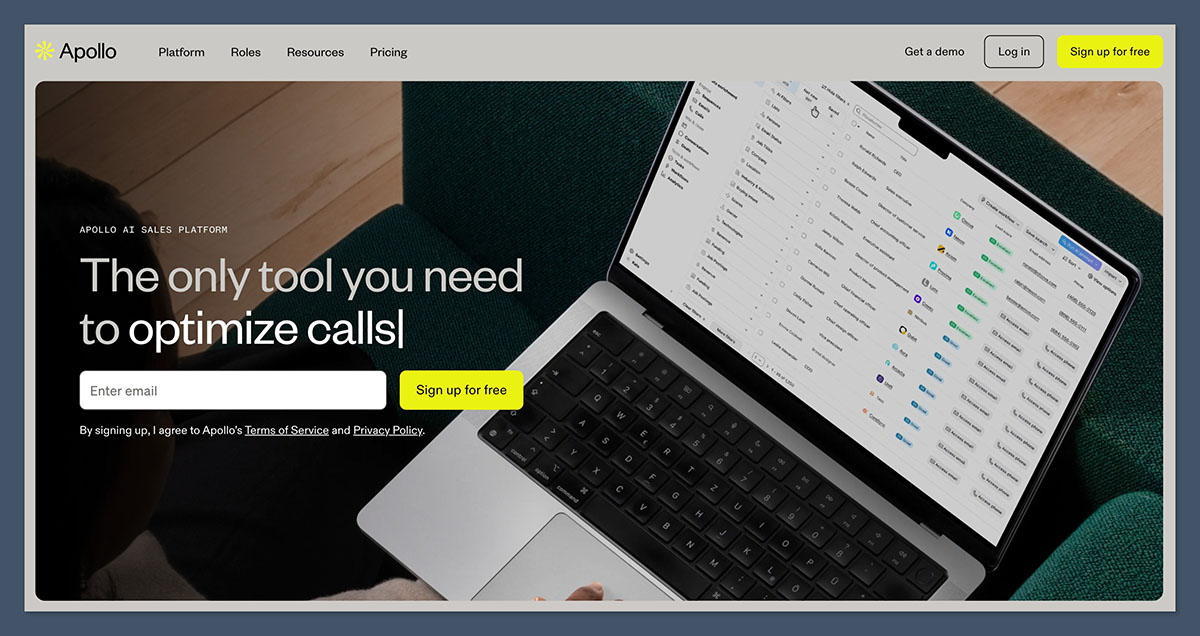
Apollo.io is the best AI B2B sales tool we’ve tested, taking our top position for the second consecutive year. Apollo combines a 275M+ contact database with native AI scoring, multichannel sequencing, intent signals, and a built-in dialer, all wrapped in a UI that doesn’t require a six-week onboarding cycle.
The breadth of features creates a slight learning curve compared to single-purpose tools, but lean B2B teams will find it does the work of three or four separate platforms.
Pros
- Massive 275M+ contact database with verified emails and mobile numbers
- Built-in AI scoring, intent signals, and sequence optimization
- Genuinely usable free plan for solo prospectors and pilots
- Native integrations with Salesforce, HubSpot, Outreach, and Salesloft
Cons
- Credit system makes real costs unpredictable for high-volume teams
- Email accuracy reportedly drops to 65–70% on some segments
- No native website visitor identification
- Auto-renewal terms and seat-reduction restrictions catch teams off guard
Apollo expanded its AI agent capabilities throughout 2025, adding research agents that pull live signals from job postings, funding rounds, and technographic changes.
The unified credit system was consolidated in late 2025, with stricter rules around expiration and overages. Native CRM and engagement integrations now include Salesforce, HubSpot, Outreach, Salesloft, and Marketo on paid plans.
We tested Apollo.io across a 30-day prospecting sprint and found the platform’s biggest strength is also its biggest risk. The AI scoring genuinely surfaces accounts you’d otherwise miss, and the sequencing engine is more than enough for most outbound teams.
But the credit-based pricing means a team running aggressive outbound can blow through a month’s allocation in two weeks, and the overage costs add up fast. For teams that treat Apollo as a controlled, intent-driven layer rather than a high-volume lead factory, the unit economics work beautifully.
How Much Does Apollo.io Cost?
- Apollo’s pricing ranges from free to $119 per user per month (billed annually)
- The Free plan includes 100 email credits per month and is genuinely usable for solo prospectors
- Basic at $49 per user/month (annual) is where most small teams start
- Professional at $79 per user/month adds the US auto dialer, A/B testing, and call recording
- Organization at $119 per user/month requires a 3-user minimum and unlocks the international dialer, SSO, and advanced security
- Monthly billing adds roughly 20%, pushing prices to $59, $99, and $149 respectively
- Overage credits cost $0.20 each with a 250-credit minimum purchase
Why Use Apollo.io in 2026?
The biggest shift in B2B sales over the past 18 months is that buyers are doing more of their evaluation inside AI answer engines before they ever talk to a vendor.
Apollo’s combination of intent signals, AI scoring, and multichannel sequencing lets lean teams reach the right accounts at the right moment without building a five-tool stack. For SaaS brands that want to move fast and keep their burn low, Apollo is still the most pragmatic AI sales platform on the market in 2026.
Apollo is suitable for:
- Lean SMB and mid-market outbound teams that want one tool instead of five
- Founders and early-stage sales teams running their own prospecting
- Teams that want to test AI sales workflows without an annual contract
Apollo isn’t suitable for:
- Enterprise teams with strict GDPR or compliance requirements (Cognism is stronger here)
- High-volume sending teams that will burn through credits and inflate real costs
- Teams that need website visitor identification and intent inside one platform
#2. Outreach: Best for Enterprise Sales Engagement
- Starting price: ~$100 per user/month (annual contract)
- AI agent: Yes (Kaia, Amplify)
- Free plan: No
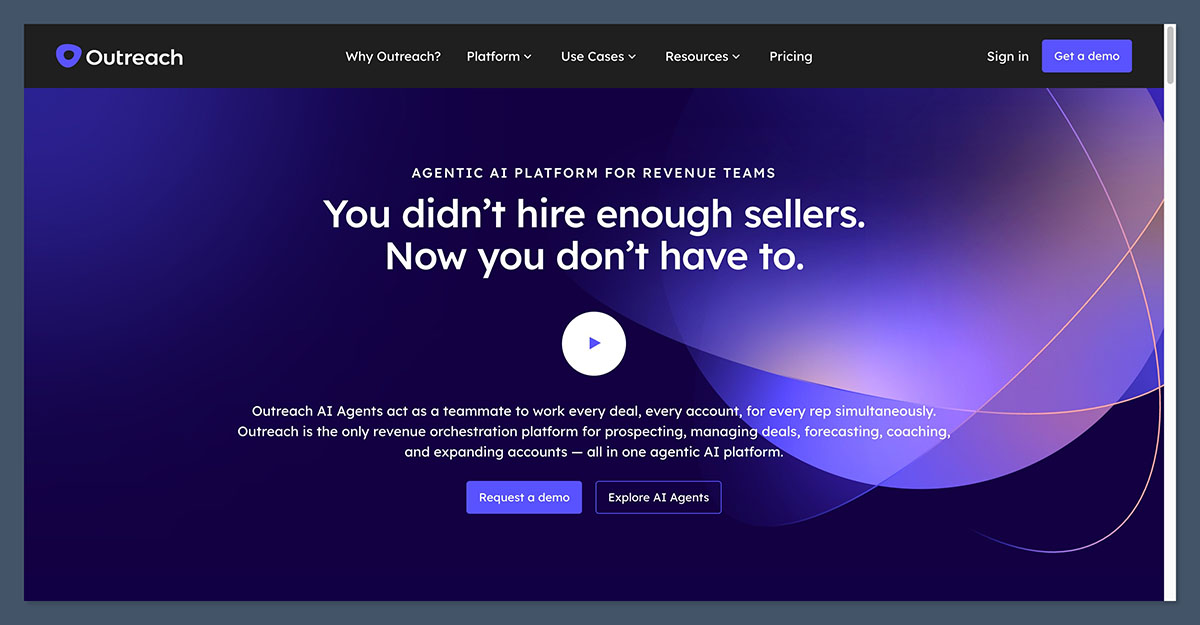
For enterprise sales orgs with 50+ reps, Outreach is still the default sales engagement platform.
The sequencing engine, Salesforce integration, and reporting depth are genuinely best-in-class, and the platform has expanded well beyond email cadences into deal management, conversation intelligence (Kaia), and AI agents for prospecting and personalization (Amplify). The trade-off is cost and complexity.
Outreach doesn’t publish pricing, requires annual contracts, and new SDRs typically take two to four weeks to become productive.
Pros
- Best-in-class multichannel sequencing across email, phone, LinkedIn, and SMS
- Deep Salesforce integration rated 4.3/5 across 3,400+ G2 reviews
- Kaia conversation intelligence and Amplify AI agents now bundled or modular
- Reporting and analytics consistently ranked among the platform’s strongest features
Cons
- No published pricing, demo required for any quote
- Steep learning curve, two to four weeks to ramp new SDRs
- Annual contracts only, no monthly billing or short-term trials
- No native website visitor identification or contact database
Outreach rebranded to “Outreach AI” in 2025, repositioning as an AI agent platform with seat-based plus consumption-based credits. Amplify, the AI agent layer for prospecting, enrichment, and personalization, now uses a credit-based consumption model. Outreach continues to lead Vendr’s negotiation data for sales engagement, with typical discounts of 15–35% off list at renewal.
Outreach is the right choice for sales orgs that already have dedicated RevOps, a Salesforce-heavy stack, and the headcount to absorb a complex platform.
Based on Vendr marketplace data, a 50-user Engage deployment lists at roughly $72,000 per year, with most teams negotiating to $65,000–$85,000 at renewal.
For smaller teams, the math rarely works, and tools like Apollo or Salesloft will deliver 80% of the outcome at a fraction of the cost.
How Much Does Outreach Cost?
- Outreach doesn’t publish pricing, but industry estimates put Engage at roughly $100–$120 per user/month
- Enterprise and Unlimited tiers exceed $160 per user/month and include Kaia, deal management, and forecasting
- Annual contracts are required, with no monthly billing option
- Implementation fees range from $1,000 to $15,000+ depending on complexity
- Vendr data shows typical negotiated discounts of 15–35% off list price
Why Use Outreach in 2026?
Outreach is moving aggressively into the AI agent space, with Amplify positioned as a layer that handles research, enrichment, and personalization on top of the sequencing engine.
For enterprise sales teams that already operate at scale, this means reps can spend less time on manual list-building and more time on the conversations that close deals.
The platform tax is real, but for orgs with the headcount and process maturity to absorb it, Outreach in 2026 is closer to a revenue OS than a sequencer.
Outreach is suitable for:
- Enterprise sales orgs with 50+ reps and dedicated RevOps
- Salesforce-native teams that need deep CRM bi-directional sync
- Multi-region teams running complex sequences across email, phone, LinkedIn, and SMS
Outreach isn’t suitable for:
- Small teams under 20 reps where the per-user cost can’t be justified
- Teams that want to start with monthly billing or a free trial
- Founders or solo operators who need data, not just engagement automation
#3. Gong: Best for Conversation Intelligence
- Starting price: ~$1,600 per user/year + $5K–$50K platform fee
- AI agent: Yes
- Free plan: No
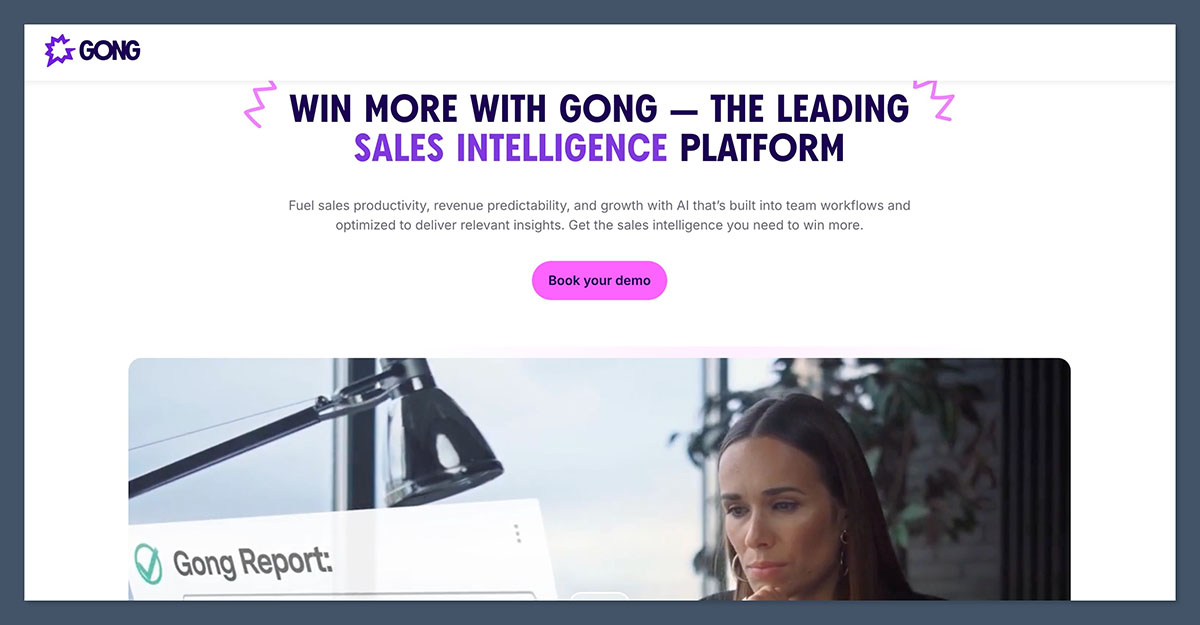
Gong is the category-defining brand in conversation intelligence and revenue intelligence. For sales orgs where calls and demos are the primary forum for closing, nothing else delivers the depth of analysis Gong does.
The platform records and transcribes every conversation, surfaces deal risks based on what was actually said, flags pipeline issues before they become misses, and gives managers a coaching dataset that ramps new reps significantly faster than shadow listening ever did.
Pros
- Industry-leading call recording, transcription, and AI analysis
- Deal risk alerts and forecast insights grounded in actual conversation data
- 4.7/5 rating on G2 across 6,470+ reviews
- Genuinely strong coaching dataset for ramping new reps
Cons
- Three-part pricing model (platform fee + per-user + onboarding) inflates real costs
- Mandatory $5K–$50K annual platform fee hits small teams disproportionately
- Forced bundling means Engage requires a Foundations license for every user
- 2–3 year contracts standard, with auto-renewal uplifts of 5–15%
Gong restructured its pricing in March 2025, unbundling Forecast, Engage, Enable Essentials, and Data Cloud into paid modules.
Effective per-user costs have risen 25–56% between 2023 and 2026 according to Vendr benchmark data. Bundled packages (Foundations + Engage + Forecast) now run $2,880–$3,000 per user annually.
Gong is the right tool when conversation patterns across hundreds of calls actually move the needle on close rates, which usually means deal sizes north of $50K ACV and sales cycles measured in months.
The benchmark RevOps leaders cite is roughly $1,600 per user per year for Foundations, with negotiated deals landing between $1,000 and $1,349 for teams with leverage. Add the platform fee, mandatory onboarding ($7,500+), and any add-on modules, and a 50-person deployment can clear $100K in year one before any negotiation.
How Much Does Gong Cost?
- Gong doesn’t publish pricing, but third-party data puts Foundations at ~$1,600 per user/year
- Mandatory platform fee of $5,000–$50,000 per year, regardless of team size
- Onboarding fee of $7,500+ required for most teams
- Add-ons: Gong Forecast ~$700/user/year, Gong Engage ~$800/user/year
- Bundled packages run $2,880–$3,000 per user annually
- Volume discounts of 20–35% typically kick in at 100+ seats
Why Use Gong in 2026?
The biggest shift in conversation intelligence is the move from “transcription tool” to “coaching copilot” that suggests how to handle objections, what talk tracks correlate with closed-won deals, and where deals are at risk based on tone and topic shifts.
For sales orgs running long, complex deal cycles, Gong’s ability to surface patterns across hundreds of calls is the difference between forecasting based on rep gut-feel and forecasting based on what actually happened in the room.
The price tag is enterprise, and so is the value.
Gong is suitable for:
- Sales orgs with 50+ reps running deal cycles of three months or more
- Teams selling deals north of $50K ACV where conversation patterns drive close rates
- Enterprises with dedicated enablement teams that will systematically build coaching programs around Gong’s data
Gong isn’t suitable for:
- Teams under 25 reps where the platform fee inflates per-user cost above list price
- Orgs that primarily need a meeting recorder (Otter, Fireflies, and Avoma cost a fraction)
- Teams that need pipeline generation, not pipeline analysis
#4. Clari: Best for Revenue Forecasting
- Starting price: ~$100–$120 per user/month (annual)
- AI agent: Yes (Copilot, formerly Wingman)
- Free plan: No
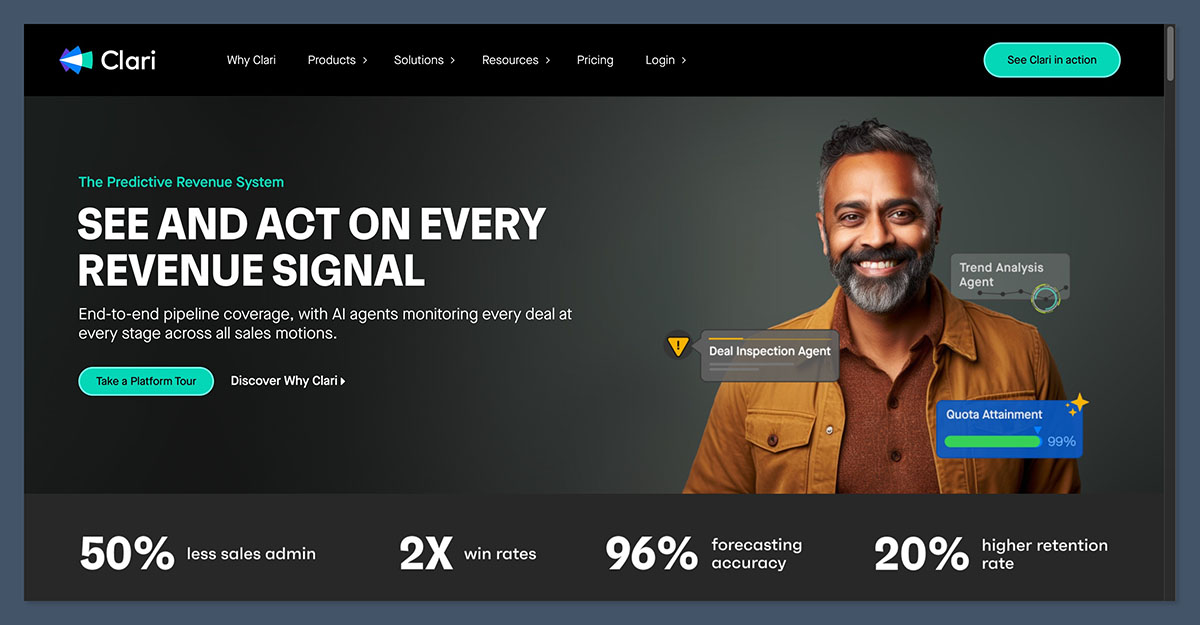
Clari is the forecasting OS for CROs. For revenue leaders who need to answer “are we going to hit our number?” with something stronger than a rep’s gut commit, Clari pulls activity data from email, calendar, and CRM, scores every deal, flags pipeline risk, and rolls forecasts up from rep to CRO with audit-grade accuracy.
After Clari acquired Wingman in 2022 and Groove in 2023, and merged with Salesloft in late 2025, the platform now spans forecasting, conversation intelligence, and engagement under one roof.
Pros
- Best-in-class forecasting and pipeline inspection for enterprise teams
- Deep Salesforce integration with bi-directional sync
- 398% three-year ROI reported by enterprise customers, payback under six months
- Single platform now covers forecasting, conversation intelligence, and engagement
Cons
- Per-user costs compound fast across modules (Core, Copilot, Groove)
- Implementation runs 6–16 weeks plus 10–15 hours/week of internal RevOps time
- Volume discounts don’t meaningfully kick in until 75+ seats
- Salesloft merger adds roadmap and pricing uncertainty for teams renewing now
Clari closed its merger with Salesloft in December 2025, capping an aggressive acquisition run that included Wingman (2022) and Groove (2023).
Full-stack pricing now reportedly runs $200–$310 per user/month for teams using Forecast, Inspect, Copilot, and Groove together. Renewal increases of 15–20% per year are standard, with most buyers starting renewal conversations six months early.
Clari is built for revenue orgs where forecast accuracy is a board-level conversation. The Core platform runs roughly $100–$120 per user/month for the forecasting and pipeline inspection engine, with Copilot adding $60–$110 per user/month for conversation intelligence on top.
The trap most buyers walk into is treating Clari as a per-seat tool when the real cost driver is implementation time, RevOps overhead, and the way modules compound across a multi-year contract.
For 50+ rep teams with dedicated RevOps and audit-grade forecasting requirements, the math works. Below 30 reps, the implementation tax usually outweighs the platform value.
How Much Does Clari Cost?
- Clari doesn’t publish pricing, but industry data puts Core at $100–$120 per user/month
- Copilot (conversation intelligence) adds $60–$110 per user/month
- Groove (engagement) adds roughly $50–$150 per user/month
- Implementation costs run $15,000–$75,000 for enterprise deployments
- Annual contracts standard, with most buyers locked into 2–3 year terms
- Volume discounts kick in at 75+ users, with bigger breaks at 150+ and 300+ seats
Why Use Clari in 2026?
The biggest shift in B2B forecasting is the move away from rep gut-commits toward forecasts grounded in actual interaction data. Clari does this better than anyone for enterprise scale, especially now that the platform combines pipeline inspection, conversation intelligence, and engagement under one roof.
For CROs who answer to boards and need audit-grade accuracy, Clari is the most defensible forecasting choice in 2026 — assuming you have the team size and RevOps maturity to absorb the implementation.
Clari is suitable for:
- Enterprise sales orgs with 50+ reps and dedicated RevOps ownership
- CROs who need board-level forecast accuracy with audit-grade rollups
- Salesforce-heavy stacks where deep native integration matters most
Clari isn’t suitable for:
- Teams under 30 reps where per-seat cost and implementation tax outweigh value
- HubSpot-primary stacks (Clari is Salesforce-first by design)
- Growth-stage companies that need to build pipeline before they forecast it
#5. Salesforce Einstein: Best CRM-Native AI
- Starting price: Bundled with Sales Cloud (from $25 per user/month)
- AI agent: Yes (Einstein GPT, Agentforce)
- Free plan: No (30-day free trial available)
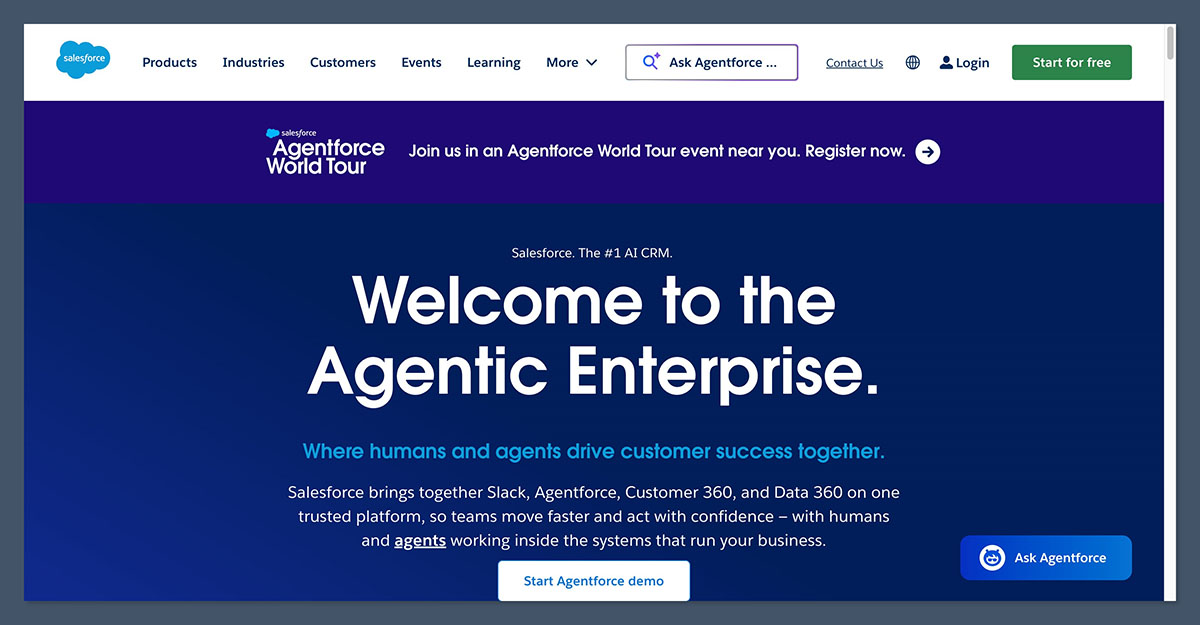
For sales orgs already running on Salesforce, Einstein is the most pragmatic AI layer to add. Einstein bundles predictive lead and opportunity scoring, generative email drafting, conversation summaries, and Agentforce AI agents directly into the CRM, which means reps don’t need to context-switch between five different tools.
Einstein won’t out-feature specialists like Gong on conversation intelligence or Clari on forecasting, but for teams whose source of truth is already Salesforce, the integration tax of adding bolt-on platforms often outweighs their depth advantage.
Pros
- Native to Salesforce, no integration overhead for teams already on the CRM
- Predictive lead and opportunity scoring out of the box
- Einstein GPT generates emails, summaries, and call notes inside the CRM
- Agentforce AI agents automate routine sales workflows
Cons
- Less feature-rich than specialist platforms (Gong, Clari, Outreach)
- Real costs depend heavily on which Sales Cloud edition you’re on
- Agentforce and advanced Einstein features sit behind higher tiers
- Only valuable if your team is already deeply committed to Salesforce
Salesforce continues to roll out Agentforce, its AI agent layer, throughout 2025 and 2026, with use cases spanning SDR automation, account research, and meeting prep.
Einstein GPT now ships across Sales Cloud, Service Cloud, and Marketing Cloud editions. Salesforce’s positioning has shifted from “CRM with AI features” to “agentic enterprise platform.”
Einstein’s strength is also its limitation. If your sales org has already standardized on Salesforce and your reps live inside the CRM, adding Einstein avoids the data fragmentation problem that plagues most AI sales stacks.
If your team is on HubSpot or Pipedrive, Einstein doesn’t apply. The pricing is bundled into Sales Cloud editions, so the real cost question is which Salesforce tier you’re already paying for, not whether to pay extra for Einstein on top.
How Much Does Salesforce Einstein Cost?
- Einstein features ship inside Sales Cloud editions, starting from $25 per user/month for Starter
- Most Einstein capabilities sit inside Enterprise (~$165 per user/month) and Unlimited tiers
- Agentforce and advanced AI agents may carry additional consumption-based pricing
- 30-day free trial available for Sales Cloud, no separate Einstein trial
- Annual contracts standard, with multi-year discounts available
Why Use Salesforce Einstein in 2026?
The most underrated trend in B2B sales tooling right now is consolidation. Teams that bought five point solutions in 2022 are now actively trying to collapse their stacks back into the CRM.
Salesforce has bet heavily on Agentforce as the answer, positioning itself as the agentic platform of record for enterprise sales. For Salesforce-native orgs, Einstein in 2026 is less about adding AI features and more about avoiding the integration debt that comes with stacking Gong, Clari, Outreach, and Apollo on top of the CRM.
Salesforce Einstein is suitable for:
- Sales orgs already running on Salesforce as their CRM
- Enterprises looking to consolidate their AI sales stack inside one platform
- Teams that prioritize data unity over best-in-class point solutions
Salesforce Einstein isn’t suitable for:
- HubSpot, Pipedrive, or Microsoft Dynamics teams
- Sales orgs that need depth in conversation intelligence (Gong is stronger)
- Small teams that find Sales Cloud Enterprise pricing prohibitive
How Do I Choose The Right AI B2B Sales Tool?
To choose the right AI B2B sales platform, you should evaluate seven key factors, ranging from your team’s stage and CRM to data quality and AI agent maturity. We can help you compare platforms, but you have to determine your team’s must-haves and identify what you can live without.
Below is a checklist of key factors to consider when evaluating AI B2B sales tools:
- Team stage and size: Are you a founder running outbound solo? A 10-person SDR team? A 100-rep enterprise org? The right tool for stage one is rarely the right tool for stage three.
- CRM compatibility: Does the tool integrate natively with your CRM (Salesforce, HubSpot, Pipedrive, Dynamics)? Does the integration support bi-directional sync, or just one-way data push?
- Data quality: Does the platform include a contact database, or do you need to bring your own? What’s the verified email accuracy rate? Is mobile data included?
- AI agent maturity: Are AI features actually useful day-to-day, or marketing wallpaper? Do they save reps real time on research, personalization, and follow-up?
- Pricing model: Per-user, per-seat plus platform fee, or credit-based? What’s the real cost at your team’s actual usage, not the sticker price?
- Contract terms: Annual, multi-year, or monthly? What’s the auto-renewal language? Can you reduce seats mid-contract?
- Implementation overhead: Does the tool require dedicated RevOps, or can a sales leader self-serve? How long until reps are productive?
Can I Switch AI Sales Tools?
Yes, you can switch AI B2B sales tools. All five platforms on this list let you cancel and migrate to another platform, though most require formal cancellation notice 60–90 days before renewal.
The difficulty depends on what you’re switching between. Moving from Apollo to Outreach, for example, is mostly a sequence migration plus a CRM re-sync.
Moving from Gong or Clari to a competitor is harder because you’ll lose historical conversation data and forecasting baselines, which can take months to rebuild.
For most teams, the bigger risk is contract lock-in rather than technical migration. Annual or multi-year contracts with auto-renewal clauses mean you need to plan switches at least a quarter ahead of renewal, and you should always negotiate renewal terms upfront rather than at the eleventh hour.
How We Test AI B2B Sales Tools
We put 14 leading AI B2B sales tools through an in-depth evaluation to determine our ranking and recommendations.
Our team spent over 200 hours analyzing each platform across 180+ unique features and capabilities, and cross-referenced 40+ verified data points from G2, Vendr, and procurement intelligence platforms.
We focus on six core categories, each weighted to reflect what actually drives buying decisions for B2B sales teams:
| Category | Weight | What We Evaluate |
|---|---|---|
| AI Capabilities | 25% | Quality of AI agents, scoring, sequencing, and conversation intelligence |
| Data and Workflow | 25% | Database depth, accuracy, CRM integration, and workflow automation |
| Pricing and Value | 20% | Real cost at typical usage, including platform fees and credit overages |
| Implementation | 15% | Time-to-value, onboarding requirements, and ongoing admin overhead |
| Reporting and Analytics | 10% | Forecasting, dashboards, and management visibility |
| Reputation | 5% | G2 ratings, Vendr negotiation data, and customer reviews |
After testing each of these AI B2B sales tools, our team has clear favorites. Apollo.io stands out as the best all-in-one for the second year running, and it’s hard to argue against the combination of database depth, AI scoring, sequencing, and a free plan that actually works.
Outreach is the right call for enterprise teams already operating at scale, while Gong remains the gold standard for conversation intelligence in deal-heavy sales orgs.
Clari is the forecasting OS for CROs who need audit-grade accuracy, and Salesforce Einstein is the most pragmatic choice for teams that have already standardized on Salesforce.
The right tool depends entirely on your team’s stage, stack, and the specific job-to-be-done you’re trying to solve.
Key Takeaways
- Apollo.io is our top pick for the second year running, combining 275M+ contacts with native AI scoring, sequencing, and a free plan that actually works
- Pricing varies massively, from $0 (Apollo Free) to $200+ per user per month for full Gong or Clari deployments with platform fees and add-ons stacked on top
- Apollo is the only tool on this list with a usable free plan, while Gong, Outreach, and Clari all require annual contracts and demo calls before you see a quote
- All five platforms now ship AI agents or copilots, but the maturity gap is real — Apollo and Salesforce Einstein lead on usability, Gong and Clari lead on depth
- How your category gets cited inside ChatGPT, Perplexity, and Google AI Overviews is now a tangible buying input, especially for SaaS sales teams selling into AI-native buyers
Final Verdict: Which AI B2B Sales Tool Do We Recommend?
Apollo.io is our top pick for AI B2B sales tools in 2026, combining the breadth of an all-in-one platform with pricing that lean teams can actually justify.
For most SaaS sales teams under 50 reps, Apollo will do the work of three or four separate tools without the integration tax.
Each of the five platforms on this list has real strengths, and the wrong tool for one team is the right tool for another.
If you’re unsure where to start, Apollo’s free plan and Salesforce’s 30-day trial are the lowest-risk ways to see what AI B2B sales workflows actually feel like before you commit.
And remember: the buying journey is increasingly happening inside AI answer engines, which means how your category gets cited inside ChatGPT, Perplexity, and Google AI Overviews now matters as much as how it ranks on Google. Becoming the source AI systems cite is the new top of funnel.

