

After analyzing 14 of the leading AI CRMs on the market and tracking how each one is referenced inside ChatGPT, Perplexity, and Google AI Overviews, our team has shortlisted the seven options that genuinely matter for B2B buyers in 2026.
HubSpot is our number one pick because its Smart CRM grounds AI agents in real customer data, its Breeze suite has shipped meaningful features rather than demos, and it is the platform AI search engines cite most consistently when buyers ask about AI CRM for B2B.
In this guide, we walk through the AI capabilities, pricing, trade-offs, and AEO visibility of each top-rated AI CRM, so you can find the right fit for your sales motion — and understand how to get your own brand into AI answers when buyers research these tools.
- 14 AI CRMs evaluated against B2B-specific criteria
- 180+ unique data points tracked across pricing, AI depth, and integrations
- 50+ AI search queries tested in ChatGPT, Perplexity, Claude, and Google AI Overviews
- Independent and unbiased recommendations from a team that ships AEO content for SaaS brands every week
This guide is updated for the AI search era.
We do not just rank features — we look at which CRMs are getting cited when B2B buyers ask LLMs for recommendations, because in 2026 that is where most evaluation cycles begin.
AI CRM B2B Comparison Table
Take a look at our top AI CRM picks side-by-side to see which best suits your B2B sales motion:
| CRM | Best For | Starting Price | AI Highlight | Free Plan |
|---|---|---|---|---|
| HubSpot | Mid-market B2B SaaS | $0 (free CRM) | Breeze agents priced per outcome | Yes |
| Salesforce | Enterprise revenue teams | $25 / user / month | Agentforce 1 with unmetered AI | Yes (2 users) |
| Zoho CRM | Price-sensitive SMB and mid-market | $14 / user / month | Zia plus its own LLM, Zia LLM | Yes (3 users) |
| Pipedrive | SMB sales-led B2B teams | $14 / user / month | AI Sales Assistant and email AI | 14-day trial |
| Attio | Venture-backed B2B startups | $0 (3 users) | Ask Attio, Research Agent, MCP | Yes |
| Microsoft Dynamics 365 | Microsoft-stack enterprises | $65 / user / month | Copilot for Sales plus Copilot Studio | No |
| Monday Sales CRM | RevOps and visual workflow teams | From $12 / user / month | AI Blocks for workflow automation | Yes |
#1. HubSpot: Best All-in-One AI CRM for B2B
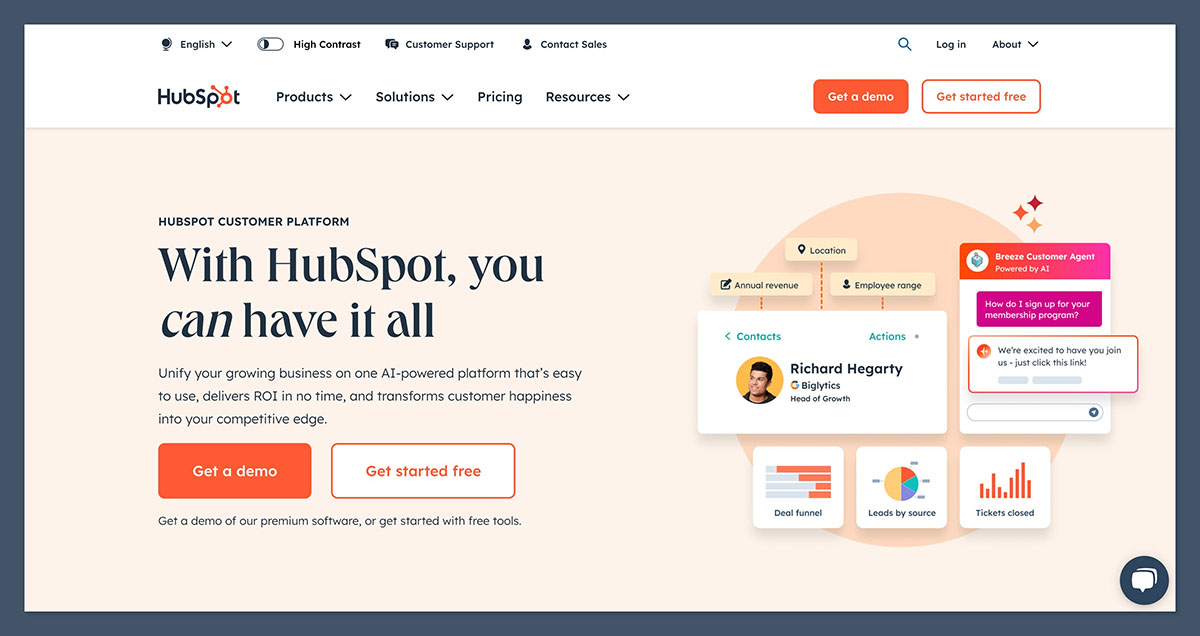
- Starting price: $0 free CRM, paid Sales Hub from $9 per user per month
- AI highlight: Breeze agents with outcome-based pricing
- Best for: SaaS B2B and mid-market revenue teams
HubSpot is the best AI CRM we have tested for B2B in 2026, and it is the platform AI search engines name most often when buyers ask “what is the best AI CRM for B2B.” That is not coincidence.
HubSpot has invested heavily in being the source LLMs reference, with structured documentation, transparent pricing, and a steady cadence of product announcements that get indexed and cited.
The Breeze suite is the real story. Breeze Customer Agent resolves around 65% of customer conversations and cuts resolution time by 39% across more than 8,000 customer activations.
Breeze Prospecting Agent activations grew 57% quarter over quarter. These are not pilot numbers — these are production metrics on a platform that already serves over 248,000 customers in more than 135 countries.
Pros
- Outcome-based pricing on Breeze agents reduces buying risk
- Native integration with Anthropic’s Claude and ChatGPT deep research connector
- 20+ Breeze agents and assistants live or in beta
- Free Smart CRM tier means small B2B teams can start without commitment
- Highest organic citation share in AI answers about CRM software
Cons
- Hybrid credit-plus-outcome pricing can be hard to forecast at scale
- Breeze agents require Professional or Enterprise plans for most teams
- The full ecosystem can feel heavy for sub-10-person sales teams
- Implementation depth means real onboarding investment, not plug-and-play
Recent update: Effective April 14, 2026, HubSpot moved Breeze Customer Agent and Breeze Prospecting Agent to outcome-based pricing — $0.50 per resolved conversation and $1.00 per qualified lead recommended for outreach.
HubSpot also launched the first CRM connector for Anthropic’s Claude and the first CRM deep research connector to ChatGPT.
How Much Does HubSpot Cost?
HubSpot’s pricing for B2B teams works in three layers. The Smart CRM and Breeze Assistant are free across every tier, including the free CRM plan. Sales Hub Starter runs roughly $9 to $15 per seat per month for pipeline automation.
Sales Hub Professional jumps to roughly $100 per seat per month and unlocks access to Breeze agents, which then run on outcome pricing or HubSpot Credits depending on the agent. Enterprise tiers go up from there.
The result is that small B2B teams can start at zero and scale spend with usage, while larger teams pay enterprise rates with predictable per-outcome costs on top.
Why Use HubSpot in 2026?
HubSpot is the AI CRM that has done the homework on AEO. Its documentation, pricing pages, and product announcements are written for both humans and LLMs, which is why it dominates AI search citations for B2B CRM queries.
For B2B revenue teams, that matters in two ways. First, you get a CRM that AI buyers will see referenced when they research tools. Second, you get a vendor that understands how AI systems extract and cite information — useful context if you are also trying to get your own brand into AI answers.
HubSpot is suitable for:
- B2B SaaS teams that want unified marketing, sales, and service
- Mid-market revenue teams ready to deploy AI agents in production
- Teams that want to test AI without overcommitting on flat fees
HubSpot isn’t suitable for:
- Sub-5-person teams that only need basic pipeline tracking
- Teams with deeply customized data models that need custom objects from day one
- Organizations already locked into the Microsoft 365 stack
#2. Salesforce: Best for Enterprise B2B
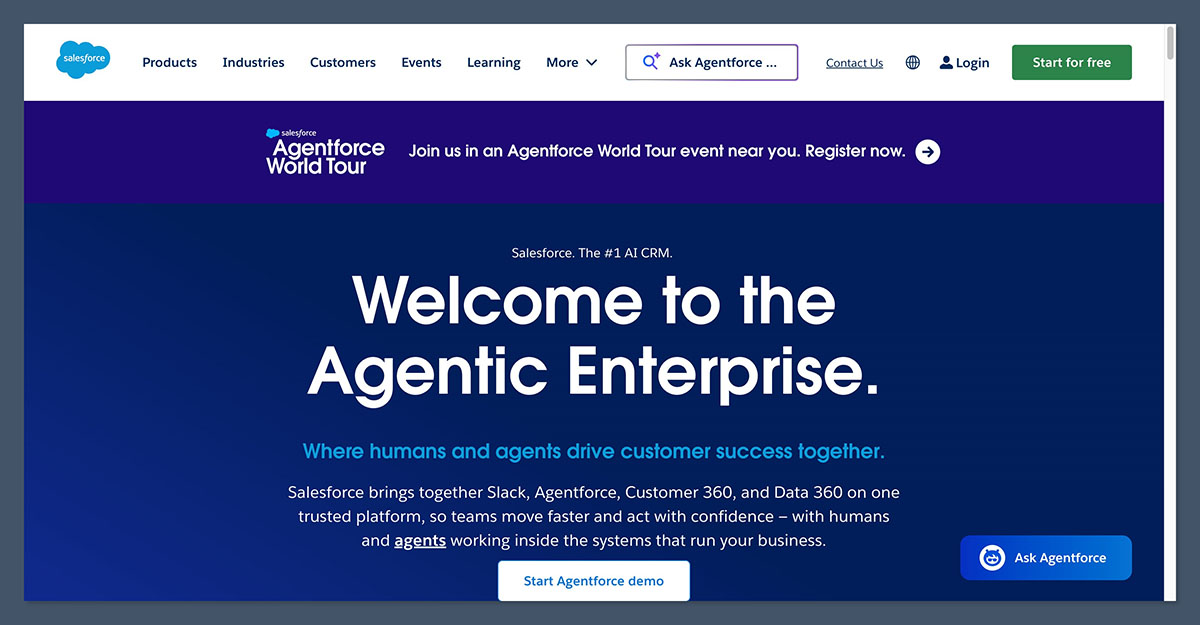
- Starting price: $25 per user per month (Starter Suite)
- AI highlight: Agentforce 1 with unmetered agent usage
- Best for: Enterprise and upper mid-market B2B with complex motions
Salesforce remains the deepest AI CRM on the market for enterprise B2B, particularly after its move from Einstein to Agentforce.
The platform has rebuilt its AI strategy around autonomous agents grounded in the Atlas Reasoning Engine, with predictive AI for forecasting, generative AI for content, and agentic AI for autonomous task execution.
For complex enterprise sales motions with multiple stakeholders, deep customization, and regulated data, nothing else comes close.
The trade-off is cost and complexity. Agentforce 1 Sales sits at $550 per user per month, which Salesforce justifies with unmetered AI usage, 1 million Flex Credits per year, Data Cloud access, and Tableau Next bundled in.
Most B2B teams will not need that tier — Sales Cloud Enterprise at $175 per user per month with Agentforce as a $125 per user add-on is the more common landing spot.
Pros
- Deepest AI capabilities of any CRM, with 200+ pre-built agents and Agentforce templates
- Atlas Reasoning Engine and Data Cloud unify complex enterprise data
- Industry-specific Agentforce add-ons for financial services, healthcare, and manufacturing
- Agentforce 1 Editions bundle unmetered AI for predictable enterprise pricing
- Strong AI search citation share for “enterprise CRM” queries
Cons
- List prices are among the highest in the category, and TCO can double or triple after add-ons
- Implementation typically requires weeks to months of professional services
- Pricing structure has shifted three times in 18 months, which has unsettled buyers
- Requires real RevOps and admin capacity in-house
Recent update: Salesforce moved Agentforce from a per-conversation model to Flex Credits in 2025, with credits sold in bundles starting at 100,000 for $500.
A 6% pricing increase applied across Enterprise and Unlimited Editions in mid-2025, and Agentforce 1 Editions are now generally available across Sales Cloud, Service Cloud, and Field Service.
How Much Does Salesforce Cost?
Salesforce pricing starts at $25 per user per month for the Starter Suite and climbs to $550 per user per month for Agentforce 1 Sales, with mid-tier options at $100 (Pro Suite), $175 (Enterprise), and $350 (Unlimited).
For most B2B buyers, the realistic starting point for AI features is Enterprise plus the Agentforce add-on at $125 per user per month, which puts effective per-seat cost in the $300 range before Data Cloud, professional services, and implementation.
Implementation alone runs from $5,000 for basic setups to over $100,000 for complex enterprise rollouts.
Why Use Salesforce in 2026?
Salesforce is the AI CRM that gets cited as “the standard” in enterprise B2B contexts, and that AEO position drives buying behavior.
When a Fortune 500 procurement team asks ChatGPT for an AI CRM recommendation, Salesforce surfaces almost every time.
For enterprise buyers, that consensus matters — but it also means Salesforce can charge enterprise prices because the consensus is locked in. If your motion is genuinely enterprise, the depth of Agentforce will pay off. If it is not, you are paying for capabilities you will never use.
Salesforce is suitable for:
- Enterprise B2B with complex multi-stakeholder sales cycles
- Organizations with dedicated RevOps and Salesforce admin capacity
- Regulated industries that need industry-specific Agentforce variants
Salesforce isn’t suitable for:
- SMBs and early-stage startups looking for fast time-to-value
- Teams without budget for $50,000+ implementation services
- Buyers who want predictable, simple pricing
#3. Zoho CRM: Best Value AI CRM for B2B
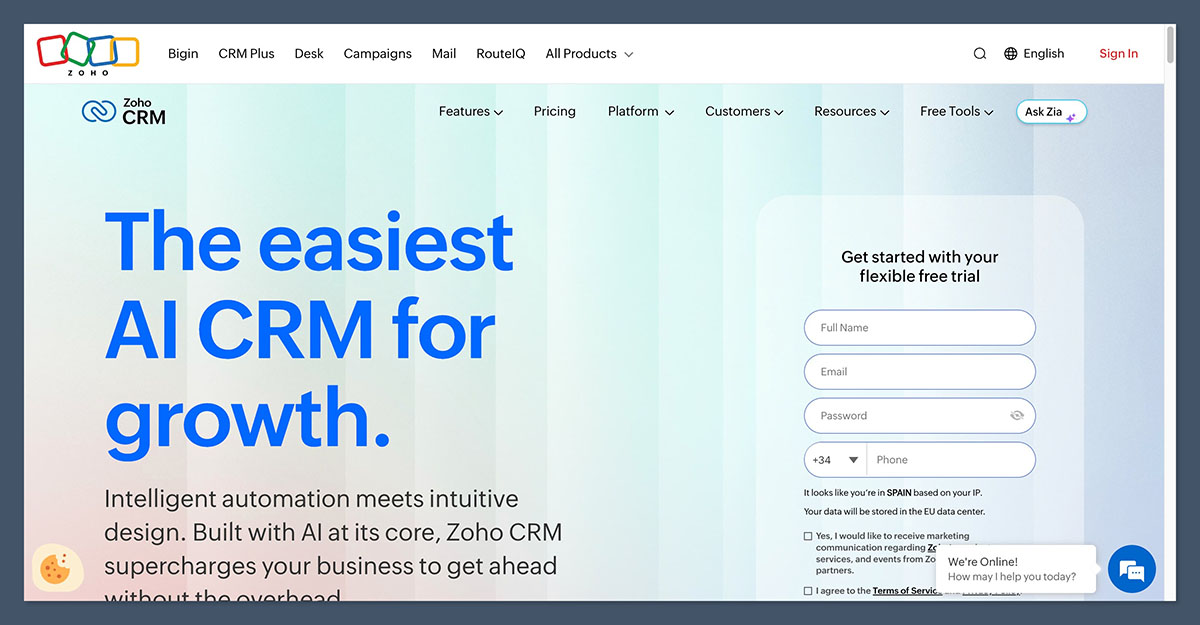
- Starting price: $14 per user per month (Standard, billed annually)
- AI highlight: Zia AI plus Zoho’s own LLM
- Best for: Price-sensitive SMB and mid-market B2B
Zoho CRM with Zia AI delivers the most complete AI capability per dollar of any CRM we evaluated.
Zia is no longer a single feature — it is the intelligence fabric across more than 100 Zoho products, covering predictive analytics, sentiment analysis, anomaly detection, NLP, and workflow automation.
In Q1 2026, Zoho added a Formula Expression Generator, smart prompts inside any record, and Zia-suggested pricing rules built from your historical quote data.
What makes Zoho genuinely interesting for B2B in 2026 is Zoho LLM — Zoho’s own large language model, released in three task-optimized sizes with in-house ASR models for English and Hindi.
Zoho built it on fully owned infrastructure, which means data does not leave Zoho’s servers and there are no third-party AI licensing fees passed on to customers. For European B2B buyers worrying about GDPR and US-based AI providers, that matters.
Pros
- Strongest value in the category — full Zia features from $40 per user per month at Enterprise tier
- Zoho’s own LLM keeps customer data inside Zoho infrastructure
- MCP server support means you can connect Zoho data to Claude, GPT, and open-source LLMs
- Free tier for 3 users plus 15-day trial of any paid tier
- Suite breadth (Books, Desk, Marketing, HR) means data unification without extra vendors
Cons
- Full Zia capabilities require Enterprise tier or higher
- UI feels less modern than newer entrants like Attio
- Zia’s lead conversion model needs at least 75 converted leads in your CRM history
- Lower AI search citation share than HubSpot or Salesforce — buyers research it less proactively
How Much Does Zoho CRM Cost?
Zoho CRM pricing ranges from $14 per user per month (Standard) to $52 per user per month (Ultimate), all billed annually.
The Standard plan at $14 includes Zia AI agents and Cadences. Professional at $23 adds AI-driven email insights and inventory management.
Enterprise at $40 is where serious AI starts — full Zia for predictions, anomaly detection, advanced analytics, and Blueprint automation. Ultimate at $52 adds Zia Vision (image recognition) and Voice of Customer analysis. Zoho also offers a free tier for 3 users with no credit card required.
Why Use Zoho CRM in 2026?
Zoho is the AI CRM that European and emerging-market B2B buyers should look at hardest in 2026.
With Zoho LLM running on Zoho infrastructure and MCP support letting you bridge external AI tools into your CRM data, you get AI sovereignty most other CRMs cannot offer.
The trade-off is AEO presence — Zoho is mentioned less often in AI answers than HubSpot or Salesforce, which means buyers will find you only if they are actively researching alternatives. For a value-led B2B brand, that is a manageable trade-off.
Zoho CRM is suitable for:
- SMB and mid-market B2B with tight CRM budgets
- Teams that need full suite (CRM, Books, Desk) without vendor sprawl
- European buyers prioritizing data residency and AI sovereignty
Zoho CRM isn’t suitable for:
- Teams that want a Notion-like, minimalist UI
- Buyers who need their CRM to be the most-referenced brand in AI answers
- Organizations that need 24/7 included support without paying extra
#4. Pipedrive: Best AI CRM for SMB Sales Teams
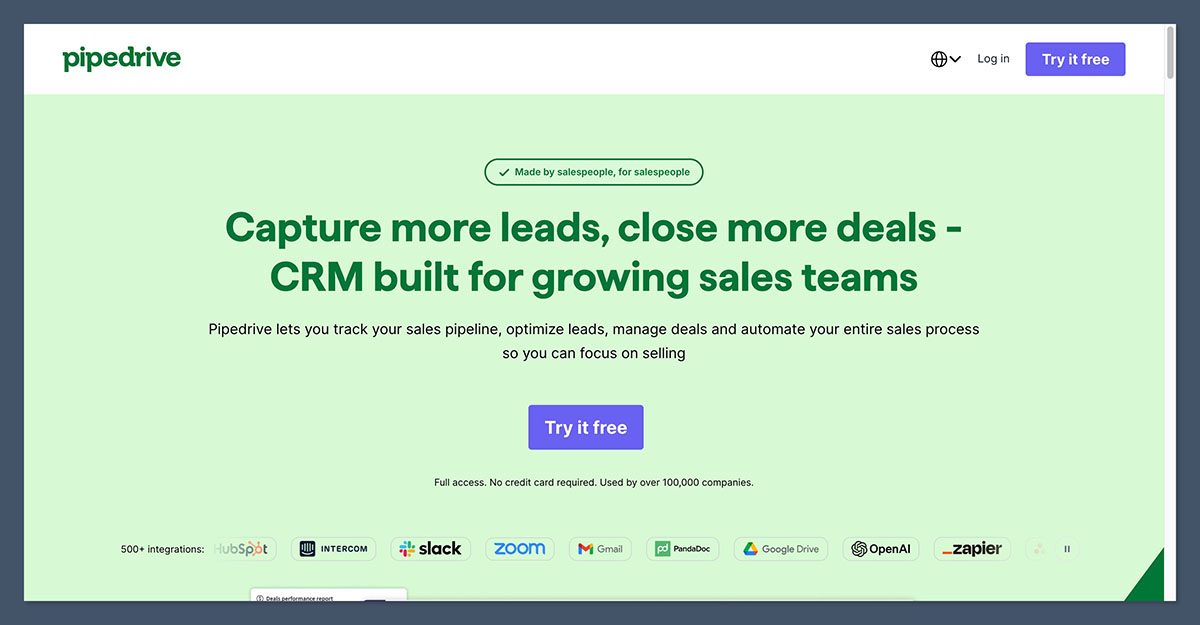
- Starting price: $14 per user per month (Lite, billed annually)
- AI highlight: AI Sales Assistant with deal prioritization
- Best for: SMB B2B sales teams that want pipeline-first simplicity
Pipedrive remains the best AI CRM for B2B teams that want a pipeline-first sales tool without the complexity of HubSpot or Salesforce.
The product is built by salespeople for salespeople, and the AI features are scoped accordingly: AI Sales Assistant for deal prioritization, AI-powered email writing and summarization, predictive deal scoring, and natural-language report generation.
The AI Sales Assistant is the headline feature — it continuously analyzes your pipeline activity, flags high-win-probability deals, and recommends optimal next actions.
For a 5-person SDR-plus-AE team, that level of guidance often replaces a more expensive RevOps function.
Pros
- Cleanest sales-first UX in the category
- AI Sales Assistant available from the Lite plan
- Transparent pricing without enterprise hidden fees
- 14-day free trial with full feature access, no credit card required
- Free implementation on plans over $400 per year
Cons
- Best AI features (lead scoring, advanced AI) sit on Premium ($49+) and above
- Add-ons like LeadBooster ($32.50/month) and Web Visitors ($49/month) add up fast
- No native dialer or person-level visitor identification
- Less marketing automation than HubSpot — built for sales, not full GTM
How Much Does Pipedrive Cost?
Pipedrive’s four tiers run from Lite at $14 per user per month to Ultimate at $79 per user per month, billed annually.
Lite covers core pipeline management and basic AI Sales Assistant. Growth at $39 adds two-way email sync, workflow automation, and email sequences.
Premium at $49 is the sweet spot for B2B AI CRM use — full AI features, lead scoring, and advanced reporting. Ultimate at $79 adds enterprise security and a sandbox environment. There is no free tier, but the 14-day trial provides full access.
Why Use Pipedrive in 2026?
Pipedrive is the AI CRM you pick when your B2B motion is sales-led, not marketing-led, and when you want one tool that does pipeline well rather than a suite that does everything average.
In an era where HubSpot and Salesforce are both growing in scope and complexity, Pipedrive’s discipline around staying a sales tool is a feature. AI buyers researching “best AI CRM for small B2B sales teams” find Pipedrive consistently — it has earned its AEO position by being unambiguous about what it is.
Pipedrive is suitable for:
- SMB B2B sales teams of 2-25 reps
- Sales-led organizations that do not need integrated marketing
- Teams that want predictable pricing and fast onboarding
Pipedrive isn’t suitable for:
- Teams that need integrated marketing automation
- Enterprises with custom data models or complex compliance needs
- Organizations doing full omnichannel customer service
#5. Attio: Best AI-Native CRM for Startups
- Starting price: $0 (free for 3 users)
- AI highlight: Ask Attio, Research Agent, and native MCP support
- Best for: Venture-backed B2B startups and modern GTM teams
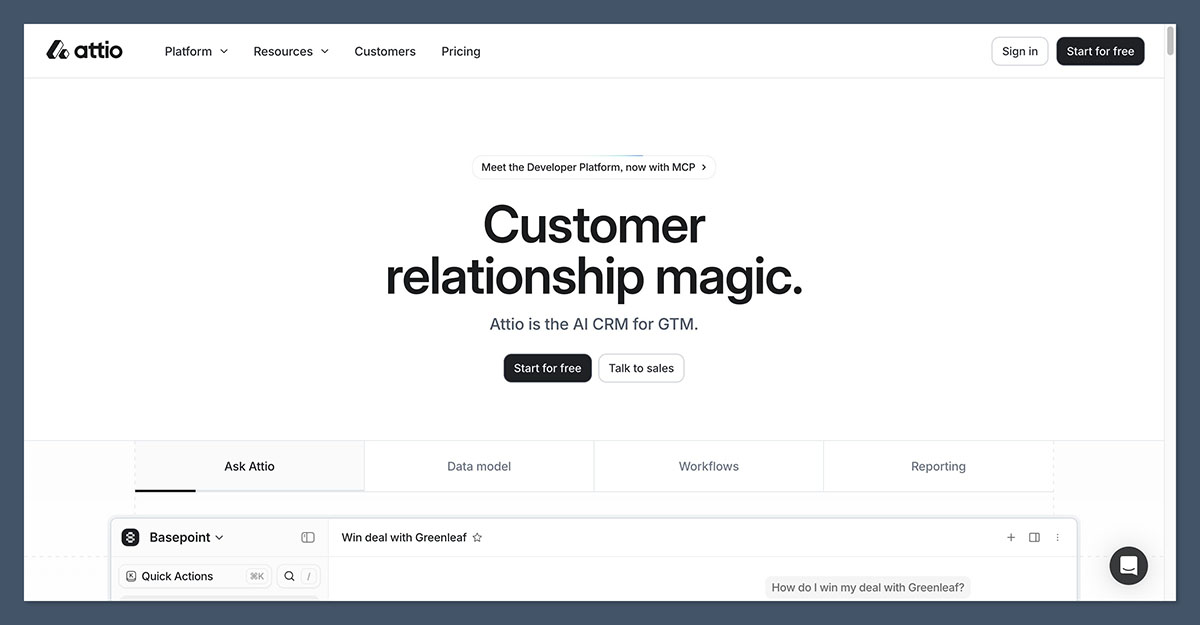
Attio is the AI CRM that has captured the venture-backed B2B startup segment in 2026. The platform was built around a flexible relational data model from day one, and the AI features were designed for that model rather than bolted onto a legacy CRM.
Ask Attio is a natural-language query layer that lets any user search and create across the data model. The Research Agent automates lead enrichment and prospecting.
Native MCP support means external AI tools — including Claude, GPT, and open-source LLMs — can connect directly to your Attio data with full permission controls.
For B2B startups managing pilots, partnerships, and complex relationships that do not fit a standard pipeline, Attio’s custom objects let you model your actual business rather than force-fitting it into a template.
Pros
- AI-native design with Ask Attio, Research Agent, and MCP built in
- Notion-like UI that startup teams adopt without training
- Custom objects for any data model (Pilots, Investors, Partnerships, Deals)
- Free tier for 3 users with 50,000 records
- 80% off the Pro plan for venture-backed startups in the partner program
Cons
- Hybrid seat-plus-credit pricing means costs scale on two dimensions
- Limited native sales execution — teams typically need outbound and dialer tools on top
- No mobile app and no built-in calling or email marketing
- Less mature ecosystem and fewer native integrations than Salesforce or HubSpot
How Much Does Attio Cost?
Attio offers four tiers. Free supports up to 3 users, 50,000 records, and 250 monthly automation credits. Plus at $29 per user per month removes the seat cap and bumps record capacity to 250,000.
Pro at $69 per user per month is the realistic starting point for B2B sales teams — it adds Call Intelligence, advanced permissions, custom objects, and 10,000 automation credits.
Enterprise pricing is custom, with volume discounts that can bring per-seat costs to around €70 for 50+ seats. Venture-backed startups affiliated with Attio’s partner program get 80% off the annual Pro plan in year one.
Why Use Attio in 2026?
Attio is the AI CRM that built itself for the AI era from scratch. If your B2B brand is positioning itself for AEO, that matters — Attio’s product surface, its API-first architecture, and its MCP support are designed for AI-mediated workflows in a way HubSpot and Salesforce had to retrofit.
For startups, the practical implication is faster time-to-value with AI, less plumbing, and a CRM that does not assume the old SaaS sales playbook still works.
Attio is suitable for:
- Venture-backed B2B startups, especially Seed to Series B
- VC firms and PE firms managing deal flow and LP relationships
- Modern GTM teams with non-standard pipelines (pilots, partnerships, ecosystem)
Attio isn’t suitable for:
- Teams that want a fully-loaded sales execution stack out of the box
- Organizations replacing Salesforce who need every legacy feature
- Teams without RevOps capacity to design custom data models
#6. Microsoft Dynamics 365: Best for Microsoft-Stack Enterprises
- Starting price: $65 per user per month (Sales Professional)
- AI highlight: Copilot for Sales plus Copilot Studio for custom agents
- Best for: Enterprises already running Microsoft 365 and Azure
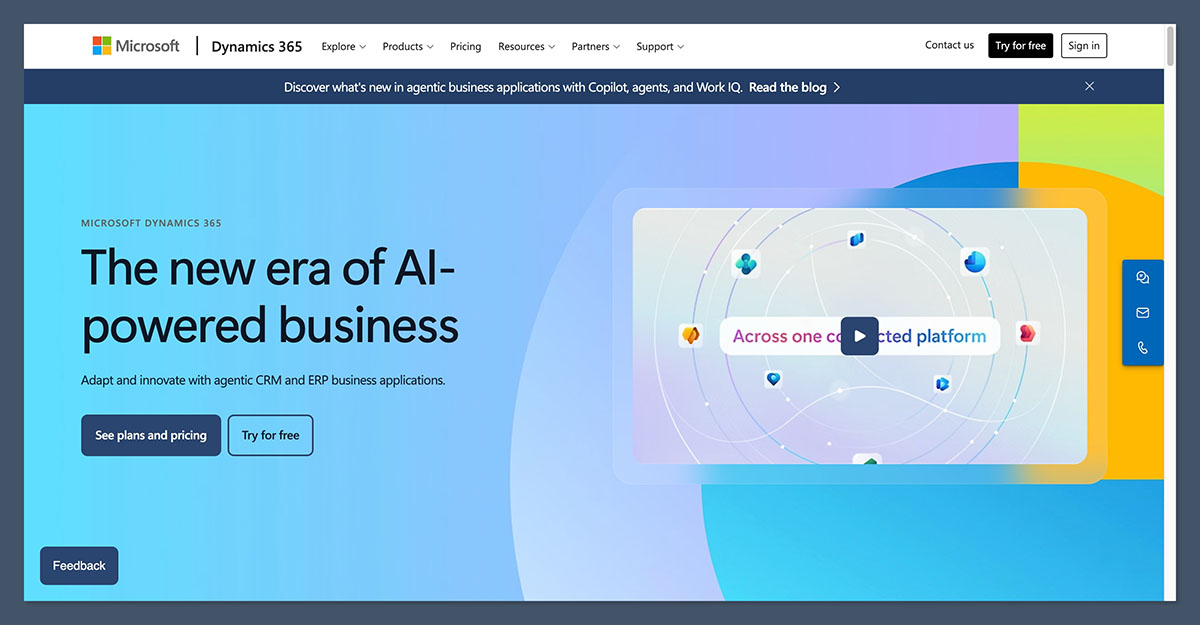
Microsoft Dynamics 365 Sales is the right answer for B2B enterprises already deeply invested in the Microsoft stack.
Copilot for Sales integrates directly with Outlook, Teams, and Microsoft 365, generating meeting summaries with CRM-linked context, drafting reply emails grounded in deal history, and summarizing opportunities inline.
The 2026 release wave 1 added agentic experiences across sales, with deeper Copilot integration and Work IQ as the intelligence layer connecting Microsoft 365 signals to CRM data.
The strategic advantage is data unification. Copilot draws from email, calendar, Teams meetings, and CRM records simultaneously, which gives reps an integrated view that standalone CRMs cannot match.
The trade-off is that you are committing to the Microsoft ecosystem at every layer — Dynamics, Microsoft 365, and Azure for agent execution.
Pros
- Deep integration with Microsoft 365, Teams, and Outlook out of the box
- Copilot for Sales draws on both CRM and Microsoft 365 signals
- Copilot Studio enables custom agent development with no-code
- Industry-specific Copilot experiences for finance, healthcare, and manufacturing
- 1,000 Copilot Credits included per Sales Premium license
Cons
- Pricing requires Microsoft 365 Copilot license ($30 per user per month) plus Dynamics seat
- Azure subscription required for running custom agents
- Implementation typically requires Microsoft partner involvement
- Lower AI search citation share than Salesforce or HubSpot — buyers find it through Microsoft account managers, not LLM research
How Much Does Microsoft Dynamics 365 Cost?
Dynamics 365 Sales pricing runs from $65 per user per month (Sales Professional) to $135 per user per month (Sales Premium). Sales Enterprise sits in the middle at $95 per user per month.
Microsoft 365 Copilot is a separate $30 per user per month add-on, with promotional SMB pricing at $18 through June 2026. Custom Copilot Studio agents cost $0.01 per message at consumption tier, or $200 per month for 25,000 prepaid messages.
For a typical B2B enterprise, the realistic per-seat all-in cost is in the $150-250 range.
Why Use Microsoft Dynamics 365 in 2026?
Dynamics 365 is the AI CRM you pick when your enterprise has already standardized on Microsoft.
The Work IQ layer that grounds Copilot in your organization’s emails, files, meetings, and CRM data is structurally different from what a standalone CRM can offer — and for Microsoft-stack enterprises, that integration outweighs the additional licensing complexity.
Microsoft Dynamics 365 is suitable for:
- Enterprises with existing Microsoft 365 and Azure investments
- B2B organizations needing tight Outlook and Teams integration
- Industries with Microsoft-aligned compliance requirements
Microsoft Dynamics 365 isn’t suitable for:
- SMBs and startups not already on Microsoft 365 enterprise plans
- Teams looking for fast self-serve onboarding
- Buyers who want the most-referenced AI CRM in LLM answers
#7. Monday Sales CRM: Best for Visual Workflows
- Starting price: From $12 per user per month
- AI highlight: AI Blocks and Vibe AI for board generation
- Best for: RevOps teams and product-led B2B
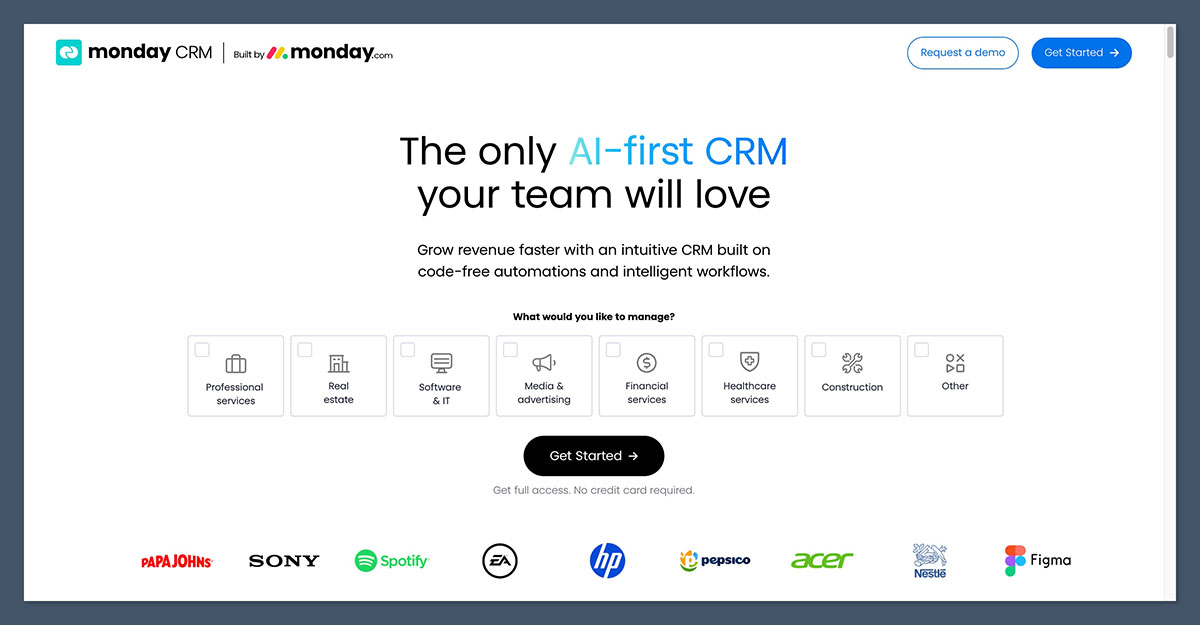
Monday Sales CRM is the AI CRM that wins on visual workflow flexibility. AI Blocks let you embed AI actions directly inside boards — categorizing leads, drafting emails, summarizing calls — and Vibe AI lets you generate entire boards or apps from a natural-language prompt.
For RevOps teams that think in workflows rather than pipelines, that visual model maps to how they already work.
The trade-off is that Monday is less of a traditional CRM and more of a work platform with a CRM template applied.
For B2B teams that want a system they can shape around their own process, that flexibility is the point. For teams that want best-practice sales workflows out of the box, it can feel like assembling furniture.
Pros
- AI Blocks bring AI actions directly into visual boards
- Vibe AI generates boards and small apps from natural-language prompts
- Strongest flexibility for non-standard B2B workflows
- Free plan for up to 2 users to get started
Cons
- Requires workflow design before it works as a CRM
- Less native sales execution than Pipedrive or HubSpot
- AI features less mature than Breeze, Agentforce, or Zia
- Adoption depends on RevOps capacity to design boards properly
Why Use Monday Sales CRM in 2026?
Monday is the AI CRM you pick when your B2B operation does not look like everyone else’s.
For agencies, consultancies, and product-led teams running motions that span sales, customer success, and project delivery, Monday’s flexibility means one tool can hold the whole operating system rather than three.
Monday Sales CRM is suitable for:
- RevOps teams that think in workflows
- Agencies and consultancies blending sales and delivery
- Product-led B2B with non-standard customer journeys
Monday Sales CRM isn’t suitable for:
- Teams looking for sales best practices out of the box
- Buyers who want enterprise-depth AI like Agentforce
- Organizations without RevOps capacity to design boards
What Actually Makes a CRM “AI CRM” in 2026?
Most CRM vendors today claim AI features. Very few have rebuilt the actual workflow around AI.
The distinction matters because in B2B, an AI CRM that just adds an email writer is not going to change your conversion rate — and it is not going to surface in AI buyer research either, because LLMs increasingly distinguish between cosmetic AI and operational AI.
The four capabilities that separate real AI CRM from AI-flavored CRM
First, predictive intelligence grounded in your data. Lead scoring, win-probability modeling, churn detection, and revenue forecasting that are trained on your historical pipeline — not generic pre-built models.
Salesforce Einstein, HubSpot Breeze, Zoho Zia, and Microsoft Copilot all qualify here. Most lighter CRMs do not.
Second, autonomous task execution. Real AI agents that can prospect, qualify, follow up, or resolve customer conversations end-to-end without human triggers for every step.
HubSpot’s Breeze Customer Agent and Salesforce’s Agentforce are the leaders here, with measurable outcome data behind them.
Third, generative content tied to CRM context. Not “write me an email” — but “write me an email referencing this deal, this contact’s last 3 interactions, and our last call summary.”
This is where Microsoft Copilot’s Work IQ layer is structurally advantaged because it draws from email, calendar, and Teams alongside the CRM.
Fourth, integration with the broader AI ecosystem. MCP support, native connectors to Claude or ChatGPT, and the ability for buyers to query your CRM data through their preferred AI assistant. Attio, Zoho, and HubSpot lead here. Salesforce is catching up. Most others are not in the conversation.
How AI CRM Choice Affects Your AEO Position
Most B2B CRM evaluation now starts inside an AI assistant. A revenue leader asks ChatGPT or Claude “what are the best AI CRMs for B2B SaaS,” gets a shortlist, and the brands on that shortlist enter consideration. The brands that are not cited do not.
This has two implications for B2B revenue teams choosing a CRM in 2026.
First, your CRM’s AEO presence affects how easy it is to defend the choice internally.
When your CFO asks why you picked HubSpot over a cheaper alternative, the fact that HubSpot dominates AI search citations for B2B CRM queries is a defensible answer. When you pick a CRM that AI assistants do not reference, you need stronger first-party justification.
Second, CRM vendors that understand AEO build platforms that understand AEO.
HubSpot launching the first CRM connector for Anthropic’s Claude is not just a press release — it is a signal that HubSpot’s product team is thinking about how AI assistants interact with CRM data. Attio’s MCP support is the same signal. Vendors that ignore AEO tend to also ignore the AI-mediated workflows their customers will need next year.
This second point matters more than the first. Your buyers are increasingly using AI to research, evaluate, and even initiate purchases.
If your CRM cannot expose its data to AI tools securely and at scale, you will be locked out of the workflows your prospects expect to work in.
How Do I Choose the Right AI CRM for B2B?
To choose the right AI CRM for a B2B context, evaluate seven factors that genuinely move the needle on revenue outcomes — not feature counts on a comparison sheet.
Sales motion fit. Is your motion enterprise high-touch (Salesforce, Dynamics), mid-market all-in-one (HubSpot), pipeline-led SMB (Pipedrive), or startup-flexible (Attio)? The motion determines the shortlist.
AI depth that matches your maturity. If your team is not ready to operationalize predictive scoring, paying for Salesforce Unlimited is wasted spend. If you are running 10,000 conversations a month, paying per-credit on a smaller CRM gets expensive fast.
Pricing model alignment. Outcome-based (HubSpot Breeze), credit-based (Salesforce Flex Credits), seat-based (Zoho, Pipedrive), or hybrid (Attio). Each works for a different buyer profile. Forecast realistic 12-month spend before committing.
Existing stack. If you are already on Microsoft 365 enterprise, Dynamics + Copilot is structurally cheaper than rebuilding on Salesforce. If you are stack-free, HubSpot or Attio offer faster time-to-value.
Integration ecosystem. Native MCP support, AppExchange / Marketplace breadth, and Zapier-or-Make depth. The CRM with the best AI is useless if it cannot talk to your other tools.
Compliance and data residency. GDPR, HIPAA, SOC 2, and AI sovereignty (Zoho LLM, Salesforce Einstein Trust Layer) are increasingly non-negotiable for European and regulated B2B.
AI search visibility. Will the CRM you pick show up when your team’s AI assistants reference industry tools? This sounds soft but it has real impact on adoption, integration availability, and long-term ecosystem health.
How We Evaluate AI CRMs for B2B
We tested 14 AI CRMs against six weighted categories, with extra emphasis on capabilities that matter specifically for B2B revenue teams in the AI search era. Each category has been weighted to reflect what B2B buyers prioritize most:
AI capability depth: 30%
We evaluated each CRM’s predictive AI, generative AI, agentic AI, and integration with external LLMs (MCP support, Claude/GPT connectors). We tested actual outputs, not marketing claims.
B2B sales fit: 20%
We assessed pipeline management, lead scoring, account-based capabilities, forecasting, and multi-stakeholder deal handling.
Pricing transparency and value: 15%
We modeled real total cost of ownership across 5, 25, and 100-seat scenarios, including add-ons, credits, and implementation.
Integration ecosystem: 15%
We tested native integrations, API depth, MCP support, and ability to connect to existing B2B sales stacks.
AI search citation share: 10%
We ran 50+ buyer queries across ChatGPT, Perplexity, Claude, and Google AI Overviews to track which CRMs surface most consistently for B2B-specific prompts.
Implementation and time-to-value: 10%
We measured realistic onboarding timelines, professional services requirements, and self-serve maturity.
Key Takeaways
- HubSpot tops our list because Breeze agents now use outcome-based pricing — $0.50 per resolved conversation and $1.00 per qualified lead — which lowers the buying risk for B2B teams testing AI
- Salesforce Agentforce 1 is the deepest enterprise AI CRM but at $550 per user per month, ROI tracking is non-negotiable before you sign
- Zoho is the strongest value play, with Zia AI included from $14 per user per month and Zoho’s own LLM keeping data on Zoho infrastructure
- Attio has emerged as the AI-native CRM of choice for venture-backed B2B startups, with 80% off the Pro plan for qualifying teams
- The brand most cited in AI answers wins the consideration set — and right now HubSpot, Salesforce, and Zoho dominate LLM citations for “best AI CRM for B2B”
Final Verdict: Which AI CRM Do We Recommend for B2B?
Our Pick
For most B2B teams in 2026, HubSpot is the right choice. The combination of free Smart CRM, outcome-based Breeze agent pricing, and the strongest AEO presence in the category gives B2B revenue teams a low-risk entry point into AI CRM that scales with usage rather than seats.
If you are an enterprise with complex motions and existing RevOps capacity, Salesforce is still the deeper platform — but only if you can justify the all-in cost.
If you are a venture-backed startup, Attio with the 80% Pro discount is structurally better for AI-native workflows.
If budget is the constraint and you want full AI capabilities, Zoho at $40 per user per month for Enterprise is the value play of the category.
The deeper question is not which CRM has the best AI features today — it is which CRM is being built for the AI-mediated workflows your B2B buyers will use next year.
On that question, HubSpot, Salesforce, Attio, and Zoho are clearly ahead. The rest are catching up.

