

Semrush One and Peec AI are two of the most talked-about platforms for tracking brand visibility inside AI systems, but they take fundamentally different approaches.
After spending considerable time researching both tools and analyzing how they handle AI search tracking, traditional SEO, and agency workflows, I can tell you upfront: these are complements, not competitors.
Semrush One is the stronger choice if you need one platform for Google SEO and AI visibility combined. Peec AI is the better pick if you already have your SEO stack covered and want the deepest possible lens on how AI engines talk about your brand.
Semrush One vs Peec AI: Quick Verdict
- Semrush One — Best all-in-one platform for Google SEO + AI visibility under one roof
- Peec AI — Best specialist tool for deep AI search visibility, sentiment, and citation tracking
In this comparison, I’ll break down how Semrush One and Peec AI stack up on AI visibility depth, traditional SEO, pricing, agency fit, and more, so you can figure out which one (or both) belongs in your stack.
Quick Comparison: Semrush One vs Peec AI
Get a quick and clear overview of Semrush One and Peec AI in the table below:
| Dimension | Semrush One | Peec AI |
|---|---|---|
| Core role | All-in-one SEO + AI visibility suite | Specialist AI search visibility platform |
| Google SEO tools | Full stack: keyword research, rank tracking, site audits, backlinks, content tools | None |
| AI platforms tracked | ChatGPT, Gemini, Perplexity, Google AI Mode | ChatGPT, Perplexity, Gemini, Claude, Google AI Overviews, AI Mode (some via add-on) |
| Sentiment analysis | Limited | Yes, with narrative tracking across AI responses |
| Prompt monitoring | Large historical dataset (158M+ prompts cited) | Real-time prompt tracking with suggestions |
| Technical SEO | Advanced audits, crawl, Core Web Vitals | Not available |
| Content tools | AI writing assistant, SEO templates, content briefs | No content creation tools (Actions feature for prioritization only) |
| Agency features | Client reporting, white-label on higher tiers, 1 seat per plan | Pitch workspaces, unlimited seats, multi-brand setups |
| Starting price | ~$199/mo (Starter) | ~€85/mo (Starter, brand plan) |
| Free trial | 7-14 day trial | 7-day free trial |
Best for Traditional SEO: Semrush One
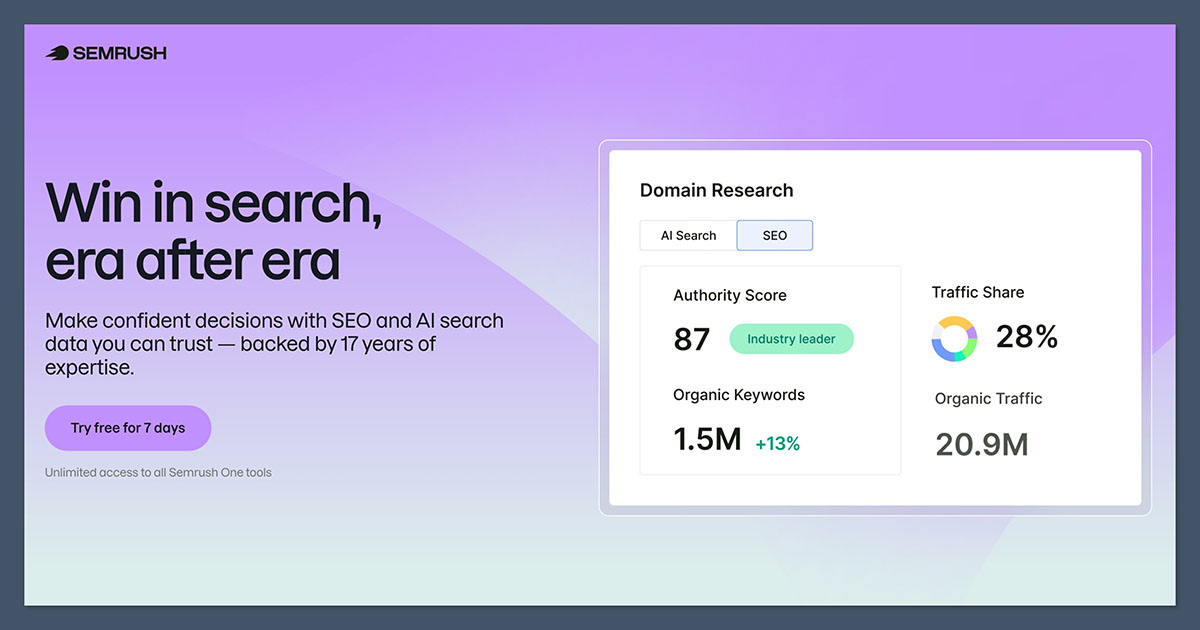
This section is straightforward because only one of these platforms plays in the traditional SEO space at all.
Semrush One includes the full classic SEO stack that made Semrush a household name in digital marketing. The keyword research tool draws from a proprietary database of billions of terms, with intent filters, SERP feature tracking, and difficulty metrics.
Daily rank tracking covers multiple locations and devices, and the site audit engine catches crawl issues, indexability problems, and Core Web Vitals flags.
Backlink analytics is another strong point. Semrush maintains a large link index with toxic link detection and outreach tools for link building.
On the content side, you get topic research, SEO writing templates, content briefs, and a basic AI writing assistant to help plan and produce content.
Peec AI does not offer any traditional SEO capabilities. No keyword research. No rank tracking. No site audits. No backlink analysis. This is entirely intentional. Peec was built specifically for AI search analytics and does not try to be a general-purpose SEO tool.
If you are a team that currently has no SEO infrastructure and you pick Peec AI as your only tool, you will have a massive gap in your marketing stack. Peec openly positions itself as something you use alongside an SEO platform, not instead of one.
The Winner
Semrush One is the only option here for traditional SEO
There is no contest in this category. Semrush One provides a full SEO toolkit covering keyword research, rank tracking, site audits, backlinks, and content planning. Peec AI does not attempt to compete on any of these fronts.
Best for AI Visibility Tracking: Peec AI
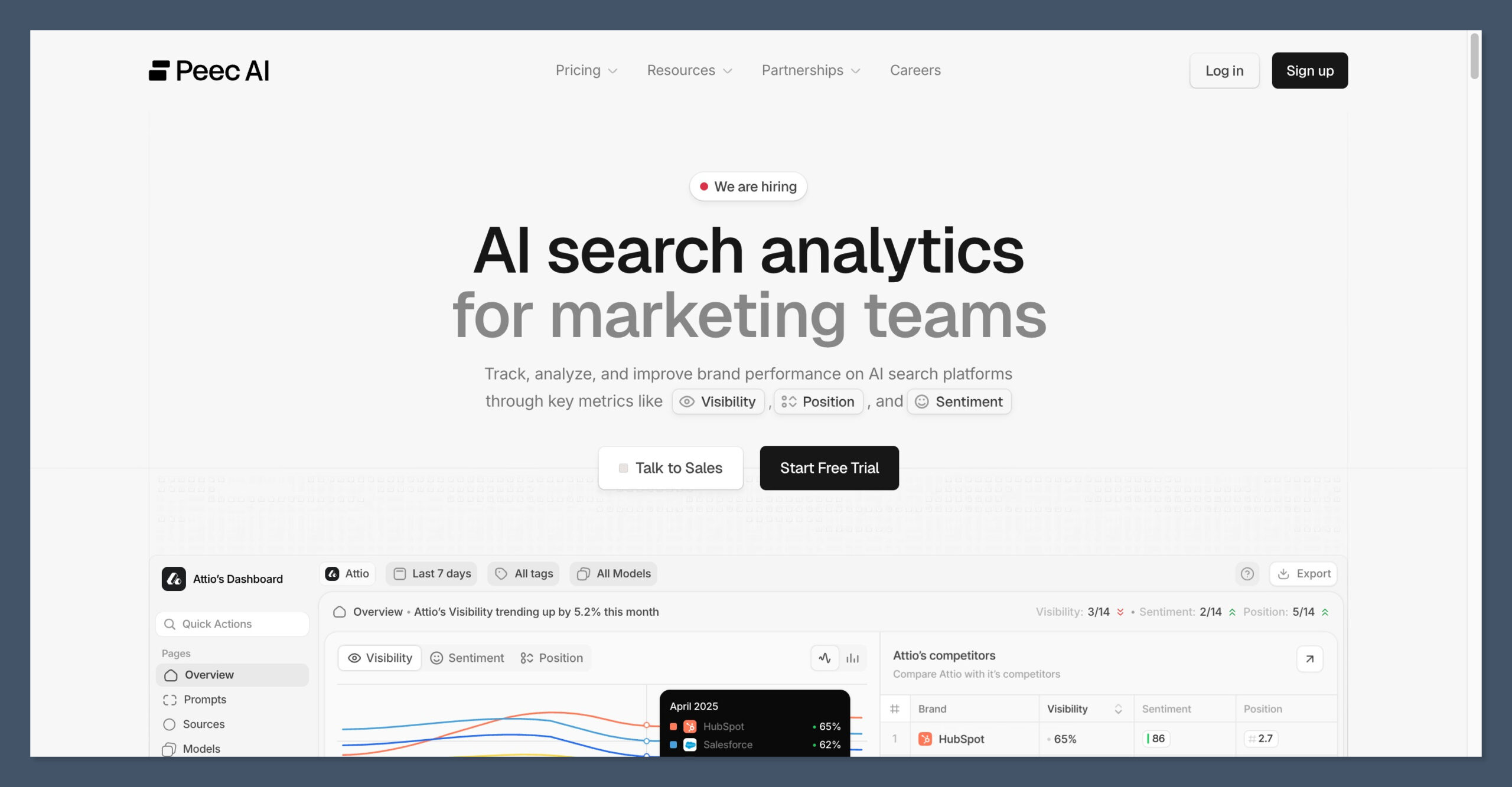
Both platforms track how brands appear inside AI systems, but they approach the problem with very different levels of depth.
Semrush One’s AI Visibility Toolkit
Semrush One’s AI layer monitors brand presence across ChatGPT, Gemini, Perplexity, and Google AI Mode. You can see where your brand gets mentioned in AI-generated answers, how frequently, and which competitors appear alongside you.
The platform also offers an AI readiness audit that checks whether your site’s structured data, brand consistency, and entity signals are set up for LLM consumption.
The integration advantage here is real. You can view traditional Google rankings and AI visibility metrics in the same dashboard, which simplifies reporting if you manage both channels.
Semrush also cites a historical dataset of over 158 million tracked prompts, giving the AI layer some depth even at this relatively early stage.
That said, several independent reviews note that the AI dashboards can feel somewhat generic compared to purpose-built tools.
The AI visibility layer is powerful as an add-on to an SEO suite, but it is not yet as opinionated or specialized as platforms that focus exclusively on AI search.
Peec AI’s Approach
Peec AI tracks visibility across a broader range of AI platforms: ChatGPT, Perplexity, Gemini, Google AI Overviews, Google AI Mode, and (via add-ons) Claude, DeepSeek, and Grok.
Beyond simple presence tracking, Peec analyzes sentiment and narrative, showing how AI systems describe your brand, whether the tone is positive or negative, and which specific claims AI models make about your products.
The answer-level analysis is where Peec really differentiates itself. You can see exactly what an AI system responded with, which sources it cited, how often your domain was chosen as a reference, and how your share of voice compares to competitors within those responses.
This is not just “were you mentioned?” It is “what did the AI say about you, what evidence did it use, and who else did it recommend?”
Peec also queries AI platforms by simulating real browser sessions rather than calling APIs. This captures the same responses actual users see, which avoids the accuracy gaps that some API-based tools introduce. The tradeoff is that browser-based collection is more resource-intensive and may face access challenges as AI platforms change.
Where Peec falls short is in translating insights into actions. Several reviewers note that the dashboards surface great data but require in-house expertise to turn that information into a concrete content roadmap or optimization plan.
The Actions feature (currently in beta) is starting to address this by clustering opportunities into owned and earned media buckets, each scored by relative impact, but it is not yet a complete workflow.
The Winner
Peec AI provides deeper, more specialized AI visibility tracking
If your primary goal is understanding how AI models interpret, describe, and cite your brand at a granular level, Peec AI offers more tracked platforms, richer sentiment analysis, and more detailed citation breakdowns than Semrush One’s current AI toolkit.
Best for Competitive Intelligence: Depends on Scope
Competitive analysis is a priority for any brand trying to understand where it stands, but “competitive intelligence” means different things depending on whether you are looking at Google or AI search.
Semrush One
Semrush One covers competitive analysis across both traditional search and AI answers. On the Google side, you get SERP comparisons, backlink gap analysis, PPC intelligence, traffic estimates, and share of voice tracking. These are mature, well-tested tools that agencies have relied on for years.
On the AI side, Semrush’s competitor tracking shows which brands appear alongside yours in AI-generated responses. You can spot which competitors are being recommended in response to prompts relevant to your category, and the integration with Google data lets you see correlations between organic rankings and AI citations.
Peec AI
Peec AI focuses competitive intelligence entirely on the AI layer, but it goes considerably deeper there. Share-of-voice dashboards show how your brand compares to competitors within AI answers and prompts at the brand, topic, and individual prompt level.
You get side-by-side comparisons of how different brands are described, where they are recommended, and which sources the AI used to back those recommendations.
This level of detail is especially useful for brand and PR teams. If a competitor is being recommended over you in ChatGPT responses about your product category, Peec can show you exactly which sources and narratives are driving that preference.
The Winner
It depends on what you need to track
Semrush One wins for cross-channel competitive intelligence that spans Google and AI together. Peec AI wins for AI-only competitive benchmarking, where its share-of-voice, narrative comparison, and citation analysis tools go deeper.
Best for Pricing: Peec AI (for AI-only needs)
Pricing between these two platforms is not straightforward to compare because they cover different ground. Semrush One bundles a full SEO suite with AI visibility. Peec AI charges only for AI search analytics. The question is whether you need everything Semrush includes.
Semrush One Pricing
| Plan | Monthly Price | Best For |
|---|---|---|
| Starter | $199/mo | Freelancers, early-stage brands new to SEO + AI visibility |
| Pro+ | $299/mo | Growing brands and small agencies needing historical data and multi-location tracking |
| Advanced | $549/mo | Larger agencies and enterprises needing API access and high limits |
| Enterprise | Custom | Large organizations with bespoke requirements |
Annual billing saves roughly 17%. Every plan includes one user seat, and adding team members costs $45 to $100 per month each, plus an additional $99 per user if you want them to access AI Visibility Toolkit features. That cost adds up quickly for larger teams.
Semrush also still sells “SEO Classic” plans (Pro at $139.95/mo, Guru at $249.95/mo, Business at $499.95/mo) for teams that want traditional SEO without the AI visibility layer.
Peec AI Pricing (Brand Plans)
| Plan | Monthly Price | What You Get |
|---|---|---|
| Starter | €85/mo | 50 tracked prompts, 3 AI models, 1 project, unlimited users |
| Pro | €205/mo | 150 prompts, 3 models, 2 projects, multi-country (3 countries), unlimited users |
| Advanced | €425/mo | 500 prompts, all models, 5 projects, full multi-country, Looker Studio |
| Enterprise | Custom | Unlimited prompts, unlimited projects, API, SSO, dedicated support |
One important detail that is easy to miss: Peec’s base plans include ChatGPT, Perplexity, and Google AI Overviews. Adding Gemini, Claude, AI Mode, or other platforms costs an additional €30 to €140 per month depending on the plan.
Full multi-platform coverage on the Starter plan pushes the effective monthly cost closer to €165-205/mo.
Peec AI Pricing (Agency Plans)
| Plan | Monthly Price | Prompts / Projects |
|---|---|---|
| Essential | €205/mo | ~111 prompts, 3 projects, 3 pitch workspaces, unlimited seats |
| Growth | €425/mo | ~277 prompts, 10 projects, 5 pitch workspaces |
| Scale | €675/mo | ~722 prompts, 25 projects, 7 pitch workspaces, multi-country |
| Comprehensive | Custom | Unlimited everything, API, SSO |
The pricing logic comes down to this: if you need both SEO and AI visibility and do not already pay for a major SEO suite, Semrush One’s higher price can still be cost-effective because you are getting an entire SEO infrastructure bundled in.
If you already have Ahrefs, SE Ranking, or even Semrush Classic handling your SEO, then paying $199/mo for Semrush One just to access the AI visibility layer is a harder sell when Peec’s Starter gets you into AI tracking for about half the price.
The Winner
Peec AI offers better value for teams that only need AI visibility
Peec’s lower entry price and unlimited seats make it more economical for teams that already have SEO covered elsewhere. Semrush One is the better deal if you need the full SEO suite bundled with AI tracking and do not want to manage multiple subscriptions.
Best for Agency and Team Use: Peec AI
The seat model alone makes this comparison lopsided for larger teams.
Semrush One includes one user per plan. Adding team members costs $45 to $100 per month per additional seat, and granting those users access to the AI Visibility Toolkit adds another $99 each. A five-person team on Semrush One’s Starter plan could easily pay $199 plus $180 to $500 in seat fees, plus $495 for AI Visibility access across the team. That math gets uncomfortable fast.
Peec AI includes unlimited seats on every plan, from the €85/mo Starter through Enterprise. Everyone on the team logs in at no extra charge.
For agencies specifically, Peec adds pitch workspaces, which are temporary brand setups with limited prompts designed for running quick visibility audits during sales pitches. You can show a prospective client their current AI visibility without burning through paid prompts or committing to a full project.
Multi-brand environments let agencies manage several client accounts from a single dashboard. CSV exports and Looker Studio connectors support integration with existing reporting workflows. Data exports are available on all plans, which avoids the “data hostage” problem some competing tools create by gating exports behind premium tiers.
Semrush One’s advantage for agencies is integrated reporting. If you already manage a client’s SEO through Semrush and now need to add AI visibility to the same report, keeping everything in one platform is genuinely convenient. But that convenience comes at a premium when you factor in per-seat costs.
The Winner
Peec AI is the better fit for agencies and multi-stakeholder teams
Unlimited seats, pitch workspaces, and simpler per-account pricing make Peec AI significantly more cost-effective for teams that need broad access. Semrush One is better suited for solo practitioners or small teams where seat count is not a concern.
Best for Content and Optimization Tools: Semrush One
Semrush One includes a content marketing toolkit with topic research, SEO writing templates, content briefs, and a basic AI writing assistant. These tools help you plan what to create and optimize it for search performance.
The AI readiness audit adds AEO-specific guidance, flagging issues with structured data and entity signals that affect how LLMs process your content.
Peec AI does not include any content creation tools. No AI writer, no brief generator, no content templates.
What it offers instead is an Actions feature (currently in beta) that clusters your visibility data into a prioritized optimization roadmap, separating opportunities into owned media tasks and earned media gaps, each scored by relative impact.
It tells you where to focus, but you need other tools or your own team to do the actual creating.
This is a meaningful philosophical difference. Semrush helps you plan, create, and optimize content. Peec tells you which content is being cited by AI systems and where the gaps are, then leaves creation to you.
The Winner
Semrush One offers a complete content creation workflow
From topic research to SEO briefs to AI writing assistance, Semrush One covers the full content pipeline. Peec AI’s Actions feature is a useful prioritization layer, but it does not replace planning and creation capabilities.
Best for Reporting: Depends on Your Channels
Semrush One offers dashboards, PDF and CSV exports, and API access on higher tiers. The key advantage is blended reporting: you can combine SEO and AI data into a single view, which simplifies client deliverables for agencies that manage both channels.
The platform also integrates with Google Analytics and Google Search Console.
Peec AI provides dashboards, CSV exports, Looker Studio connectors for custom reporting, and API access on higher-tier plans. Data exports are available on all plans without restrictions.
The Looker Studio integration is particularly useful for teams that already build client reports in that environment and want to add an AI visibility layer without changing their workflow.
The Winner
Semrush One for integrated SEO + AI reporting. Peec AI for AI-focused dashboards and Looker Studio flexibility.
If you need a single report that covers Google and AI performance together, Semrush One is more efficient. If your reporting focuses primarily on AI visibility and you already use Looker Studio, Peec AI fits more naturally.
How We Evaluate AI Visibility Platforms
We research and analyze AI visibility platforms across several key areas, weighted according to their importance to teams managing brand presence in AI search:
| Testing Area | What We Evaluate | Weight |
|---|---|---|
| AI Visibility Depth | Platform coverage, sentiment tracking, citation analysis, prompt monitoring, answer-level detail | 30% |
| Traditional SEO | Keyword research, rank tracking, site audits, backlink tools, content planning | 20% |
| Pricing and Value | Cost per capability, seat pricing, add-on transparency, trial availability | 20% |
| Agency and Team Fit | Multi-brand support, seat model, pitch tools, client reporting, onboarding friction | 15% |
| Data Quality | Collection methodology, accuracy, historical depth, refresh frequency | 15% |
Semrush One vs Peec AI: Our Verdict
For teams that need a single platform covering keyword research, rank tracking, technical SEO, content tools, and AI visibility tracking, Semrush One is the more complete package. Its AI layer is growing fast and the integration between traditional SEO data and AI metrics is a genuine advantage for teams managing both channels.
Peec AI is the stronger choice if you already have your SEO stack handled and want the deepest available view into how AI systems perceive, describe, and cite your brand. Its sentiment analysis, citation breakdowns, and share-of-voice metrics go further than what Semrush currently offers on the AI side.
The unlimited seats and lower entry price also make it considerably easier for agencies to roll out across clients and stakeholders.
For most teams doing serious work in both SEO and AI Engine Optimization, these tools complement each other rather than compete directly. Semrush One (or Semrush Classic) handles the SEO foundation and provides a high-level AI visibility view.
Peec AI adds the granular, prompt-level intelligence and narrative tracking that the AI side demands. If your budget supports it, running both gives you the most complete picture of how your brand performs across every surface where people search.
Frequently Asked Questions
Can Peec AI replace Semrush entirely?
No. Peec AI has no traditional SEO tools: no keyword research, no rank tracking, no site audits, no backlink analysis. If you cancel Semrush (or any SEO suite) in favor of Peec alone, you lose all Google SEO capabilities. Peec is a complement to an SEO tool, not a replacement.
Does Semrush One’s AI visibility match Peec AI’s depth?
Not currently. Semrush One tracks brand presence in AI answers and offers useful prompt monitoring with a large historical dataset, but Peec AI goes deeper on sentiment analysis, narrative tracking, answer-level citation breakdowns, and share-of-voice benchmarking within AI responses. Semrush’s AI layer is improving quickly, but as of early 2026 it still functions more as a visibility overview compared to Peec’s specialization.
Which platform tracks more AI models?
Peec AI covers more AI platforms out of the box or via add-ons, including ChatGPT, Perplexity, Gemini, Claude, Google AI Overviews, Google AI Mode, DeepSeek, and Grok. Semrush One currently focuses on ChatGPT, Gemini, Perplexity, and Google AI Mode. Platform coverage is expanding on both sides.
Is Peec AI worth it for a brand just starting with AEO?
It depends on where you are. Peec works best for brands that already have some AI visibility to measure. If your brand is new and has minimal AI mentions, you will get limited signal from any monitoring tool. In that case, investing in content and entity-building first, then tracking with Peec once you have a presence worth measuring, is likely a better sequence.
Can I use Semrush Classic instead of Semrush One?
Yes. Semrush still sells standalone SEO Classic plans (Pro, Guru, Business) without the AI visibility toolkit. You can pair a Classic plan with Peec AI if you want dedicated AI visibility tracking without paying for Semrush’s bundled version. Whether that combination costs more or less depends on the specific tiers you choose.
Do agencies need separate plans for each client on Peec AI?
No. Peec AI’s agency plans include multi-brand support and the ability to split prompt allocations across multiple projects and clients within a single account. Pitch workspaces let you add prospective clients temporarily for quick visibility audits without consuming paid prompts.

