

Every SEO agency I know can tell you the top 200 Google ranking factors. Very few can tell you what actually gets a brand cited in a ChatGPT answer.
That gap is where the next wave of visibility is being won or lost.
In 2025, Goodie published what’s become the closest thing the industry has to a unified framework for AI search visibility: the AEO Periodic Table.
It draws on analysis of over 2.2 million prompts across ChatGPT, Claude, Perplexity, Gemini, Google AI Overviews, and Grok to map out which factors consistently move the needle on citations across AI systems.
This article breaks down what’s in that table, how to read it, and how to turn it into a practical strategy for brands that want to become the sources AI answers are built from.
What the AEO Periodic Table Actually Is
Traditional SEO is about ranking pages. AEO is about something structurally different: being selected as a building block in answer assembly.
When a user asks ChatGPT or Perplexity a question, the model isn’t choosing which page to rank first.
It’s fetching from multiple sources, verifying, synthesizing, and constructing an answer. Your content either enters that candidate pool or it doesn’t. The AEO Periodic Table is a framework for understanding what determines membership in that pool.
The Goodie study doesn’t publish every data point publicly, but the factor clusters and per-model scores have been documented and analyzed in depth. What emerges is a set of factor families, each with a distinct weight, that together determine whether AI systems trust, parse, and cite your content.
The key conceptual shift: this isn’t about keyword placement or backlink counts. It’s about whether an AI system can verify that your content is authoritative, accurate, and structurally accessible enough to be useful in an answer.
The Six Factor Families
Think of these as the groups in the periodic table. Each family contains related elements that work together. No single factor dominates in isolation.
Content Depth and Relevance
Content relevance scores around 93/100 across models, making it the top-ranked factor cluster.
Content quality and depth follows at 90/100. The research is explicit here: AI systems reward pages that dive deep, connect ideas, and make knowledge accessible for extraction. Thin location pages and keyword-padded intros don’t enter the candidate pool.
The practical elements within this family:
- C1 – Intent-first coverage: Content that answers the actual question, not just content that contains the keyword.
- C2 – Depth and completeness: Long-form guides, topic clusters, and detailed process explanations that handle edge cases.
- C3 – Answerability and structure: Clear headings, numbered lists, FAQs, and comparison tables that make extraction easy for AI systems.
- C4 – Freshness: Updated statistics, recent examples, and current screenshots. AI systems penalize stale content, especially in fast-moving categories.
Credibility, Authority, and Trust
Credibility and trust averages 88.2/100 across models, but the range is wide. Claude sits at the top requiring ~95/100, with the most lenient model still above 80/100. This means that regardless of which AI engine you’re optimizing for, trust signals are non-negotiable.
The elements in this family map closely to Google’s E-E-A-T framework but extend it:
- A1 – Professional credentials and expertise: Author bios, organizational information, certifications, and credentials that can be verified.
- A2 – Verifiable performance data: Case study results, benchmarks, and success metrics that are specific and checkable.
- A3 – Third-party trust anchors: Listings in relevant directories, review platforms, and standards bodies.
- A4 – Brand mentions and off-site citations: Coverage in industry publications, podcasts, and community sites.
Citations and Co-occurrence
This is the family most brands underinvest in, and it’s becoming more critical as AI systems get better at cross-referencing. Citations and mentions score around 86.8/100 overall, with Perplexity especially citation-dependent at 92/100.
Co-occurrence is the newer concept here: AI systems validate facts by checking whether the same claim, brand name, or positioning appears consistently across multiple independent sources. If what you say on your website doesn’t match what others say about you across the web, that inconsistency reduces your citation probability.
- M1 – In-content citations from authoritative publishers: Being referenced by recognized outlets in your space.
- M2 – Media and PR coverage: Industry press, trade publications, podcast appearances, and webinar features.
- M3 – Directory and marketplace presence: Legitimate listings that function as trust anchors, not just SEO link-building.
- M4 – Co-occurrence consistency: Aligned bios, product descriptions, claims, and positioning across every surface where you appear.
Technical Foundation and Agent Experience (AX)
The Goodie framework calls this the Agent Experience factor family: the technical baseline that determines whether AI agents can crawl, parse, and trust your content at all. If they can’t fetch your pages reliably, you never enter the candidate pool regardless of how strong your content is.
AX scoring has decreased somewhat as model sophistication has increased, but it still underpins everything else:
- T1 – Crawlability: Clean internal linking, accurate XML sitemaps, sensible robots.txt, and no heavy JavaScript gating that blocks AI crawlers.
- T2 – Performance: Sub-1.2s load times, mobile readiness, and clean Core Web Vitals scores.
- T3 – Structured data: Organization, FAQ, HowTo, Article, and sector-specific schema types that give AI systems structured context about what the page contains.
- T4 – Semantic HTML and accessibility: Proper heading hierarchy, descriptive alt text, and accessible link text that makes document structure machine-readable.
Entities and Knowledge Graph Presence
The GEO Periodic Table framework, which maps generative search factors more broadly, identifies entity strength as a core factor family that sits alongside and overlaps with AEO. AI systems don’t just index pages; they build models of entities: organizations, people, products, and concepts and the relationships between them.
If your brand exists as a clearly defined, consistently described entity across the web, AI systems can reason about it with confidence. If your entity definition is unclear or contradictory, you get filtered out even when your content is relevant.
Key actions in this family: build Organization and Person schema on your site, establish consistent entity descriptions across Wikipedia, Wikidata, and knowledge graphs where applicable, and ensure your product or service entity has clear, distinct attributes that AI systems can anchor on.
Brand and Community Signals
This is the family with the most overlap between AEO and GEO. It covers structured knowledge, contextual authority, and cross-channel reinforcement: being part of the conversation across platforms where AI systems collect signal.
Reddit, Quora, LinkedIn, industry forums, and community platforms are active data sources for models like Perplexity and Grok.
A brand that exists only on its own website is invisible to the social and community layers of AI search. Being present, helpful, and consistently positioned in these spaces contributes to the co-occurrence and credibility signals that move citation probability.
We tested three of these factor families against 65 million crawler requests
The Periodic Table is a useful map. We were able to put real first-party numbers behind three of its six families, using 65.1 million AI-bot requests across 38 sites.
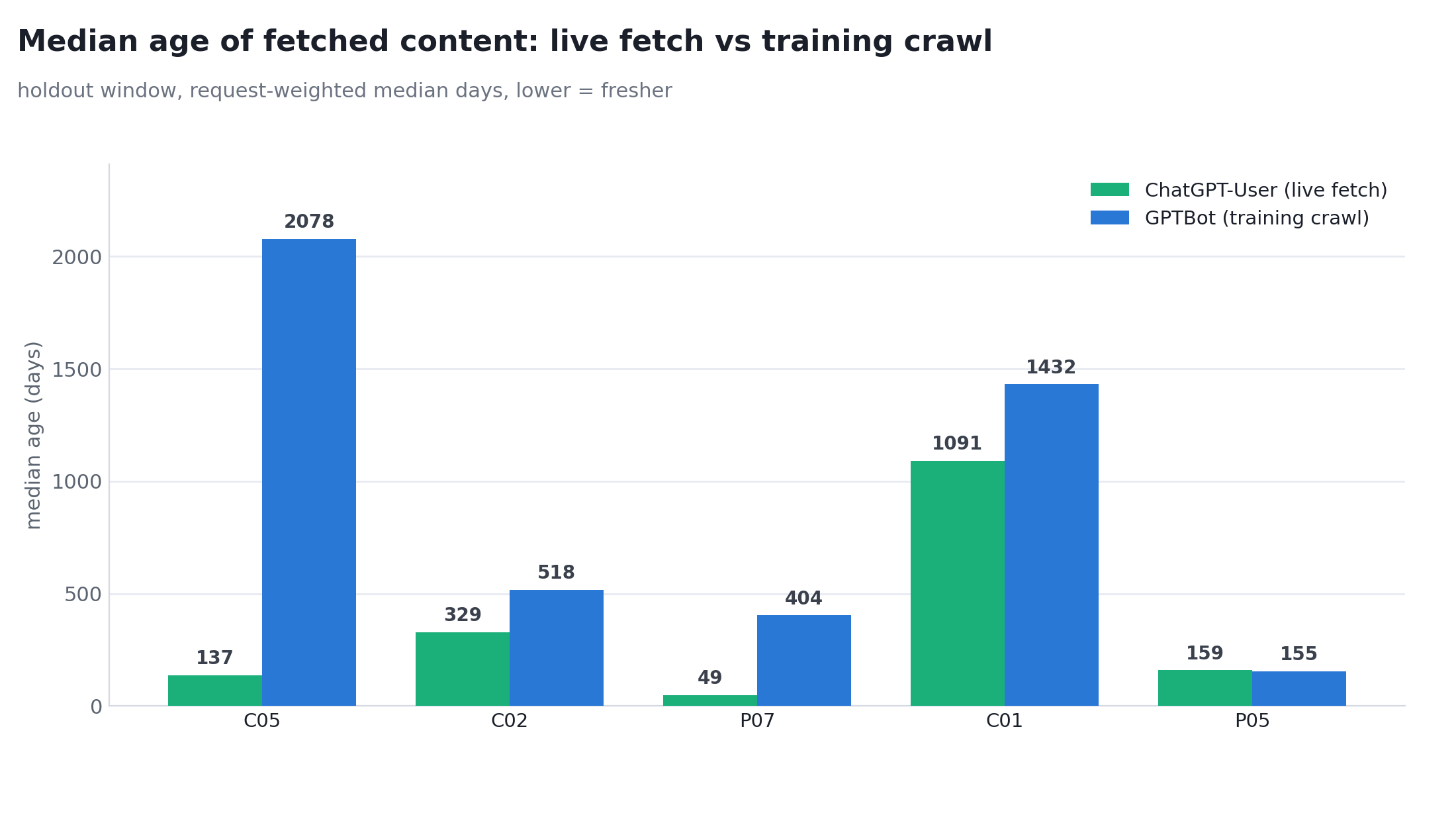
C4 Freshness holds. The bot that fetches pages into live answers (ChatGPT-User) consistently pulls younger content than the training crawler. On one site the pages it fetched had a median age of 137 days versus 2,078 for GPTBot. Fresh content is not a nice-to-have for answer inclusion, it is what the live-fetch bot goes after.
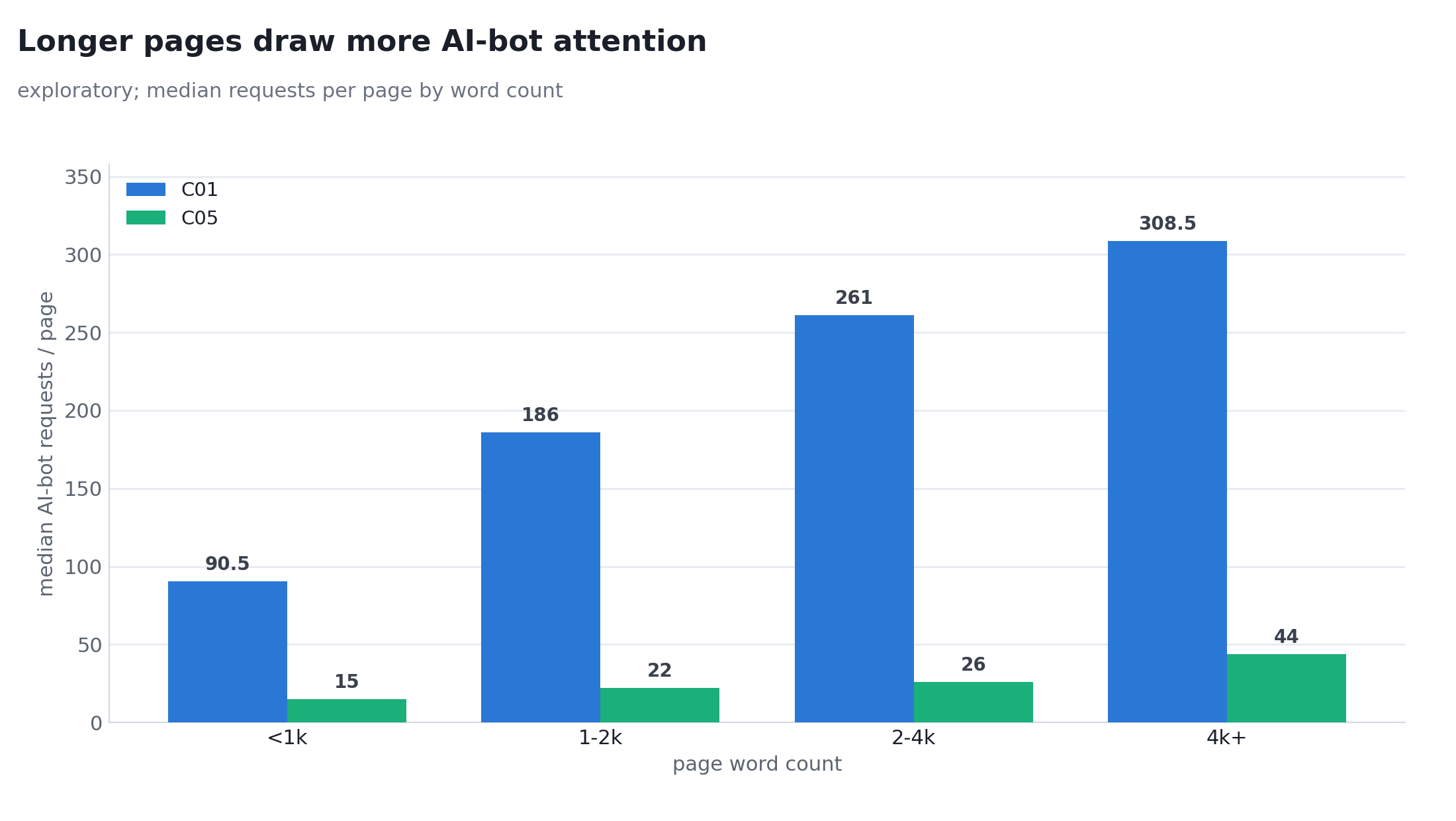
C2 Depth shows up as a clean gradient. On our content-heavy sites, median AI-bot requests per page climb steadily with word count, for example from 90 requests for sub-1,000-word pages to 308 for 4,000-plus on one site. Longer, more complete pages draw more crawler attention.
C3 Structure points the same way, with a caveat. Pages containing data tables drew roughly 2 to 5 times the AI-bot requests of table-free pages on the two sites with enough of each to compare, holding page age and Google impressions constant. We flag this as directionally supported rather than settled, because it was solid on our two largest samples and thin on the smaller ones. We would rather tell you that than overclaim.
Do this: treat depth, structure, and freshness as the three families you can act on today, and measure them on your own crawler logs the way we did.
Data and method: the dataset page.
How Different AI Models Weight the Table
One of the most useful outputs from the Goodie research is the per-model scoring breakdown. The same content can perform very differently depending on which AI system is answering the query.
| Model | Strongest Factor | What to Prioritize |
|---|---|---|
| ChatGPT | Content depth and practical value | Deep FAQs, comprehensive guides, step-by-step process content |
| Claude | Trust and verifiability (95/100) | Citations to primary sources, conservative claims, explicit fact-checking |
| Perplexity | External citations (92/100) | Third-party references, up-to-date information, knowledge graph presence |
| Gemini / Google AI | Content relevance (94/100) and localization | Semantically rich topic clusters, local signals, hreflang |
| Grok | Freshness and social signals | Recent content, active social presence, real-time relevance |
The practical implication: if you’re a B2B SaaS brand where AI citations in research-intent queries matter most, Claude and ChatGPT are probably the models generating those answers.
That means the trust and depth factors deserve the most investment.
If you’re in a local or time-sensitive category, Gemini and Grok weighting shifts your priorities.
AEO vs GEO vs AX: Where the Periodic Table Sits in the Broader Stack
It helps to understand how these frameworks nest before building a strategy around them.
SEO is still the foundation. Technical health, crawlability, and organic search visibility matter because AI systems crawl the same web. You don’t abandon SEO for AEO; you build on it.
AEO (Answer Engine Optimization) is the layer that addresses how AI systems select and cite content in direct answers. The AEO Periodic Table lives here. It covers content depth, trust signals, citation density, and structured answerability.
GEO (Generative Engine Optimization) is a broader frame that covers how brands appear and are characterized within generative AI experiences, including entity representation, knowledge graph positioning, and cross-channel presence.
AX (Agent Experience) is the technical layer that determines whether AI agents can interact with your content at all: speed, schema, crawlability, and semantic structure.
The AEO Periodic Table connects all four. It’s not a replacement for existing frameworks; it’s the first serious attempt to quantify the weights that govern AI citation behavior across all of them.
A 90-Day Roadmap for Working the Table
The research maps cleanly onto a phased implementation sequence. Each phase builds the foundation for the next.
Days 1–30: Technical and AX Baseline
Before any content work matters, AI agents need to be able to access and parse your site reliably. Audit crawlability, fix Core Web Vitals, implement Organization and FAQ schema, and clean up robots.txt and sitemaps. This is the table stakes layer. Skipping it means the content work in phase two doesn’t register.
Days 31–60: Content Depth and Schema
Identify the queries where AI answers are already being generated in your category. Audit which sources are being cited. Then build content that is deeper, more structured, and more verifiably authoritative than what’s currently winning.
Add FAQ sections, convert thin pages into comprehensive guides, and implement HowTo or Article schema where appropriate. Prioritize intent-first structure over keyword density.
Days 61–90: Citations, Co-occurrence, and Thought Leadership
Start building the off-site citation layer. Pitch relevant industry publications, get listed in authoritative directories, pursue podcast appearances and press coverage.
Simultaneously, audit your co-occurrence consistency: ensure that your brand name, product descriptions, and key claims say the same thing everywhere they appear. Inconsistency in this layer actively undermines the trust signals built in phase one.
What This Means for Brands Building AI Visibility Now
The AEO Periodic Table is useful not because it gives you a new checklist, but because it reframes the goal. You’re not trying to rank pages. You’re trying to become the kind of source that AI systems reach for when assembling answers in your category.
That requires a different kind of investment. Thin content that ranks in traditional search doesn’t enter the AI candidate pool. Backlinks that pass PageRank don’t necessarily build the citation density and co-occurrence patterns that AI systems respond to.
The signals that matter have shifted, and the Goodie research gives us the first quantified map of where they’ve shifted to.
The brands that figure this out in the next 12 months will have a compounding advantage as AI search grows. The window for first-mover positioning in AI citations is real, and it’s closing faster than most teams realize.
The periodic table is the framework. The question is which elements your brand is missing.

